Tag: Indiana angel investing

  • Meet June Pitch Presenter #2: Ody, De La Paz CEO, Sensytec, Inc.

    Meet June Pitch Presenter #2: Ody, De La Paz CEO, Sensytec, Inc.

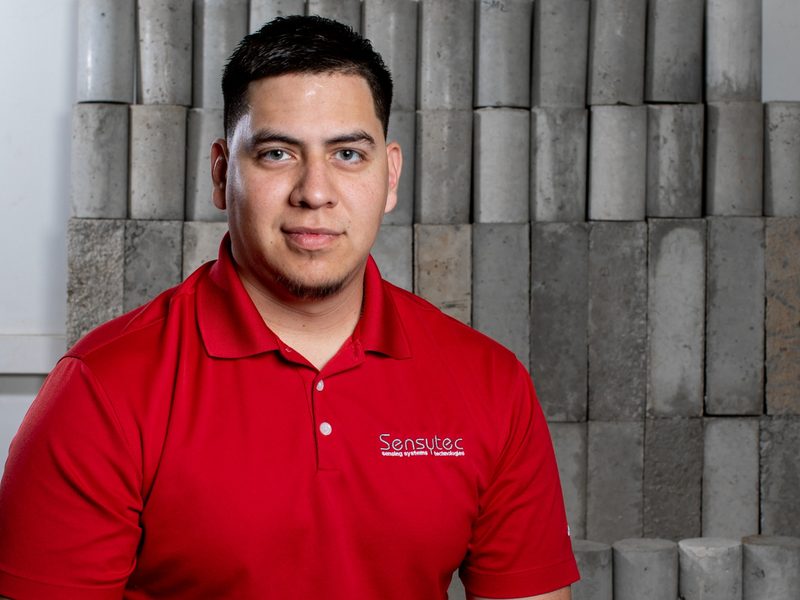
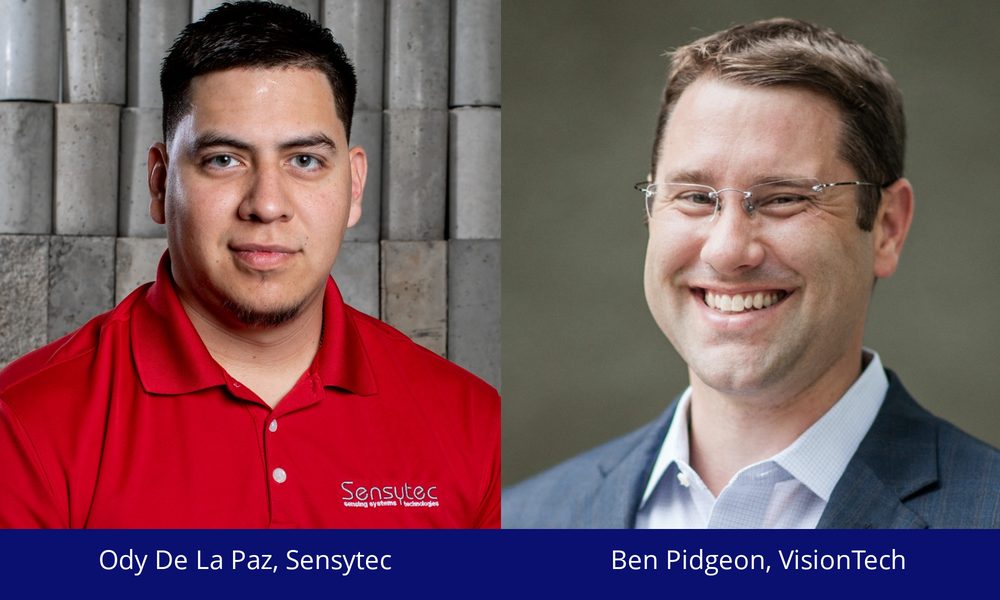
    While we were reviewing companies for June Pitch Week, a colleague at Lateral Capital, a micro VC in Sarasota, Florida, suggested VisionTech Angels take a look at Sensytec, a tech company out of Houston with a solution for the concrete industry. When I connected with the company’s CEO and Co-founder Ody De La Paz, he explained just how old school the concrete industry is and as a result, what a bottleneck and budget buster it’s become for the construction industry. Their solution is two-pronged, wireless real-time monitoring of concrete and an app that keeps a contractor’s fingers on the pulse of a job’s concrete, potentially saving a tremendous amount of time and money. The VisionTech Screening Committee and I invited Ody to present during our June Pitch Week. Here’s a sneak preview. I hope you’ll join us to hear Ody and participate in the discussion on this investment opportunity.
    BP: How did you get involved in the concrete industry?
    OD: I worked in the construction industry in my late teens and early 20s and found out quickly that working with concrete, specifically pouring and breaking test cylinders, was back-breaking work. I literally waited for the concrete trucks to come to the job site, they’d fill my wheelbarrow, I’d shovel the wet concrete into cylinders, wait for it to dry, and then break the cylinders to see if it had set correctly. It was time consuming and  like I said, back breaking!

    Later, as a student in the University of Houston’s entrepreneurship program, I met Anudeep Reddy, a civil and structural engineering student. He was working on a “smart cement” technology for monitoring the structural health of concrete and cement. I was intrigued. We started working together and in 2016 we co-founded Sensytec.

    BP: What pain point did you see in the market?
    OD: Concrete is a paint point for the construction industry. (Laughs) As complicated as it can be, the process of pouring, curing, and monitoring concrete is pretty much a guessing game. It’s largely reliant on manual tests that involve casting test cylinders, waiting for them to cure, and sending them to a lab to perform a break test. This is extremely time consuming. There are also many variables that can go wrong with concrete such as weather, the wrong mixture of water and cement and human error. During this last year, we’ve seen a labor shortage, causing more issues. Finally, problems with concrete can set a project back weeks and when a project goes past a deadline that costs money and contractors lose bonuses for meeting deadlines.

    Our solution, called SensyRoc™, is a wireless sensor that is embedded into the concrete as it’s poured. The sensor collects real-time data as the concrete cures, sending it wirelessly to our free mobile app where users, contractors, and their teams can instantly see and share what is happening with the concrete. Monitoring in place with Sensytec means no more cylinder tests are needed, less manual labor is needed and no waiting days for results. It’s all there on their smart phones when they need it, which is usually now. Time is money, and if you can save even a day on pouring, that’s significant. On average, we save contractors two days per pour on their projects, which equates to about $7,000- $10,000 a day.

    BP: That’s impressive. What kind of data are you tracking?
    OD: We’re tracking and monitoring a number of things like the in-place temperature of the concrete as that impacts the quality of the cure. We’re also tracking the setting time and compressive strength. And finally, the thing that really sets Sensytec apart is that we’re monitoring the electrical resistivity. When concrete is poured there can be voids, air pockets if you will, that won’t be detected by monitoring temperature alone. Electrical resistivity identifies the nature of voids. If there’s a problem, it can be addressed immediately and not weeks, months, or years down the road when it could become a structural or even liability issue. Electrical Resistivity also provides data on Hydration of concrete, water & cement ratio, and slump of concrete allows contractors to fully understand their concrete mix and better optimize their mix designs for their projects.

    BP: What kind of IP do you have?
    OD: We currently hold a worldwide patent on Smart cement technology and have a patent pending on SensyRoc that is intended to also be a worldwide patent. These patents are protecting the electrical resistivity measurements using embedded sensors in concrete, asphalt and other materials.

    BP: What kind of traction do you have?
    OD: We are commercial with our sensors in Texas, Oklahoma, Florida, Minnesota, and Iowa. Some of our customer are Flatiron, Meyer Contracting, Harvey Builders, and Silverstar Construction.

    BP: What is the competitive landscape?

    OD: There are competitors in this space. Hilti, which is a large supplier to the concrete industry, has a sensor solution. There’s also Giatec and Kryton that offer monitoring solutions. These products are all the same tech and only use temperature measurements. What sets us apart though is the electrical resistivity measurements. When concrete is poured, there can be voids, air pockets if you will, that won’t be detected by monitoring temperature alone. Electrical resistivity identifies the nature of voids. If there’s a problem, it can be addressed immediately and not weeks, months, or years down the road when it could become a structural or even liability issue. Electrical resistivity also provides data on hydration of concrete, the water and cement ratio. This allows contractors to fully understand their concrete mix and better optimize mix designs for their projects.

    BP: What is the potential for exit?
    OD:  Potential acquirers include large tool companies like DeWalt and Bosch that are adding to their technology solutions. RediMix, which is the leading concrete company in the U.S., is another potential acquirer.

    BP: What will this round be used for?
    OD: We are raising a $1 million seed round which we will use to expand outside of Texas, scale our manufacturing, and make key hires in sales, manufacturing and electrical engineering.

    BP: Why should VisionTech investors back you?
    OD: The concrete sector of the construction industry has tremendous room for improvement as it is still reliant on time-intensive manual processes. We believe there is a significant opportunity as our sensors and app will save contractors a tremendous amount of time and money. We are specifically looking for investors who bring more than capital and will serve more as partners in our growth and can potentially make introductions in the construction industry.

    To learn more about Sensytec, visit their website. VisionTech Angels’ June Pitch Events will be virtual on Tuesday, June 22 and Thursday, June 294at 6 p.m. Pitch events are open to our members and accredited investors interested in joining our group. To register, check your email for an invitation, go to our Events page or email Ben Pidgeon at bpidgeon@visiontech-partners.com.

  • Meet October Pitch Company Global Neighbor Whose Green Weed-Beating Agtech May Transform Farming

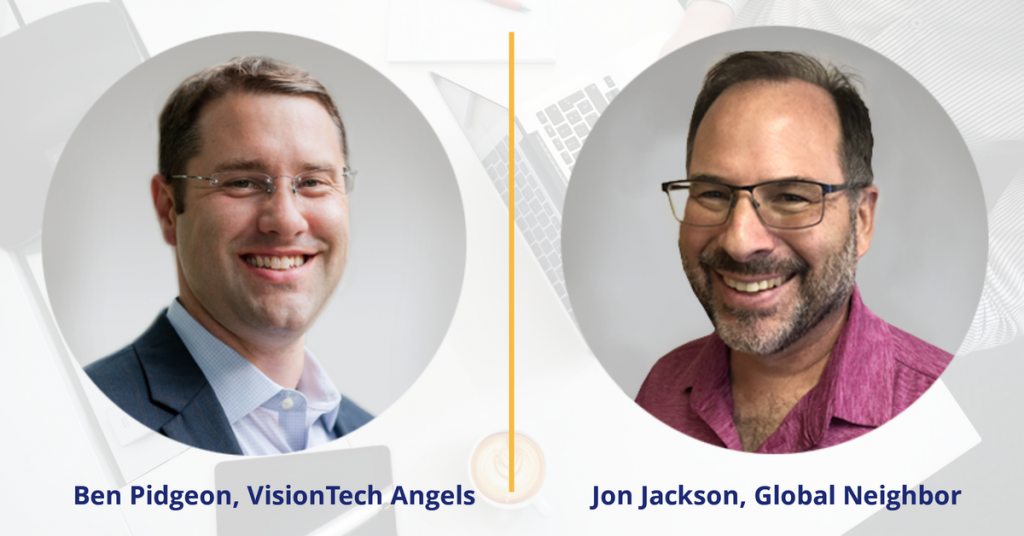
    Michael Bloomberg once explained farming in this tongue-in-cheek way: “You dig a hole, you put a seed in, you put dirt on top, add water, up comes the corn.” Even I, a city guy, know that farming is a lot more complicated than that. In fact, agtech is among the hottest and arguably sophisticated tech sectors today. That’s why I’m excited to introduce our first October Pitch Week presenter, Jon Jackson, president of Global Neighbor Inc. (GNI). His company may be on the verge of transforming how farmers around the world control a growing problem, herbicide-resistant weeds, using a green technology called Directed Energy to kill weeds and their seeds rather than chemical-based herbicides. GNI has secured $3 million in support from the U.S. Department of Defense and the USDA and captured the attention of farmers. Here’s a preview of the investment opportunity Jon will share in detail at  VisionTech Angels’ Pitch Events later this month. Enjoy!

    Ben Pidgeon, executive Director, VisionTech Angels

    BP: How did you get interested in agtech?
    JJ: I have to credit my parents. At 14, they let me farm five acres on the family farm and keep the money from the crop sales. I planted soybeans, sold my harvest, made some money—and wrestled with weeds. Later, I saw my brother’s epic struggle with weed control as he was raising organic soybeans for export to Japan. This “tribal knowledge” coupled with being an engineer, ultimately led to Global Neighbor Inc. (GNI) and helps tremendously when I talk with the farm community about our technology.

    BP: You also have a connection with VisionTech Angels.
    JJ: I do. GNI is headquartered in the Dayton area and we’ve worked with TEC Dayton, which hosts a VisionTech Angels chapter, on multiple projects such as filing our international patents. TEC has also supported us with mentors, who suggested VisionTech Angels should be at the top of our list.

    BP: Explain GNI and the problem you’re solving.
    JJ: Agricultural around the world is at a crossroads in terms of feeding the world and doing so in a sustainable manner. One answer is regenerative agriculture which is a conservation and rehabilitation approach to food and farming systems. Currently, the industry relies heavily on chemical herbicides and insecticides, which can have devastating consequences for the  environment and public health. At the same time, weeds are becoming increasingly resistant to chemical herbicides. This increases weeding costs, reduces farmer yields and profits, and exacerbates the excessive use of herbicides that contributes to soil degradation and also the incidence of non-Hodgkin’s lymphoma. Farmers using combines to harvest crops make the problem worse as combines collect and distribute weed seeds back into the field, increasing weeds in following years.

    Weed-related crop losses are a huge issue. Without weed control measures, U.S. and Canadian corn and soybean farmers would see estimated yield losses near 50 percent, losing $43 billion annually. That’s why farmers spend billions annually on weed control measures.

    Jon Jackson, President, Global Neighbor

    Our vision is to solve the world’s food sustainability problem with technology. We use high-intensity, multi-wavelength light sources called directed energy to control weeds. This technology has the potential to be deployed at scale economically. When combined with regenerative agriculture techniques, we can provide a novel farming system that will allow wide adoption of sustainable ag practices and reduce dependence on chemical herbicides.

    BP: What products do you have in the pipeline?
    JJ: Though our consumer-directed Weederase is already selling and our SmartSprayer will be out shortly, our first agtech product is the Weed Seed Destroyer (WDSD) that kills weeds at the seed stage. The WDSD addresses the challenge of herbicide-resistant weeds in grain crops, a clear and urgent pain point in terms of lower yields and loss of income. The WDSD mounts to the back of a combine and applies directed energy to basically kill the weed seeds which are in the chaff. We’ve tested the WDSD concept with many farmers, and they immediately grasp the concept and the value. We produced a video with farmers expressing their excitement about directed energy weed control. They are pretty excited! View video here.

    BP: How easy will it be to commercially scale your solution?
    JJ: From a manufacturing perspective, scaling is straightforward. It is not a highly capital-intensive business, and the gross margins are high. Our primary market will be aftermarket sales, which involves retrofitting combines with our WDSD system, a process that takes about an hour. Our sales channel will be through the independent ag dealer network across the country. These dealers already offer similar retrofit and aftermarket technical support to farmers.

    BP: What’s the status of your intellectual property?
    JJ: We are an early pioneer in the use of directed energy for weed control and our approach is unique. This has allowed us to craft our intellectual property to provide broad protection. We have seven issued U.S. patents and four U.S. and international patents pending.

    BP: Why hasn’t anyone tried this before?
    JJ: Until now, sustainable ag practices like non-chemical herbicides have not been widely adopted because of how impractical they are to scale. Others are exploring the use of lasers for weed control but lasers for use in ag are technically complex and cost prohibitive. The most direct competition for weed seed control are chaff mills, which use high-speed mills to grind weed seeds. Chaff mills, although highly effective, are high price—up to $100,000. There are other issues, but chaff mills are gaining market acceptance. Our WDSD system will sell for about half the price, use approximately half the power, and will not suffer from excessive maintenance or result in system downtime.

    BP: Who is your ideal customer?
    JJ:
    Our target market is small grain owner-operator family or smaller corporate farmers that own combines. These farmers care about their land, and herbicide resistant weeds reduce the value of their farmland and a farm’s profitability. There are approximately 120,000 operating combines in the United States, with approximately 100,000 of them owned by family or small corporate farmers that farm more than 500 acres of grain crops.

    BP: You have the USDA’s support via an SBIR Phase I grant. What captured their interest?
    JJ: We are thrilled to have won an SBIR from USDA to support our WDSD development! Their interest is driven by the acceleration of global trends. First is the tremendous growth in the number of herbicide-resistant weeds in the United States and worldwide. Research out of Australia confirm that a major tool in the fight against herbicide-resistant weeds is harvest weed seed control; that is, making the weed seeds non-viable at the time of harvest. Finally, our approach of using non-chemical directed energy to control weed seeds is novel and consistent with consumer preferences and government policy trends, reflecting a tidal shift toward sustainable ag. 

    BP: What will this fundraising round be used for?
    JJ: We are raising a $375,000 seed round to leverage our USDA SBIR funding. This will be used to bring on a key engineering hire, support product development efforts including prototype and demonstration expenditures, and support initial marketing outreach and initial product sales. Our goal is to achieve a significant value inflection milestone prior to raising our next round.

    BP: Why should VisionTech Angels members invest in GNI?
    JJ: Two reasons. First, it takes the chemical industry $300 million and 10-plus years to develop a new herbicide with a new mode of action to destroy weeds. We’ve received $3 million in non-dilutive grants and with this substantial R&D investment, we’re developing alternative weed control modes of action for substantially less money and in far less time than the chemical industry.

    Second, there are many companies applying software, the internet of things, machine learning, robotics, and genomic tech to agriculture, all in attempt to disrupt the industry. Many of these attempts will fail as they are a technology searching for a market, a me-too strategy not substantially differentiated, or are burdened by substantial costs of development and deployment. We are not falling into these traps. Instead, we are integrating a proven technology, directed energy weed control, into a farmer’s normal operating practices, and leveraging existing equipment to solve real problems. We believe we have the potential to disrupt the industry and change the world.

    To learn more about Global Neighbor Inc., visit their website. VisionTech Angels’ October Pitch Events include a live event on Tuesday, October 27 in Fort Wayne at the Pine Valley Country Club at 6 p.m. and a virtual pitch event on Thursday, October 29 at 6 p.m. Pitch events are open to our members and accredited investors interested in joining our group. To register, check your email for an invitation or email Ben Pidgeon at bpidgeon@visiontech-partners.com.

  • VisionTech Angels Pumps $210,000 into Resonado Whose Flat Core Speaker Technology Is Changing the Shape of Sound

    The investment is part of a bridge round raise intended to accelerate Resonado’s entry into the home audio, wearables, automotive and leisure vehicles industries.

    INDIANAPOLIS, Indiana (August 25, 2020) – – VisionTech Angels, one of the premier angel investing networks in the Midwest, has successfully completed a $210,000 investment in Resonado, a startup out of the University of Notre Dame whose Flat Core Speaker™ (FCS™) technology is changing the shape of sound and disrupting multiple industries that use audio in their products.

    Resonado is currently closing a $500,000 bridge round that began in early 2020. The round is oversubscribed at just under $1 million. Other investment groups participating in the round are Queen City Angels, Connetic Ventures, Lofty Ventures, and a number of private investors.

    Commenting on the announcement, VisionTech Angels Executive Director Ben Pidgeon said, “We’re extremely pleased to add Resonado to our investment portfolio. More than half of our 125 members participated in Resonado’s virtual pitch in March and of these, one-third made investments. That speaks volumes about the opportunity.”

    Pidgeon added, “The investment is also meaningful because our members, many of whom have founded and run successful companies themselves, are committed to supporting startups that launch from Indiana universities, whether through investment or business expertise. Indiana, and the Midwest at large, continue to strengthen its position as an innovation-rich ecosystem, launching startups and fueling investment.”

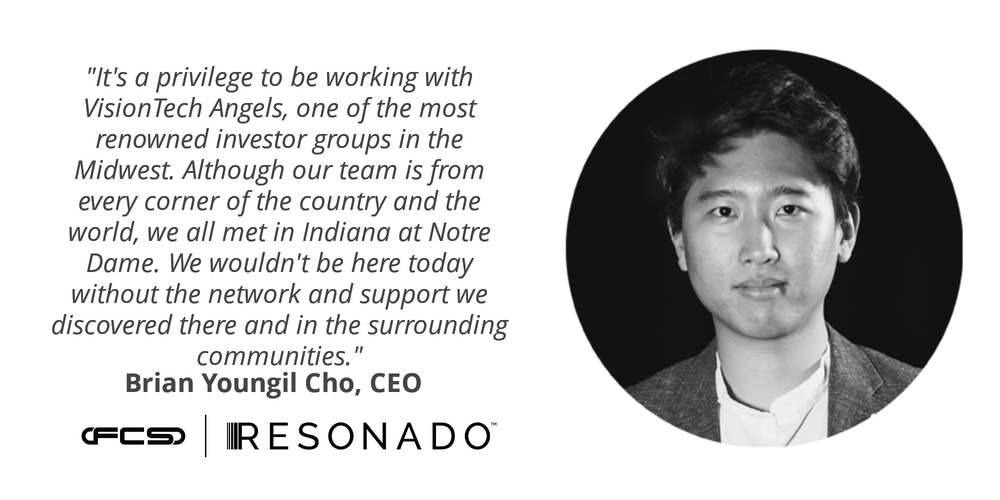
    Resonado CEO and Co-founder Brian Youngil Cho welcomes VisionTech Angels to the team. “It’s a privilege to be working with VisionTech Angels, one of the most renowned investor groups in the Midwest. Although our team is from every corner of the country and even the world, we all met in Indiana at Notre Dame and Resonado wouldn’t be here today without the network and support we discovered there and in the surrounding communities. Part of the support when we were first starting out was from investors at VisionTech Angels, and so this investment is particularly meaningful for us. We’re determined to keep working hard to take our company to the next level and hope to represent Indiana and the Midwest well along the way.”

    Resonado was founded in 2017 by Notre Dame students Cho, Christian Femrite, Erikc Perez-Perez, and Peter Moeckel, who were focused on developing audio technology more in-line with today’s devices. The result is a thinner, lighter, and more versatile speaker architecture that replaces the century-old speaker “cone” and gives manufacturers and brands greater flexibility to create and integrate into their products. This is welcome news for the wireless audio device industry, estimated to reach $134.2 billion by 2025 the automotive sound system market, and others that rely on innovative design and sound quality to drive consumer demand.

    Resonado plans to apply the proceeds of the round to strengthening its intellectual property protection, support ongoing research and development, and finetune market readiness and manufacturing. The company signed a licensing agreement with leading audio manufacturer Zylux in late June and has three products set to hit store shelves before the end of the year.

    About VisionTech Partners I VisionTech Angels
    Founded in 2008, VisionTech Partners I VisionTech Angels is a privately held company that links investors to high-potential, early-growth companies. Based in Indianapolis, capital of one of the nation’s most vibrant innovation regions, VisionTech Angels has chapters in Bloomington, Fort Wayne, Indianapolis, Lafayette, Dayton, Ohio. Our investment portfolio includes 35 companies, and more than 130 members across Indiana and Ohio. Membership is open to accredited investors. Those interested in joining are encouraged to contact VisionTech Angels.

    About Resonado
    Resonado is an American technology company that designs and provides proprietary speaker transducer technologies to brands and manufacturers. The company’s flagship product, Flat Core SpeakerTM (FCS™) technology, is redefining the shape of sound with a fully scalable, thin-profile, lightweight, premium electrodynamic speaker transducer type. FCS technology’s thin structure and high aspect ratio enables unprecedented design innovations to products in industries including aerospace, automotive, consumer electronics, home theater, and marine. Resonado launched the brand nationwide as the Official Sound Partner of Notre Dame Athletics in late 2019 with plans to enter the marketplace in 2020. The company was founded by four undergraduate students at the University of Notre Dame in 2017 and is based in South Bend, Indiana. Learn more at resonado.com.

  • Meet August Pitch Company CarrierHQ, the First and Only Usage-Based Insurance for Motor Carriers

    I recently met with CarrierHQ CEO Scott Prince, an Indianapolis-based company that focuses on optimizing small fleet insurance and payments and offers a much-needed solution to small carriers in the form of an online marketplace where they can get insurance, bring down premium costs, and enjoy a host of other add-on services that make running a small business easier and more profitable. Here’s a preview of the CarrierHQ story Scott will share in detail at  VisionTech Angels’ Pitch Events later this month. Enjoy!

    BP: How did you learn about VisionTech Angels?
    SP: I’ve lived in Indianapolis since 2007 and have been on the board of The Venture Club of Indiana and other investing groups. When we started our fundraising, I mentioned it to Oscar Moralez and he referred me to VisionTech Angels.

    Ben Pidgeon

    BP: Explain CarrierHQ and the problems you’re solving.
    SP: Just like any industry, the commercial carrier industry is driven by two things, time and money. You have to get products to their destination as cheaply, safely, timely, and as profitably for yourself as possible. And you have to do it by insuring your tractor-trailer rigs. While challenging, the big carriers keep their insurance costs under control by negotiating contracts for thousands of trucks at a time. That’s not the case for small fleet owners. The biggest problem they have is getting and paying for insurance, which has doubled in the last few years, with some paying over $20,000 per truck. Compounding that is insurance companies want large premium down payments. With thin operating margins and weekly receivables, small operators find it hard to start a policy without adding the expense of premium financing and then find it difficult to pay the quarterly installments. Helping their cash outflows match up with weekly inflows can really strengthen their business.

    Our solution is similar to ones being used in the personal vehicle space that combine in-vehicle telematics data with an insurance premium risk and rating algorithm to qualify and track active driver performance and reward those with safe driving practices. An example of this is State Farm’s Drive Safe and Save program. We’re applying that same approach to the commercial carrier industry. Earlier this year, we launched Fleet Advantage, the first and only usage-based insurance to the motor carrier industry in partnership with Aon and Crayhill Capital Management. Aon is a $40 billion, publicly traded, global professional services firm that sells a range of financial risk-mitigation products including insurance. Crayhill supplies us with a $150 million factoring facility we can turn dozens of times each year. By tracking driver performance and rewarding those who adopt safer driving habits, we can bring down insurance costs by as much as 50%. We provide actionable data into their drivers’ on-the-road behaviors so they can coach or make other changes.

    BP: What are the other benefits?
    SP: We’re following the consumer model there, too. With CarrierHQ, small fleet owners can go to our online portal, get a quote, purchase their insurance, manage payments, and update their policy—all in minutes versus days or weeks. This is a huge time-saver for people juggling all of the other tasks associated with running a fleet. No more time wasted with back and forths with brokers, supplying frustrating loss data and faxing. Yes, faxing is still prevalent in the industry if you can believe it. Additionally, we offer factoring, and without going into a lot of detail here, so they pay monthly for their insurance and enjoy a no money down option. It’s very similar to automatic bill pay. It’s a huge solution for small fleets that often have problems with cash flow.

    Scott Prince, CarrierHQ

    BP: Is insurance your only offering?
    SP: No, but it is our primary focus along with payments. We offer some add-on products like Comdata OnRoad fuel and funds cards, ELDs, leasing, and business formation services, and eventually will leverage the unique data we’re collecting across the motor carrier value chain in a number of ways.

    BP: Who is the ideal customer – small or large fleets?
    SP: Our ideal customer is the small, privately owned commercial carrier company with a fleet of less than 20 tractors. These folks tend to be very entrepreneurial, typically have a high school education, pretty good at juggling all aspects of the business, but challenged by insurance premium costs and slow cash flow. We also meet with larger fleets and aggregators in the industry that want to consolidate contractors or convert fleets to owner-operators.

    BP: What do fleet owners like about CarrierHQ?
    SP: The biggest thing is the money we save them direct control of their big insurance cost. We’re effectively turning insurance from a fixed to a controlled variable cost. It can cost up to $20,000 a year to insure a Class A truck. Semi-tractors like this can gross over $200,000 a year, and it’s painful when 10 percent of that has to go to insurance. If they drive safely, they get an initially competitive rate that can go down by as much as 30 percent in-term. Instead of spending $15,000-20,000 per truck, they’re spending $8,000-12,000. Putting that kind of money back in their pocket makes them very happy and gives them the ability to add equipment to their fleet. Conversely, if they don’t drive safely, their rates increase. Either way they get access to data so they can instantly manage their drivers. Fleet owners also like the fact they can manage everything on the CarrierHQ portal on their smartphones. When you’re on the road like they are, that convenience is greatly appreciated.

    BP: How big is the market?
    SP: There are a million small fleet motor carriers with 20 or fewer trucks, and many have fewer than five. In terms of the usage-based, pay-as-you-go insurance market, it’s anticipated to cross $115 billion (US) by 2026. Our initial focus is a 250,000-truck market of safer driving small fleets with annual premiums of $36 billion. We’ll expand from there.

    BP: Do you have competitors?
    SP: No. We’re the first and only usage-based motor carrier insurance. Progressive and Great West are major players in the motor carrier market, but don’t yet have comparable products to compete with us.

    BP: What is your competitive advantage?

    SP: It’s definitely being first to market with a solution for a major business-killing pain point. Also, companies have to meet individual state requirements and be approved by state departments of insurance as well as meet federal regulations. Currently, we’re approved in 22 states with another 12 states pending. We’ll be in 47 states by the end of the year.

    BP: There’s been tremendous disruption in the logistics and trucking industries due to COVID-19. How has it affected your business?
    SP: Like everyone else, we were closely monitoring how the pandemic would impact our business. Instead of slowing down, it has boomed. While some industry sectors have slowed, ecommerce and consumer products-related hauling is active, and smaller fleets have adjusted much more quickly to the new normal. While the larger fleets have had difficulty quickly adapting to supply chain disruptions, small fleet owners are often more flexible. And CarrierHQ is right there with them, keeping them covered and supplying them with essential, competitively priced and easy to use back-office services to help them grow.

    BP: What will this fundraising round be used for?
    SP: Right now, we have a productive team of 13. We’ve purposefully hired people who are experienced, very good at their roles and can multi-task. As we bring on states, we’ll need to scale our team. The new funds will largely be directed toward product development, customer acquisition and marketing, and expanding our client service team.

    BP: Why should VisionTech Angels invest in your company?
    SP: There are two reasons. What CarrierHQ is doing should be an interesting play to anyone with experience in insurance technology, fintech or transportation; they know the pain points. And frankly, we want investors who won’t stand on the sidelines, but will share their expertise. Second, the financial return could be significant. We’re very much tech-driven and tech-enabled and while we’re solving an immediate need, insurance, the data we’re collecting opens the door to more opportunities. All of this makes CarrierHQ exciting and attractive to investors.

    To learn more about CarrierHQ, visit their website. VisionTech Angels’ August Pitch Events include a live event on Tuesday, August 25 in Fort Wayne at the Pine Valley Country Club at 6 pm and a virtual pitch event on Thursday, August 27 at 6 pm. Pitch events are open to our members and accredited investors interested in joining our group. To register, check your email for an invitation or email Ben Pidgeon at bpidgeon@visiontech-partners.com.
  • Meet August Pitch Company Ateios, Maker of the First Flexible, Paper Thin, Customizable Battery

    Disruptive startups have the ability to change entire industries. Think about Airbnb and how they disrupted the vacation rental industry. Or Instacart, which is changing how we shop for groceries. Rajan Kumar, founder and CEO of Ateios, our first August Pitch Event presenter, has big plans to redefine the battery industry with a technology called conformal electronics. I have to admit, I had no idea what that was before meeting Rajan. In a nutshell, it’s a battery printed on flexible material that conforms to the application’s requirements. This is the polar opposite of traditional rigid batteries that fit into products designed to accommodate their shape. Rajan’s battery technology is driven by the $6.7 billion primary market demanding thinner, lighter power sources for a wide range of electronics. Here’s a preview of the Ateios story Rajan will share in detail at VisionTech Angels’s Pitch Events later this month.

    Ben Pidgeon, Executive Director, VisionTech

    BP: How did you learn about VisionTech Angels?
    RK: I met Oscar Moralez for coffee through the TechStars Accelerator powered by The Heritage Group. After sharing the Ateios story, he suggested VisionTech Angels was a better fit given the stage of the company. So here I am.

     BP: Why did you relocate Ateios from the West Coast to Indiana?
    RK: Actually, we’re bi-coastal. Our business team is located in San Diego to be accessible to Southern California and Silicon Valley. Our R&D and manufacturing team, including myself, relocated to Indiana to take advantage of the Battery Innovation Center (BIC), a $15 million R&D and commercialization center in southern Indiana. We had landed a significant customer and they were concerned about our ability to manufacture. The BIC could help us with scaling our manufacturing. Since we began collaborating with the BIC, we’ve improved our battery capacity by 30%.

     BP:  Ateios’ focus is “conformal electronics?” What exactly is this?
    RK: Conformal electronics includes materials, components, and devices that exhibit some degree of mechanical strain tolerance or stretchability. Traditionally, batteries used in electronics are very rigid and shaped like a cylinder or coin. The technology has not changed in more than 40 years. Here’s an example, if you wanted to integrate a heart monitor into clothing, conformable electronics make the device thinner, less bulky, more forgiving with body movement, and infinitely more wearable than a rigid device. Ateios is building paper-thin, flexible batteries that enable this.

    BP: Explain Ateios and the problem you’re solving?
    RK: Basically, what we’ve done is enable any material to be printed with energy with three key attributes: our batteries are paper thin, they achieve 2-5 times the energy density of coin cells and they’re customized to the needs of the product. These printed, stretchable batteries satisfy the trend of ever thinner electronics and personal devices. There is tremendous growth in etextiles used in the fitness and medical device industries; shirts and other garments that can monitor heart rates, blood pressure, diabetes, etc. Another application is industrial IoT such as sensors that monitor temperature, humidity, and vibrations in a manufacturing or distribution environment. Rigid batteries just don’t work for these applications.

    Rajan Kumar, CEO, Ateios

    The other major problem we’re solving is how to produce these batteries at a cost attractive to customers. We can manufacture our batteries 10 times faster and at one-third the cost of our competitors. This will drive innovation and adoption.

    BP: What kind of IP do you have?
    RK: Our company started with the invention of the first printed, stretchable battery. We have progressed a portfolio of intellectual property structured around systems, analytics, materials, and technologies that are needed to reshape batteries through rapid, custom manufacturing.

     BP: What’s your business model?
    RK: Our goal is to manufacture and sell the batteries to customers. We plan to build our manufacturing facility in Indiana as the state has deep experience with battering technology and a strong manufacturing presence. We have also received incentives from the Indiana Economic Development Corporation (IEDC) to locate here.

     BP: How big is the market?
    RK: Huge. Primary batteries for electronics, typically zinc oxide, is a $6.7 billion market. The rechargeable battery market is a $15 billion market. We are concentrating our efforts on the primary battery market such as wearable devices first. However, we also will pursue larger opportunities in industrial IoT space that includes soft robotics and complex sensors used by global companies like Amazon and others for asset tracking.

    BP: Do you have competitors?
    RK: ThinFilm in San Jose, California, is our largest competitor and they’re looking at one billion in unit sales by 2025. There are smaller companies as well. Ateios’ advantage is that we’ve achieved price parity with coin batteries, and we have great partnerships to scale manufacturing. The latter has been a challenge for competitors.

    BP: What will this fundraising round be used for?
    RK: We are in the process of closing an $800,000 investment round and plan to use the funds to convert three to four customers – two in wearables and two in industrial IoT – into multi-million-dollar customers. We also plan to strengthen our IP and increase our customer pipeline to 10 to 12 customers. In addition, our recent success with NSF SBIR proposal, we are confident the funding round will give us beyond 18-month runway to achieve these goals.

    BP:  Why should VisionTech Angels invest in Ateios?
    RK:  We have a compelling product with paying customers. Our management team has more than 30 years of experience in the semi-conductor and battery industries, giving us tremendous industry credibility. Our partners—Techstars, The Heritage Group and the Battery Innovation Center—are exceptional. Lastly, we will be extremely efficient in our use of funds.

    BP: Sounds great! We’re looking forward to the pitch events.

    To learn more about Ateios, visit their website. View VisionTech Angels’ August Pitch Events schedule here. The pitch events are open to our members and accredited investors interested in joining our group. To reserve your spot, check your email for an invitation or email Ben Pidgeon at bpidgeon@visiontech-partners.com.

     

  • Meet June Pitch Company #1, Resonado, Redefining the Shape of Sound

    Who remembers when the bigger the audio speakers, the bigger the sound? I’m sure a few of our VisionTech Angels members remember those days. Today; however, small is better, but surprising, sound quality has not kept pace with shrinking sizes – until now. That’s the case Brian Youngil Cho, CEO of Resonado, will make when he presents during our Virtual Pitch Events on Tuesday, June 23 at 6 pm and  Thursday, June 25 at 6 pm. Brian and co-founders Peter Moeckel and Erikc Perez-Perez started the speaker technology company while undergrads at the University of Notre Dame. With two major licensing deals of their Flat Core Speaker™ technology under their belt and three national product launches set for 2020, Resonado is not only redefining the shape of sound, they are poised to be a major disrupter in consumer electronics and vehicle audio markets. I hope you enjoy this sneak preview!

    Brian Youngil Cho

    BP: Brian, I have to admit, we haven’t seen too many pitch companies out of Notre Dame. What’s your story?
    BYC: I had no intention of becoming an entrepreneur until I was a student at Notre Dame and entered the IDEA Center’s McCloskey New Venture Competition in 2017 with my friend Peter Moeckel (Resonado co-founder). We didn’t win, but we fell in love with being entrepreneurs. Instead of giving up, we began working on our now patented Flat Core Speaker™ (FCS™) technology, a project I shared with my father while a teenager in South Korea. It had never been commercialized, in part because of a lack of market demand, but with the advent of flat-screen TVs and smart phones, tablets and other speaker-enabled micro devices, the time was right. Peter and I recruited two more Notre Dame students, Erikc Perez-Perez and Christian Femrite, and my father as chief technology officer to our team. Resonado was born.

    We competed in the 2018 McCloskey Competition and came up short. Our breakthrough came the next year when we took second place in the Rice University Business Plan Competition, the world’s largest student startup competition, and tied for first in Notre Dame’s McCloskey Competition. The publicity from these wins and from announcing our brand as the Official Sound Partner of Notre Dame Athletics fueled our first pre-seed, $1 million investment round that closed in 2019. Since then we’ve all graduated and are investing 100 percent of ourselves in Resonado.

                                         Resonado Flat Core vs  Cone Speaker

    BP: Explain your Flat Core Speaker™ technology and the problem it solves for potential customers?
    BYC: Let me start with the problem. Conical speakers have been the audio industry standard for more than a century. Speaker technology hasn’t kept pace with modern devices that are smaller, flatter or both, and audio quality has suffered as a result. It’s a significant issue across a wide swath of industries, from consumer electronics and home theater to automotive and recreational vehicles and even aerospace.

    What Resonado has done is re-think the core mechanism in audio speakers to ensure superior audio from today’s devices. The result is our FCS™ technology, a patented electrodynamic speaker transducer designed with dual parallel bar magnets and a planar voice coil mounted perpendicularly to a flat “racetrack” diaphragm. The speaker transducer’s lightweight, thin structure enables unprecedented design innovation with exceptional sound quality. The flexibility of our flat speaker structure is unleashing creativity among product designers and engineers who have been held back by the limitations of the conventional cone speaker structure.

    BP: Who are your ideal customers and what is the market size?
    BYC: We provide speaker transducer technology to both brands and manufacturers; essentially any company that produces products with speakers. Wireless audio devices, including wearables and home audio, is the leading sector, with a market value estimated to reach $134.2 billion by 2025. The automotive sound system market is expected to be $7 billion by 2026 and that doesn’t include recreational vehicles (RVs) and boats. There are many other commercial and military applications we can tap into in the future.

    BP: What is your business model?
    BYC: Licensing the technology to manufacturers and brands and selling FCS-based products. We currently have one commercially available product, our flagship Resonado Driver, the Neo Mid 5. A 5″ x 1.5″ x 1” mid-range driver designed with premium advanced materials, it’s the embodiment of our FCS technology. We  also have two more products that we’ve begun to demo to prospective clients that will soon be available. The first is our first Resonado Subwoofer, the Neo Sub 8, which implements our FCS DualCore™ technology. The second is our first Resonado Microspeaker, the Intra 60, designed with FCS Micro™ technology. Brands and manufacturers can either buy these speaker drivers outright, or license the technology we’ve developed to make them possible.

                               Ben Pidgeon

    BP: What is your current traction?
    BYC: Strong and getting stronger. We’ve just signed our biggest licensing agreement to date with a major player in the global audio industry. We also have three products scheduled to launch by the end of the year. The first is with a leading RV company. We’ve designed custom Resonado speakers from the ground up for a specific model that will later come standard in future models. The deal will be formally announced next quarter. We’re currently prototyping a home speaker product that’s only possible with FCS technology. It’s on track to launch at Costco for the Christmas season. The third is a soundbar product that is also on track to launch during the Christmas holidays at Best Buy.

    BP: Do you have any competitors?
    BYC: Although we’re not the first company to introduce thin speakers using an alternative structure to conventional conical speakers, we do believe that we are the first company to introduce thin speakers that are fully scalable both structurally and financially, without compromising sound quality. We compete against other speaker companies, but with Resonado as the sole owner of our patented FCS technology, our product is thoroughly differentiated from competitors in the space.

    BP: What kind of IP protection do you have?
    BYC: IP protection is a critical part of our strategy. We currently have two global patents issued and five pending. Our patent portfolio is managed by DLA Piper, a firm with international recognition in IP practice. Kudos also go to my father and Resonado’s Chief Technology Officer, LT Cho. He’s a former engineering executive at LG and has led successful startup exits, including an IPO, in South Korea. His expertise has directed our IP protection efforts.

    BP: How big is this investment round and how will funds be used?
    BYC: We opened a $500,000 investment round early in 2020 and have now raised over $700,000. While we’re oversubscribed, we’re continuing the raise for two reasons. We have an SBIR-II in play and the government will match what we raise through private investors. Also, having money in the bank is extremely helping at this early stage. We have other investors interested in this round, which we expect to close with our pitch to VisionTech Angels as the last round invitation. The funds will be used to address customer demands, continue to strengthen our IP protection, and support R&D, market readiness and manufacturing. We also have a new application of the FCS technology in the pipeline and have customers lining up for a 2021 launch.

    BP: You’ve recently expanded your leadership team. Who did you add?
    BYC: Earlier this year we hired Daniel F. Bodine as Resonado’s vice president of business development. Dan has more than 25 years of experience as an executive, mostly in consumer electronics. He’s previously handled accounts such as BMW, Intel, Amazon, and Sony. His addition to the team had an immediate impact to our entire business; we’re looking forward to a bright future with Dan in charge of sales.

    BP: Why should VisionTech Angels invest in your company?
    BYC: People in the audio industry are surprised at how quickly we’ve come in such a short time and with a small team; that’s a testament not only to our passion and work ethic, but to our technology, which is truly disruptive. Beyond that, after spending several months in Silicon Valley, we explicitly made the decision to remain headquartered to Indiana after graduating from Notre Dame with the hopes of becoming the Midwest’s first unicorn in our industry. The talent is here, and the region welcomes entrepreneurs and is willing to open doors for us. We’re honored that VisionTech Angels has invited us to pitch.

    Second, we aspire to build on our relationship with our alma mater. Partnerships between corporations and universities have proven to be valuable in many ways by sharing resources, technologies and talent, which tend to result in benefits not only for the institution and corporation, but also for the community. In our industry specifically, Bose’s relationship with MIT, where founder Amir Bose was a professor, has set a standard for what such a relationship could produce.

    To learn more about Resonado, visit their website. VisionTech Angels’ June Virtual Pitch Events are open to our members and accredited investors interested in joining our group. To reserve your spot, email Ben Pidgeon at bpidgeon@visiontech-partners.com.

     

  • Hippo Manager Joins VisionTech Angels’ Inaugural Virtual Pitch Event on April 30

    Working from home these past few weeks has been a challenge, particularly when you have two parents who work and three small kids you’re trying to keep on track with school lessons. The one family member who has been very happy with the new routine is our dog. He’s loved the extra attention. Our pets are big business. According to a survey conducted by the American Pet Products Association, 67% of all Americans have a dog. And those dogs – plus, cats, horses, hamsters and other pets – need regular veterinary care. Sam Razor, the co-founder and CEO of Hippo Manager, is helping vets across the country run their practices more efficient and profitably. He is presenting at VisionTech Angels’ Virtual Pitch Event Thursday, April 30 at 6 pm. I hope you enjoy this sneak preview!

    Sam Razor, Hippo Manager

    BP: Tell me a little about how Hippo Manager and the market problem being solved.
    SR: Veterinary practices are often woefully behind in technology – 77% are operating on 15-year-old plus server-based technology, and there are a surprising number still working from paper. They haven’t had the influence from insurance companies to standardize and adopt new technologies like the human medical field. Not only does this gap in technology create inefficiencies, but also causes lost revenue for the practices because services and inventory supplies aren’t captured and billed, and now there’s the added pressure of operating safely during a pandemic.

    Hippo Manager is the largest independently-owned, cloud-based, veterinary practice management software provider in the United States. We provide more features than any product on the market including SOAP notes/medical records, patient scheduler, reporting, point-of-sale, inventory, reminders, payment processing, reporting, and more.

    BP: What is your value proposition?
    SR: Our cloud-based product means that veterinarians and staff can access medical records and files from anywhere and anytime, which has been tremendously helpful for telehealth, but also in normal day-to-day operations by allowing the flexibility to do curbside check-ins and in-exam room checkouts, both of which are is quickly becoming the best standard of care for patient experience.

    Hippo Manager is priced in a straightforward way and at a substantially lower price than the total cost of ownership of a server-based options. Hippo Manager is very easy to use, and we also offer unlimited support and unlimited training, which is unique in our industry. We offer this level of service because it’s just good business for our customers to keep their new staff up-to-date on their daily tools. Our practices see 22% growth in revenue year-over-year versus industry growth of 4%. This is attributable to correctly captured charges, time savings, and better reporting to find growth areas.

    BP: What’s your revenue model?
    SR: We’re a software as a service with addition add-on features creating additional revenue streams.

    BP: Who are your competitors?
    SR: Our primary competition is server-based legacy systems. Many veterinarians adopted server-based solutions 10 to 20 years ago. Those systems are now obsolete. The companies selling them are not software companies so these systems are not being updated.

    Ben Pidgeon, Executive Director, VisionTech

    BP: What are the barriers to adoption?
    SR: Historically, veterinary practices have been slow to adopt technology. Those with antiquated legacy systems aare reluctant to change to a new system because the old systems were so difficult to learn. They want to avoid repeating that experience. While Hippo is very easy to use, it does require upfront training of the vets and their staff. Some of their routines will change, too. People can be resistant to change, especially in busy practices.

    To counter this, we have an online learning lab with more than 90 short video tutorials. We also do online training and Q&A sessions to answer questions in real time, and recently launched new coaching services to help veterinarians with the change management challenges that go beyond learning how the software works. Once people start using Hippo and seeing the financial impact on their practice, they don’t want to go back.

    BP: What is your traction to date?
    SR: Very good! We have 400 practices on the platform, representing 6,000 users. Of these, 85% are small animal practices. The other 15% are large animal practices for horses and other livestock. We’re a godsend for them as they typically see their patients at farms and they can login into our cloud-enabled platform from an ipad in their truck instead of doing hours of paperwork after returning to their office.

    BP: How big is this investment round and how do you plan to use the funds?
    SR: This is a $750,000 raise. We plan to use it to scale our sales and marketing efforts, including developing channel sales. There will also be some additional product development.

    BP: How has the coronavirus pandemic affected your business?
    SR: Veterinary clinics are considered essential business so unlike other businesses they remain open and treating patients. However, they’re trying to minimize as much direct contact as possible. Hippo can help with curbside check-in, we allow pet owners to pay by text and email rather than credit card, checks or cash, and we also integrate with telemedicine platforms where people can text in videos of their pet for the vet to determine if the pet needs to come in immediately or at a later time. And, thanks to being a cloud solution, vets can login from home, continue to work, and take calls if needed rather than all staff being in the office. Hippo’s features challenge the status quo of old processes and with the pandemic, people are taking a closer look at our solution.

    BP: Why should VisionTech Angels invest in your company?
    SR: Three reasons. We’re located in “flyover country” and are a high performing company with a practical valuation. Our business model is proven and with fuel, we believe our growing customer base will take off. Finally, the pandemic has underscored the need for cloud-enabled solutions that enable veterinary practices to stay open, treat their patients, mitigate risks, and lastly, do more of the job remotely.

    BP: Last question: do you have a dog?
    SR: I do. My family has a rescue dog named George Harrison who appears to be a Corgi-Dachshund mix and two cats. I have never met a dog like George; he’s silly, loves to wrestle, fetch and play. Great dog!

    To learn more about Hippo Manager, visit their website. VisionTech Angels’ April 30 Virtual Pitch Event is open to our members and accredited investors interested in joining our group. To reserve your spot, email Ben Pidgeon at bpidgeon@visiontech-partners.com.

  • Moralez to Introduce Boomerang Ventures at VisionTech’s Virtual Pitch Night April 30

    Oscar Moralez, founder and managing director of VisionTech Partners I VisionTech Angels, believes the nation’s venture capital (VC) community is missing out on great opportunities in the Midwest based on some impressive statistics:

    • 20 top-rated global research universities are located in Midwestern states – more than any other region.
    • 26% or U.S. corporate and university patents originate here.
    • 24% of National Institutes of Health-funded research is conducted in the Midwest.
    • 33% of Fortune 500 companies are headquartered in America’s heartland.
    • 33% of all U.S. STEM college grads are live and work here.

    And yet, VCs routinely overlook the Midwest. Less than 5% of venture capital is invested in Midwest startups.

    Not one to sit on the sidelines and accept the status quo, Moralez has launched Boomerang Ventures, a Midwest-focused, early growth stage venture capital fund headquartered in Indianapolis. Moralez will introduce Boomerang, which he describes as an investment fund by, for and with entrepreneurs, at VisionTech Angels’ Virtual Pitch Event on Thursday, April 30 starting at 6 pm on Zoom.

    His presentation will follow the investor pitches of Haley Keith, CEO of MITO Materials, and Jana Fuelworth, president of analytic.li.

    One of the main reasons for launching Boomerang is that while VCs routinely snub the Midwest, the region has the highest MOIC (multiple on invested capital) in the nation. “Our MOIC is 5.6x and that’s largely driven by three things: capital efficient companies, realistic valuations and faster profitability,” says Moralez. “There is far better value for investors in the Midwest than the Coasts and places like Austin where startups tend to have high valuations in relation to where they are.”

    He adds, “I thought, if VCs don’t want to come to the Midwest, we should start our own fund. Enter Boomerang Ventures.”

    The firm is currently raising its first fund with a target of $20 million. While VisionTech Angels’ investment sweet spot is $200,000-500,000 per deal, Boomerang will have the resources to invest $500,000 to $2 million in Series Seed and Series A deals. They may invest in some of the same deals and enhance each other’s deal flow. However, VisionTech Angels and Boomerang Ventures are completely separate entities.

    “Boomerang Ventures has its own governance structure and is raising money from different people,” Moralez explains. “There’s also the fundamental difference in that Boomerang invests as a fund rather than as a group of individual investors, which is the angel model.

    Still, the synergies between the groups will have a positive impact on Indiana’s and the Midwest’s startup ecosystem. VisionTech portfolio companies starting to scale will have a new funding source as Boomerang is positioned for larger follow-on rounds. Boomerang will also attract different investment opportunities, focusing on tech-enabled companies that thrive in the Midwest such as agriculture, life sciences, logistics, and manufacturing. When Boomerang companies do exit, the goal is to keep the proceeds in the Midwest.

    “Boomerang has a very agrarian mindset; we want to plant seeds that grow successful companies,” Moralez says. “When a Midwest venture firm invests in Midwest companies, a very fertile environment for innovation and growth, we’ll all prosper.”

    Make plans to join VisionTech Angels’ Virtual Pitch Event Thursday, April 30 starting at 6 pm and featuring investor pitches from two Indianapolis-based companies, MITO Materials and analytic.li. Oscar Moralez’ presentation on Boomerang Ventures will follow. The event, powered by Zoom, is open to VisionTech Angels members and accredited investors interested in joining the group. To register, please contact VisionTech Executive Director Ben Pidgeon at bpidgeon@visiontech-partners.com


  • COVID-19 Update: VisionTech Replaces April Pitch Week with Online Pitch Event

    INDIANAPOLIS (April 3, 2020) – – Citing the need to protect the health of member investors and respect for the Centers for Disease Control’s guidelines on social distancing, VisionTech Angels has made the decision to replace its regular five-city “pitch week” scheduled for April 27-30 with a single virtual event. The new event, during which two startup companies will make their “pitch” for angel investors’ dollars, is set for Thursday, April 30, starting at 6 p.m.

    VisionTech Angels Executive Director Ben Pidgeon says the decision to protect the well-being of the group’s 130 members and presenters via a virtual event was the right thing to do and has a silver lining. “VisionTech Angels has five distinct chapters with members spread across Indiana and Ohio. Given this, we rarely convene as one group. The April virtual pitch event gets all of us together in one place to experience the presentations and discuss the investment opportunities in real time. Given the convenience of attending in the comfort of one’s own home, I’m hopeful most if not all of our members and guests will participate.”

    The Zoom meeting format will mirror VisionTech Angels’ traditional pitch events. The CEO or president of each startup company will be given 30 minutes to present and take questions. Each presentation will be followed by 15 minutes of investor discussion.

    Pidgeon says the leaders of two Indianapolis-based startup companies, Jana Fuelberth of analytic.li and Haley Marie Keith of MitoMaterials, have accepted invitations to pitch. Analytic.li is a workforce optimization company that increases employers’ decision velocity to drive productivity, increase profitability and improve employees’ work experience. Mito Materials creates chemical additives for polymer composite manufacturers seeking superior performance, flexibility and durability.

    The virtual event will also include an introduction to Boomerang Ventures, an Indianapolis-based venture capital firm focused on Midwest startups and investors founded by Oscar Moralez. Moralez is also the managing director of VisionTech Partners.

    VisionTech Angels’ Virtual Pitch Event on April 30 is open to VisionTech Angels members and to accredited investors who would like to join the group. Those interested in participating must RSVP in advance here. Learn more on VisionTech Angels here.

  • What the Corona Virus Means to Us

    What the Corona Virus Means to Us

    Like everyone else this past week, I’ve been stunned by the breadth and speed of disruption wrought by the corona virus.

    The stock market’s slide. The cancellation of events like SXSW. School closures. Shutdowns of Apple, Nike and other retail stores. The suspension of the NCAA men’s and women’s basketball tournaments. As a native of Indiana, that last one’s a heartbreaker.

    I’ve also had many, many discussions with colleagues in the investment industry, angel investors, and startup company leaders about what all of this means. I don’t have a crystal ball so I don’t have the answers. But after a lot of reflection and considering those who rely on me and whom I rely on, I have this advice:

    Now is a great time to invest.

    I’m not referring to the deals you can get on stocks like Apple, Exxon and Delta Airlines. What I’m suggesting is now, while we have extra time on our hands and working and actually living in our homes, why not make meaningful investments like the following:


    Invest in our families.

    Many of us are seeing our kids’ schools, including universities, close for the next few weeks. While it’s going to be a challenge for those of us with small children, it does create the opportunity to invest time in our families. Here are some ideas:

    • Cook the family meals together. It doesn’t have to be fancy, but it should be fun.
    • Break out the board games or a deck of cards and teach the kids games like “Go Fish” and “52 Pickup.”
    • Grab a ball and play catch, horse or soccer.
    • Have family movie night in bed with lots of popcorn.


    Invest in ourselves.

    We tend to invest in our careers, startups and next fundraising round, but we forget about or postpone investing in ourselves. I know after a long day at work, the last thing I want to do is exercise. I also eat too many meals on the run. We know those with health conditions – many caused by lifestyle choices – are particularly vulnerable to the corona virus. This should be a wake-up call for all of us to invest in our health, which in turn protects us from everything from the corona virus to common colds to chronic diseases like diabetes and hypertension. Here are some ideas:

    • Start an exercise program. It doesn’t need to be fancy. The Department of Health and Human Services recommends that we get at least 150 minutes of moderate aerobic activity a week. This equates to five 30-minute walks each week.
    • Lift free weights at home adding pushups and planks. Three 30-minute workouts a week will build strength and improve balance. This is so easy to do.
    • Get more sleep. Most healthy adults need between 7 to 9 hours of sleep per night to function at our best. And, if you’re not getting enough sleep, you’re at a higher risk of getting sick.
    • Improve your diet. Eat clean, not junk.


    Invest in our communities.

    We will all be practicing “social distancing” for the next few weeks, which means limiting exposure to large groups of people. This doesn’t mean living alone on an island. Instead, be creative and invest in our communities. Consider these suggestions:

    • Informally adopt a road, corner, or highway in your community or neighborhood. Pick up trash, plant flowers or do maintenance. This is a great opportunity on your own or with your family.
    • Host a canned food, clothing, or toiletries drive for a local shelter or food bank. With the stress on family finances, there are plenty who will welcome the support. I have a friend who emailed everyone he knew about his food drive, providing a convenient drop-off point. He succeeded in collecting a pickup truckload of food. It was pretty simple and he managed the majority of the effort online.
    • Mentor someone: a teenager, younger colleague, a startup. We all have wisdom to share. Do it online for now, in person when life normalizes.


    We’re all stressed. Let’s turn it around.

     As my grandmother used to say, “This too shall pass.” Although we don’t know when, the corona virus pandemic will die down, there will be tests more widely available and there will be a vaccine. Schools and businesses will re-open. Sports team will take to the leads once again. Until then let’s redirect the stress and anxiety we cannot control to doing what we can. Invest in what matters.

    Be safe, be well,

    Ben Pidgeon