Tag: Ben Pidgeon

  • Meet June Pitch Company #2, Zive, Creator of Kiwi for G Suite

    When I first spoke with Eric Shashoua, CEO and founder of Zive, he shared a mind-blowing number: there are 1.5 billion Gmail accounts. When Google launched the free email service in 2004, it was a simple application. But as Gmail’s popularity grew and Google continued to embellish it, it became increasingly frustrating for users in the browser. Where there’s a problem, there’s a solution. And where there’s a large market, there’s a motivated entrepreneur. Thus Eric and the Zive team set out to make Gmail user friendly again. The result is the hugely successful Kiwi for Gmail and now Kiwi for G Suite, applications that have grown rapidly across Google’s client base. What the company’s doing next will be even stronger. It’s a great story that Eric will share when he presents at next week’s VisionTech Angels Virtual Pitch Events, Tuesday and Thursday, June 23 and 25. Here’s a preview.

    BP: Zive is not your first startup rodeo.
    ES: No, I actually started my first company while a senior at Brown University. I got an idea from the technology used for sleep studies, thinking it had a consumer application. I raised $14 million in angel and VC funding and launched the Zeo Personal Sleep Coach in the U.S. and Europe. The experience taught me two important lessons. First, it cost us $5 million to create and bring the Zeo device to market, so I became very jealous of software companies that need a fraction of that amount to commercialize. Second, in terms of attractiveness to potential acquirers, Zeo was something of a square peg in a round hole. We weren’t entirely healthcare nor were we entirely a consumer electronic product, which made an acquisition difficult. I left Zeo to start an enterprise software company, Zive, which created Kiwi.

    BP: Where did the name Kiwi come from?

    ES: Another lesson learned from my previous company. We’re focused on enterprise software, but I believe that enterprise users like to be treated like consumers. Consumers like brands that are non-threatening, even cute, and easy to remember. Email is stressful for people. The name Kiwi, coupled with our colors and the brand illustrations we use in our applications, is childlike, small, and harmless, and subtly conveys the idea that we make Gmail and G Suite easier.

    BP: Microsoft Office has been the 800-pound gorilla for years. Why are people and enterprises moving to Gmail and G Suite – and on to Kiwi?
    ES: A couple of reasons. Google is cheaper than Microsoft Office, and millennials who grew up on Gmail are now entering management and prefer Google. However, Google’s biggest strength lies in it being very good at enabling people to collaborate. Microsoft’s taken years to catch up to Google, creating better collaboration features, Microsoft Teams, and even a SaaS email model for enterprise. Microsoft under Nadella is quite a different beast than under Ballmer, but Google’s pressing their advantages hard.

    BP: Explain Kiwi and the problem you’re solving.
    ES: First let me say as a millennial, I’ve always loved Gmail. But over the years, it went from a simple application to a much more complex tool that’s harder to use. In 2013, my co-founder Ryan Shetley and I began experimenting with ways to take Gmail out of the web browser and onto desktops to make it easier to use and enhance it with productivity features. We launched our first, basic version of Kiwi for Gmail on the Mac in 2015, followed by the Windows version. We gradually expanded our offering to Kiwi for G Suite, which is the enterprise version, which makes all of the Google apps like Docs, Sheets, Slides, and Calendar work together seamlessly in a full-featured desktop office productivity suite. We’ve also integrated plugins like Zoom, Webex, BlueJeans for video conferencing plus others—things people can’t live without these days.

    Ben Pidgeon, Executive Director, VisionTech

    BP: Speaking of that, how has the pandemic affected Kiwi?
    ES: It’s the direct opposite of what many companies are facing. Kiwi is built around remote work just like Zoom, Citrix and Slack. Throughout the economic lockdown and people working at home, we’ve experienced accelerated growth. Companies are moving to G Suite and we make it easier for their users. We are very well positioned in this space.

    BP: What’s the response been to Kiwi?
    ES: Users love it, and we’ve grown to have users across the map in large companies like Salesforce, Netflix, RedHat, and Priceline. Kiwi for Gmail is one of the highest rated apps on the Mac App Store with five stars based on thousands of ratings. It’s our Trojan horse for getting into enterprise. Users who buy Kiwi do so because it saves them a lot of time doing their work – it’s outside the browser, it works well, it’s easier to manage multiple Gmail accounts, and has a number of features like Cloud Search and Focus Filters that make it much easier to find the emails and documents users are trying to work on. We’ve also gotten great press from Forbes, Inc., The Wall Street Journal, eWeek, TechRadar, and others. People say, “This is something Google should have thought of.” That’s an exciting thing to hear, because we admire Google’s product managers for really sticking it to the status quo and forcing this industry to evolve.

     BP: Tell me about your leadership team.
    ES: We have a great team: my co-founder Ryan Shetley is our CTO with extensive experience in Chromium and browser frameworks; Eric Wanta, our CMO, has deep experience in B2B marketing; and Marc Elia, who’s taken other startups from launch to exit, heads up our business development. A massive development is that Christopher Fong just joined us as an advisor to Kiwi as well. Chris spent 8.5 years with Google, much of it in business development and strategic partnerships. He is also the founder of Xoogler.co, a community of 8,500 former Google employees who are focused on startups.

    BP: What are you using this raise for?
    ES: We’re growing, and we have a number of immediate opportunities for new Kiwi for G Suite functionality that will accelerate our growth. Unrelated to Google, we also have an entirely new product that we’re building which will be much larger than our Google business. We plan to expand our team to pursue both of these things in parallel, as well as invest in sales and marketing efforts. The coronavirus-driven shift to remote work has left Zive in a very strong financial position. Our round is nearly full, and VisionTech Angels is likely the last angel investment group we’ll meet with.

    BP: Last question: Why should VisionTech Angels invest in Kiwi?
    ES: There are two reasons, neither of which I can say much about publicly. Our successes over the past nine months have led to us building a strong relationship with Google. What’s coming beyond Kiwi for G Suite will multiply our potential acquirers, and be a lot of fun for us and our investors. We’re growing rapidly, we have good relationships within the industry, the market timing is with us, we’ve validated our exit thesis, and are well positioned to exit. We can elaborate more on this when we meet.

    BP: Sounds great! We’re looking forward to the pitch events.
    ES: I’ll be there—on Kiwi for G Suite of course.

    To learn more about Kiwi for G Suite, visit their website. VisionTech Angels’ June Virtual Pitch Events are open to our members and accredited investors interested in joining our group. To reserve your spot, email Ben Pidgeon at bpidgeon@visiontech-partners.com.

  • Meet June Pitch Company #1, Resonado, Redefining the Shape of Sound

    Who remembers when the bigger the audio speakers, the bigger the sound? I’m sure a few of our VisionTech Angels members remember those days. Today; however, small is better, but surprising, sound quality has not kept pace with shrinking sizes – until now. That’s the case Brian Youngil Cho, CEO of Resonado, will make when he presents during our Virtual Pitch Events on Tuesday, June 23 at 6 pm and  Thursday, June 25 at 6 pm. Brian and co-founders Peter Moeckel and Erikc Perez-Perez started the speaker technology company while undergrads at the University of Notre Dame. With two major licensing deals of their Flat Core Speaker™ technology under their belt and three national product launches set for 2020, Resonado is not only redefining the shape of sound, they are poised to be a major disrupter in consumer electronics and vehicle audio markets. I hope you enjoy this sneak preview!

    Brian Youngil Cho

    BP: Brian, I have to admit, we haven’t seen too many pitch companies out of Notre Dame. What’s your story?
    BYC: I had no intention of becoming an entrepreneur until I was a student at Notre Dame and entered the IDEA Center’s McCloskey New Venture Competition in 2017 with my friend Peter Moeckel (Resonado co-founder). We didn’t win, but we fell in love with being entrepreneurs. Instead of giving up, we began working on our now patented Flat Core Speaker™ (FCS™) technology, a project I shared with my father while a teenager in South Korea. It had never been commercialized, in part because of a lack of market demand, but with the advent of flat-screen TVs and smart phones, tablets and other speaker-enabled micro devices, the time was right. Peter and I recruited two more Notre Dame students, Erikc Perez-Perez and Christian Femrite, and my father as chief technology officer to our team. Resonado was born.

    We competed in the 2018 McCloskey Competition and came up short. Our breakthrough came the next year when we took second place in the Rice University Business Plan Competition, the world’s largest student startup competition, and tied for first in Notre Dame’s McCloskey Competition. The publicity from these wins and from announcing our brand as the Official Sound Partner of Notre Dame Athletics fueled our first pre-seed, $1 million investment round that closed in 2019. Since then we’ve all graduated and are investing 100 percent of ourselves in Resonado.

                                         Resonado Flat Core vs  Cone Speaker

    BP: Explain your Flat Core Speaker™ technology and the problem it solves for potential customers?
    BYC: Let me start with the problem. Conical speakers have been the audio industry standard for more than a century. Speaker technology hasn’t kept pace with modern devices that are smaller, flatter or both, and audio quality has suffered as a result. It’s a significant issue across a wide swath of industries, from consumer electronics and home theater to automotive and recreational vehicles and even aerospace.

    What Resonado has done is re-think the core mechanism in audio speakers to ensure superior audio from today’s devices. The result is our FCS™ technology, a patented electrodynamic speaker transducer designed with dual parallel bar magnets and a planar voice coil mounted perpendicularly to a flat “racetrack” diaphragm. The speaker transducer’s lightweight, thin structure enables unprecedented design innovation with exceptional sound quality. The flexibility of our flat speaker structure is unleashing creativity among product designers and engineers who have been held back by the limitations of the conventional cone speaker structure.

    BP: Who are your ideal customers and what is the market size?
    BYC: We provide speaker transducer technology to both brands and manufacturers; essentially any company that produces products with speakers. Wireless audio devices, including wearables and home audio, is the leading sector, with a market value estimated to reach $134.2 billion by 2025. The automotive sound system market is expected to be $7 billion by 2026 and that doesn’t include recreational vehicles (RVs) and boats. There are many other commercial and military applications we can tap into in the future.

    BP: What is your business model?
    BYC: Licensing the technology to manufacturers and brands and selling FCS-based products. We currently have one commercially available product, our flagship Resonado Driver, the Neo Mid 5. A 5″ x 1.5″ x 1” mid-range driver designed with premium advanced materials, it’s the embodiment of our FCS technology. We  also have two more products that we’ve begun to demo to prospective clients that will soon be available. The first is our first Resonado Subwoofer, the Neo Sub 8, which implements our FCS DualCore™ technology. The second is our first Resonado Microspeaker, the Intra 60, designed with FCS Micro™ technology. Brands and manufacturers can either buy these speaker drivers outright, or license the technology we’ve developed to make them possible.

                               Ben Pidgeon

    BP: What is your current traction?
    BYC: Strong and getting stronger. We’ve just signed our biggest licensing agreement to date with a major player in the global audio industry. We also have three products scheduled to launch by the end of the year. The first is with a leading RV company. We’ve designed custom Resonado speakers from the ground up for a specific model that will later come standard in future models. The deal will be formally announced next quarter. We’re currently prototyping a home speaker product that’s only possible with FCS technology. It’s on track to launch at Costco for the Christmas season. The third is a soundbar product that is also on track to launch during the Christmas holidays at Best Buy.

    BP: Do you have any competitors?
    BYC: Although we’re not the first company to introduce thin speakers using an alternative structure to conventional conical speakers, we do believe that we are the first company to introduce thin speakers that are fully scalable both structurally and financially, without compromising sound quality. We compete against other speaker companies, but with Resonado as the sole owner of our patented FCS technology, our product is thoroughly differentiated from competitors in the space.

    BP: What kind of IP protection do you have?
    BYC: IP protection is a critical part of our strategy. We currently have two global patents issued and five pending. Our patent portfolio is managed by DLA Piper, a firm with international recognition in IP practice. Kudos also go to my father and Resonado’s Chief Technology Officer, LT Cho. He’s a former engineering executive at LG and has led successful startup exits, including an IPO, in South Korea. His expertise has directed our IP protection efforts.

    BP: How big is this investment round and how will funds be used?
    BYC: We opened a $500,000 investment round early in 2020 and have now raised over $700,000. While we’re oversubscribed, we’re continuing the raise for two reasons. We have an SBIR-II in play and the government will match what we raise through private investors. Also, having money in the bank is extremely helping at this early stage. We have other investors interested in this round, which we expect to close with our pitch to VisionTech Angels as the last round invitation. The funds will be used to address customer demands, continue to strengthen our IP protection, and support R&D, market readiness and manufacturing. We also have a new application of the FCS technology in the pipeline and have customers lining up for a 2021 launch.

    BP: You’ve recently expanded your leadership team. Who did you add?
    BYC: Earlier this year we hired Daniel F. Bodine as Resonado’s vice president of business development. Dan has more than 25 years of experience as an executive, mostly in consumer electronics. He’s previously handled accounts such as BMW, Intel, Amazon, and Sony. His addition to the team had an immediate impact to our entire business; we’re looking forward to a bright future with Dan in charge of sales.

    BP: Why should VisionTech Angels invest in your company?
    BYC: People in the audio industry are surprised at how quickly we’ve come in such a short time and with a small team; that’s a testament not only to our passion and work ethic, but to our technology, which is truly disruptive. Beyond that, after spending several months in Silicon Valley, we explicitly made the decision to remain headquartered to Indiana after graduating from Notre Dame with the hopes of becoming the Midwest’s first unicorn in our industry. The talent is here, and the region welcomes entrepreneurs and is willing to open doors for us. We’re honored that VisionTech Angels has invited us to pitch.

    Second, we aspire to build on our relationship with our alma mater. Partnerships between corporations and universities have proven to be valuable in many ways by sharing resources, technologies and talent, which tend to result in benefits not only for the institution and corporation, but also for the community. In our industry specifically, Bose’s relationship with MIT, where founder Amir Bose was a professor, has set a standard for what such a relationship could produce.

    To learn more about Resonado, visit their website. VisionTech Angels’ June Virtual Pitch Events are open to our members and accredited investors interested in joining our group. To reserve your spot, email Ben Pidgeon at bpidgeon@visiontech-partners.com.

     

  • Hippo Manager Joins VisionTech Angels’ Inaugural Virtual Pitch Event on April 30

    Working from home these past few weeks has been a challenge, particularly when you have two parents who work and three small kids you’re trying to keep on track with school lessons. The one family member who has been very happy with the new routine is our dog. He’s loved the extra attention. Our pets are big business. According to a survey conducted by the American Pet Products Association, 67% of all Americans have a dog. And those dogs – plus, cats, horses, hamsters and other pets – need regular veterinary care. Sam Razor, the co-founder and CEO of Hippo Manager, is helping vets across the country run their practices more efficient and profitably. He is presenting at VisionTech Angels’ Virtual Pitch Event Thursday, April 30 at 6 pm. I hope you enjoy this sneak preview!

    Sam Razor, Hippo Manager

    BP: Tell me a little about how Hippo Manager and the market problem being solved.
    SR: Veterinary practices are often woefully behind in technology – 77% are operating on 15-year-old plus server-based technology, and there are a surprising number still working from paper. They haven’t had the influence from insurance companies to standardize and adopt new technologies like the human medical field. Not only does this gap in technology create inefficiencies, but also causes lost revenue for the practices because services and inventory supplies aren’t captured and billed, and now there’s the added pressure of operating safely during a pandemic.

    Hippo Manager is the largest independently-owned, cloud-based, veterinary practice management software provider in the United States. We provide more features than any product on the market including SOAP notes/medical records, patient scheduler, reporting, point-of-sale, inventory, reminders, payment processing, reporting, and more.

    BP: What is your value proposition?
    SR: Our cloud-based product means that veterinarians and staff can access medical records and files from anywhere and anytime, which has been tremendously helpful for telehealth, but also in normal day-to-day operations by allowing the flexibility to do curbside check-ins and in-exam room checkouts, both of which are is quickly becoming the best standard of care for patient experience.

    Hippo Manager is priced in a straightforward way and at a substantially lower price than the total cost of ownership of a server-based options. Hippo Manager is very easy to use, and we also offer unlimited support and unlimited training, which is unique in our industry. We offer this level of service because it’s just good business for our customers to keep their new staff up-to-date on their daily tools. Our practices see 22% growth in revenue year-over-year versus industry growth of 4%. This is attributable to correctly captured charges, time savings, and better reporting to find growth areas.

    BP: What’s your revenue model?
    SR: We’re a software as a service with addition add-on features creating additional revenue streams.

    BP: Who are your competitors?
    SR: Our primary competition is server-based legacy systems. Many veterinarians adopted server-based solutions 10 to 20 years ago. Those systems are now obsolete. The companies selling them are not software companies so these systems are not being updated.

    Ben Pidgeon, Executive Director, VisionTech

    BP: What are the barriers to adoption?
    SR: Historically, veterinary practices have been slow to adopt technology. Those with antiquated legacy systems aare reluctant to change to a new system because the old systems were so difficult to learn. They want to avoid repeating that experience. While Hippo is very easy to use, it does require upfront training of the vets and their staff. Some of their routines will change, too. People can be resistant to change, especially in busy practices.

    To counter this, we have an online learning lab with more than 90 short video tutorials. We also do online training and Q&A sessions to answer questions in real time, and recently launched new coaching services to help veterinarians with the change management challenges that go beyond learning how the software works. Once people start using Hippo and seeing the financial impact on their practice, they don’t want to go back.

    BP: What is your traction to date?
    SR: Very good! We have 400 practices on the platform, representing 6,000 users. Of these, 85% are small animal practices. The other 15% are large animal practices for horses and other livestock. We’re a godsend for them as they typically see their patients at farms and they can login into our cloud-enabled platform from an ipad in their truck instead of doing hours of paperwork after returning to their office.

    BP: How big is this investment round and how do you plan to use the funds?
    SR: This is a $750,000 raise. We plan to use it to scale our sales and marketing efforts, including developing channel sales. There will also be some additional product development.

    BP: How has the coronavirus pandemic affected your business?
    SR: Veterinary clinics are considered essential business so unlike other businesses they remain open and treating patients. However, they’re trying to minimize as much direct contact as possible. Hippo can help with curbside check-in, we allow pet owners to pay by text and email rather than credit card, checks or cash, and we also integrate with telemedicine platforms where people can text in videos of their pet for the vet to determine if the pet needs to come in immediately or at a later time. And, thanks to being a cloud solution, vets can login from home, continue to work, and take calls if needed rather than all staff being in the office. Hippo’s features challenge the status quo of old processes and with the pandemic, people are taking a closer look at our solution.

    BP: Why should VisionTech Angels invest in your company?
    SR: Three reasons. We’re located in “flyover country” and are a high performing company with a practical valuation. Our business model is proven and with fuel, we believe our growing customer base will take off. Finally, the pandemic has underscored the need for cloud-enabled solutions that enable veterinary practices to stay open, treat their patients, mitigate risks, and lastly, do more of the job remotely.

    BP: Last question: do you have a dog?
    SR: I do. My family has a rescue dog named George Harrison who appears to be a Corgi-Dachshund mix and two cats. I have never met a dog like George; he’s silly, loves to wrestle, fetch and play. Great dog!

    To learn more about Hippo Manager, visit their website. VisionTech Angels’ April 30 Virtual Pitch Event is open to our members and accredited investors interested in joining our group. To reserve your spot, email Ben Pidgeon at bpidgeon@visiontech-partners.com.

  • COVID-19 Update: VisionTech Replaces April Pitch Week with Online Pitch Event

    INDIANAPOLIS (April 3, 2020) – – Citing the need to protect the health of member investors and respect for the Centers for Disease Control’s guidelines on social distancing, VisionTech Angels has made the decision to replace its regular five-city “pitch week” scheduled for April 27-30 with a single virtual event. The new event, during which two startup companies will make their “pitch” for angel investors’ dollars, is set for Thursday, April 30, starting at 6 p.m.

    VisionTech Angels Executive Director Ben Pidgeon says the decision to protect the well-being of the group’s 130 members and presenters via a virtual event was the right thing to do and has a silver lining. “VisionTech Angels has five distinct chapters with members spread across Indiana and Ohio. Given this, we rarely convene as one group. The April virtual pitch event gets all of us together in one place to experience the presentations and discuss the investment opportunities in real time. Given the convenience of attending in the comfort of one’s own home, I’m hopeful most if not all of our members and guests will participate.”

    The Zoom meeting format will mirror VisionTech Angels’ traditional pitch events. The CEO or president of each startup company will be given 30 minutes to present and take questions. Each presentation will be followed by 15 minutes of investor discussion.

    Pidgeon says the leaders of two Indianapolis-based startup companies, Jana Fuelberth of analytic.li and Haley Marie Keith of MitoMaterials, have accepted invitations to pitch. Analytic.li is a workforce optimization company that increases employers’ decision velocity to drive productivity, increase profitability and improve employees’ work experience. Mito Materials creates chemical additives for polymer composite manufacturers seeking superior performance, flexibility and durability.

    The virtual event will also include an introduction to Boomerang Ventures, an Indianapolis-based venture capital firm focused on Midwest startups and investors founded by Oscar Moralez. Moralez is also the managing director of VisionTech Partners.

    VisionTech Angels’ Virtual Pitch Event on April 30 is open to VisionTech Angels members and to accredited investors who would like to join the group. Those interested in participating must RSVP in advance here. Learn more on VisionTech Angels here.

  • What the Corona Virus Means to Us

    What the Corona Virus Means to Us

    Like everyone else this past week, I’ve been stunned by the breadth and speed of disruption wrought by the corona virus.

    The stock market’s slide. The cancellation of events like SXSW. School closures. Shutdowns of Apple, Nike and other retail stores. The suspension of the NCAA men’s and women’s basketball tournaments. As a native of Indiana, that last one’s a heartbreaker.

    I’ve also had many, many discussions with colleagues in the investment industry, angel investors, and startup company leaders about what all of this means. I don’t have a crystal ball so I don’t have the answers. But after a lot of reflection and considering those who rely on me and whom I rely on, I have this advice:

    Now is a great time to invest.

    I’m not referring to the deals you can get on stocks like Apple, Exxon and Delta Airlines. What I’m suggesting is now, while we have extra time on our hands and working and actually living in our homes, why not make meaningful investments like the following:


    Invest in our families.

    Many of us are seeing our kids’ schools, including universities, close for the next few weeks. While it’s going to be a challenge for those of us with small children, it does create the opportunity to invest time in our families. Here are some ideas:

    • Cook the family meals together. It doesn’t have to be fancy, but it should be fun.
    • Break out the board games or a deck of cards and teach the kids games like “Go Fish” and “52 Pickup.”
    • Grab a ball and play catch, horse or soccer.
    • Have family movie night in bed with lots of popcorn.


    Invest in ourselves.

    We tend to invest in our careers, startups and next fundraising round, but we forget about or postpone investing in ourselves. I know after a long day at work, the last thing I want to do is exercise. I also eat too many meals on the run. We know those with health conditions – many caused by lifestyle choices – are particularly vulnerable to the corona virus. This should be a wake-up call for all of us to invest in our health, which in turn protects us from everything from the corona virus to common colds to chronic diseases like diabetes and hypertension. Here are some ideas:

    • Start an exercise program. It doesn’t need to be fancy. The Department of Health and Human Services recommends that we get at least 150 minutes of moderate aerobic activity a week. This equates to five 30-minute walks each week.
    • Lift free weights at home adding pushups and planks. Three 30-minute workouts a week will build strength and improve balance. This is so easy to do.
    • Get more sleep. Most healthy adults need between 7 to 9 hours of sleep per night to function at our best. And, if you’re not getting enough sleep, you’re at a higher risk of getting sick.
    • Improve your diet. Eat clean, not junk.


    Invest in our communities.

    We will all be practicing “social distancing” for the next few weeks, which means limiting exposure to large groups of people. This doesn’t mean living alone on an island. Instead, be creative and invest in our communities. Consider these suggestions:

    • Informally adopt a road, corner, or highway in your community or neighborhood. Pick up trash, plant flowers or do maintenance. This is a great opportunity on your own or with your family.
    • Host a canned food, clothing, or toiletries drive for a local shelter or food bank. With the stress on family finances, there are plenty who will welcome the support. I have a friend who emailed everyone he knew about his food drive, providing a convenient drop-off point. He succeeded in collecting a pickup truckload of food. It was pretty simple and he managed the majority of the effort online.
    • Mentor someone: a teenager, younger colleague, a startup. We all have wisdom to share. Do it online for now, in person when life normalizes.


    We’re all stressed. Let’s turn it around.

     As my grandmother used to say, “This too shall pass.” Although we don’t know when, the corona virus pandemic will die down, there will be tests more widely available and there will be a vaccine. Schools and businesses will re-open. Sports team will take to the leads once again. Until then let’s redirect the stress and anxiety we cannot control to doing what we can. Invest in what matters.

    Be safe, be well,

    Ben Pidgeon


  • VisionTech Angels’ Final February Pitch Company Is “CRäKN” to Hit the Road with Ben

    Industry experience is among the things we look for in startups that want to pitch our group. How can you offer a better solution if you haven’t experienced the problem in some manner? I recently sat down with CRäKN President and CEO Scott Mindrum who gave up the life of a CPA to enter the “death care” industry more than 20 years ago. He was, in fact, very hesitant; funerals are kind of a downer. But his wife convinced him it was O.K. Today he’s happy he did. Scott launched and successfully exited one company in this space before launching his new company, which he will be pitching during VisionTech Angels’ February Road Show. It’s a good story and even better opportunity for our investors. Here’s our conversation:

    Scott Mindrum, CEO, CRaKN

    Also, over the last 15 years, funerals have moved from being very traditional religious ceremonies to being celebrations of life with cremations rather than in-ground burials. So the expectations of families and friends of the deceased are changing, which places a bit more pressure on funeral directors to meet these evolving expectations. I have deep experience in the industry, have founded and sold a very successful business in this space, and after a few years of retirement and a little angel investing of my own, felt the time was right for a new SaaS venture.

    BP: Where did the name CRäKN come from. I envision giant octopus crawling over ships.
    SM: (Laughs) Yes, the name was inspired by the legendary kraken, a Nordic octopus-like sea monster that terrorized sailors. When we were naming the company, we wanted something memorable and meaningful. Funeral directors are, by nature, world-class jugglers. Our tools give them extra arms to get the job done. The CR and KN in our name stand for customer relationships and knowledge respectively, which are important in the death care profession. But, the name also makes funeral directors smile—the ones that envision a giant octopus—which is nice to do in this industry. Finally, the name has personal meaning for me. My father, who has passed away, was 100% Norwegian and my north star so in a way, CRäKN is my homage to him.

    Ben Pidgeon, Executive Director, VisionTech

    BP: Explain your solution.
    SM: Death care is not a glamorous business, but the people who work in the industry have a high degree of empathy and are driven to help people. It’s very much a detail-oriented business that can be overwhelming. CRäKN’s software platform makes all of the processes that go into end-of-life arrangements far easier to manage. Here are some examples. A large part of a funeral director’s day is spent pulling information from several systems and paper files. CRäKN’s single entry system eliminates duplicate administrative tasks. Call answering services can be integrated with the accounting system. Pre-need records can be converted to at-need arrangements? All with a click of a button.
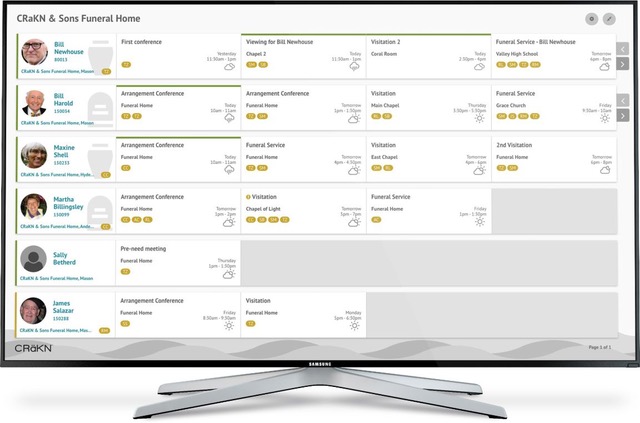
    CRäKN also allows all events to be tracked using the digital whiteboard. Funeral directors can see who is working an event and details that still need to be finalized, so the ball never gets dropped. All of this can be done from a laptop, tablet or smartphone. Funeral directors get calls at all hours so this is a big plus! We also make the compliance side of the business easy and transparent.

    BP: Do you have competitors that offer solutions comparable to yours?
    SM: We do, but other software companies catering to this market are typically not SaaS and are focused on the accounting side of the business, while CRäKN addresses the entire business from relationship management to finance and accounting and all of the important services provided by funeral homes. Our intent is to automate processes so funeral directors and their staffs can focus on the families and getting them through a challenging time.

    BP: What is your competitive advantage?
    SM: The biggest advantage is we address the enter funeral home enterprise and not just a portion of it so clients don’t have to manage and maintain multiple software licenses and vendors. And while competitors’ solutions require user training, CRäKN’s patented technology is very intuitive, easy to use and requires little or no training.

     BP: What is your revenue model?
    SM: We’re a SaaS solution, but with a twist. Instead of charging our clients by the number of users or “desks,” we offer an unlimited license and charge by the number of funerals per month. This way, any person on the funeral home staff can access the CRäKN software. This makes the monthly fee a variable, but allows us to grow with our clients or retract if their business slows. This is attractive because there is some seasonality to the death care industry; flu season and post-holidays can cause spikes. Also, cities that are either losing or gaining population like the financial flexibility.

    BP: What market traction do you have to date?
    SM: Strong. We’ve grown 1000% year-over-year since 2018. Our client base is a good cross section of the industry, ranging from very small funeral homes to very large, multi-location and publicly traded businesses.

    BP: How much money are you raising and what will the funds be used for?
    SM: The target is $800,000. This is a syndication deal through Queen City Angels. They’ve done due diligence and have already funded $300,000. In addition to VisionTech Angels, we’re talking with two other angel groups and hope to close the round with angels rather than VCs or private equity groups. We plan to use the funds to accelerate our national rollout.

    BP: Why should VisionTech Angels invest in CRäKN?
    SM: You may not know this, but Indiana is the world’s headquarters for casket manufacturing and a major state for investing in funeral startups. Aside from that, CRäKN has a number of things going for us that should be attractive to investors. Our technology is state-of-the-art. Collectively, our team has been in the death care industry for 100-plus years so our relationships and contacts are deep. Lastly, our terms are friendly to angel investors.

    To learn more about CRäKN visit their website. To RSVP for the VisionTech Angels’ February Road Show, visit our events calendar. Accredited investors interested in learning more about joining our group should contact Ben Pidgeon, bpidgeon@visiontech-partners.com.


  • Qumulex Has a Strategy – and the Leadership – to Move the Physical Security Industry to the Cloud

    Never underestimate the value of an experienced leadership team. Fishers, Indiana-based Qumulex has this in spades. The seven founders have all worked together in the commercial physical security industry and have successfully launched and exited two companies before founding their new endeavor in September 2018. I recently sat down with Qumulex President Dan Rittman who will be presenting during our February Road Show on its strategy of moving this legacy system industry to the cloud. Here’s our conversation:

    Ben Pidgeon, Executive Director, VisionTech

    BP: What are the trends within the commercial video surveillance/access control space?
    DR: Cyber security dominates conversations today yet physical security is a huge concern. Every time there’s a school shooting, a breach at a military installation or an intruder at a workplace, the first thing people ask is, what could we have done differently? Physical security systems, specifically those that are video-based, have undergone major technology shifts. Today, there’s a push to move away from on-premise equipment to cloud-based solutions. The commercial security industry is among the last to move to the cloud even though benefits are significant. Given the role of video and point-of-entry security in identifying, responding to and managing threats in real time and often in concert with law enforcement, the time for industry disruptors is now.

    BP: Explain the Qumulex solution.
    DR: Qumulex offers a cloud-based, mobile-first, unified access control and video surveillance solution for physical security integrators that serve commercial markets. We’re unique in that our mission is to provide integrators with a transition path for customers to embrace cloud technology and mobile accessibility and a subscription-based business model without an integrator having to turn their back completely on the legacy approach based on existing technology and transactional revenue. As this transition happens, Qumulex’ product line will support any mix of systems from on-premises to the cloud. The system is designed to be cloud-agnostic, but will launch with the Google cloud.

    Dan Rittman, President, Qumulex

    BP: Do you have competitors that offer solutions comparable to Qumulex?
    DR: Legacy solution providers control 95% of the market and they are the “comfort zone” for many potential Qumulex integrators and end users. Cloud competitors include Verkada, a Silicon Valley startup that raised an $80 million Series C with a $1.6 billion valuation in late January 2020, and more established companies like Eagle Eye Networks that has solid customers – McDonalds, Shell and Volvo – but has failed to achieve significant market traction.

    BP: What is your competitive advantage?
    DR: The biggest one is the experience and connections of our seven founders within the physical security integration industry. Even though Qumulex is new, the leadership team is a known and trusted in the space. The second advantage is that we’ve designed our product so transitions from legacy systems to the cloud are easier and more manageable. Our hybrid model allows customers to be both on premise and on the cloud. In our demos, people love this approach because end users get the accessibility, redundancy, and mobility benefits of video on the cloud without having to entirely replace a legacy system.

    BP: Who is your ideal customer and what market traction do you have to date?
    D
    R: Every school, hospital, university, military installation, retail/hospitality, office or manufacturing plant is an ideal customer. That said, Qumulex is a channel marketer; we sell directly to physical security integrators who sell to end-users. There are about 10,000 security integrators in North America that range from single person shops to major global integrators. Our ideal customer is in the middle; integrators that currently sell our type of product and at our price point.

    In terms of traction, there is tremendous pent-up demand. We hosted a suite at ISC West last April, which is the largest physical security show in North America. Over the course of two-and-a-half days, we had 91 booked appointments with integrators. We’ve been to other, smaller shows with the same high interest level. We currently have beta tests in progress and plan to launch in late Q2. There’s a lot of anticipation. So far, we’ve signed 11 sales rep firms to cover the United States.

     BP: What are the barriers to adoption?
    DR: The commercial security industry, like others comfortable with legacy systems, is slow to move. People tend to go with what they know so there’s an education process involved. What has really helped us is the rapid adoption of cloud-based consumer solutions like Ring smart home security. People have seen it, used it, and want that type of convenience and accessibility for their business security systems.

    There’s another market pressure working in our favor. The integrator market is consolidating, with larger companies acquiring the little guys. However, acquirers are interested in those with at least 20% in recurring revenue. Most don’t know how to move from a transactional business model to monthly recurring revenue. We can get them there so they are a more attractive acquisition target, but also better positioned should they prefer to remain independent.

    BP: What is your revenue model?
    DR: The commercial security industry is a traditional transactional business so our revenue model is both transactional and SaaS. We sell equipment for on-premise systems, but our main focus is recurring revenue from our software.

    Qumulex Team

    BP: How much money are you raising and what will the funds be used for?
    DR: Our current raise is a Series Seed 2 with the goal of raising $2 million. This will take us to our commercial launch in late Q2, and then through a year of commercial activity before a Series A round. It will supplement a significant investment made by the founders and an earlier seed round.

    BP: Why should VisionTech Angels invest in Qumulex?
    DR: I really have to go back to our leadership team: we know what we’re doing. All of us have been in the industry for 20-plus years and know the market well. We also understand startups, having founded and exited two companies to date: Integral Technologies, which we exited in 2000 for $50 million, and Exacq Technologies, exited in 2015 to Tyco for $150 million. We believe the commercial security market has reached a technology inflection point and Qumulex is positioned to disrupt, but equally important, provide a practical bridge from legacy systems to the cloud that makes adoption easier.

    To learn more about Qumulex, visit their website. To RSVP for the VisionTech Angels’ February Road Show, visit our events calendar. Accredited investors interested in learning more about joining our group should contact Ben Pidgeon, bpidgeon@visiontech-partners.com.


  • VisionTech Angels Kick Off the 2020 Investment Season with Materials Handling AI and Robotics Disrupter, SIERA.AI

    I’ve come to believe that with startups, timing is everything. It’s particularly true in the case of SIERA.AI, an Austin-based company that has created and is now commercializing autonomy software solutions for materials handling in the manufacturing and logistics industries. Though SIERA.AI is a young company, they’re building an impressive book of business with Fortune 500 companies. I recently sat down with SIERA.AI CEO Saurav Agarwal who will be presenting during our February Road Show, on just how well his company’s positioned for the market and the opportunities this affords. Here’s our conversation.

    Ben Pidgeon, Executive Director, VisionTech

    BP: What are the trends within the materials handling space that made you believe you could solve the industry’s challenges?
    SA: In short, it’s explosive growth and the growing pains that have come with it. Over the last five years, there’s been a boom in the logistics industry, due in part to the transformation that’s taken place in the retail industry. These numbers are a bit dated, but from 2014 to 2016, 833 million square feet of warehouse space came online in the U.S. alone. You can look at Indiana’s I-65 corridor and see expansion is still occurring.

    In response, manufacturing and logistics companies are adding about a million forklifts to their operations each year. At the same time, there’s a shortage of 43,000 certified operators. It’s not an easy job. Drivers  operate 10,000-pound machines in tight spaces. There’s no room for error. Sometimes drivers get careless. According to OSHA, there are 96,000 forklift-related accidents a year, with losses of upwards of $9.5 billion a year and lost wages of $3o billion. And that’s just the U.S. The opportunity for disruption was obvious.

    Saurav Agarwal, CEO, SIERA.AI

    BP: Explain your solutions.
    SA: SIERA.AI builds autonomy software for forklifts. We have two primary offerings: a basic version, for accident prevention, and a pro version, for full automation. The SIERA Safety System (S3) is added to existing driver-operated forklifts to sense and prevent accidents before they happen. The system constantly tracks driver behavior and streams real-time data to the cloud for deep analytics. The monitoring has a distinct impact on driver behavior and that coupled with S3’s ability to prevent accidents has a profound impact on safety, productivity and loss due to accidents. Driven by SIERA.AI is our autonomous mobile robot technology; forklift robots if you will. The robots map and navigate in the customer’s facility on their own, interface using Wi-Fi with the MES/ERP systems and industrial controls, and get the job done safely and reliably. Both options can be added to existing forklift fleets or can be licensed by OEMs.

    BP: What’s your revenue model? Is it an initial purchase and then monthly licensing?
    SA: Yes, there are unit sales and annual recurring revenue from licensing our software.

    BP: What market traction do you have to date?
    SA: We have five active pilots, two flagship clients converting to full adoption, and over $6 million in deals we’re currently negotiating. One of our clients is Tyson Foods; our SIERA.AI Safety Solution is in their beef processing plant in Dakota City, South Dakota. One of their biggest problems is forklift manufacturers don’t include safety technology, and they wanted to eliminate accidents. In their pilot, which took place over three months, more than 5,000 miles were driven with no accidents or near misses. Management also noted a significant change – for the better – in driver behavior. Tyson Foods has 8,000 forklifts in its fleet and could potentially license 3,000 of them with SIERA-AI, a nice amount of recurring revenue.

    BP: What are the barriers to adoption?
    SA: With the labor shortage and high cost of accidents and lost wages, the SIERA Safety System and our autonomous robots are both very attractive to companies that need to move goods safely and avoid costs. The beauty of SIERA.AI’s solutions is companies can use both the enhanced safety solution and robotics side-by-side for human-robot collaboration.

    BP: What’s your competitive advantage?
    SA: First, we have a great product market fit; SIERA.AI has the only available forklift brand agnostic safety and automation product on the market. Second is our speed to market and accelerating traction. Finally, our solutions will be well protected. We’ve filed four utility patents and four provisional patents and hope to finalize those by Q1 2021.

    BP: How much money are you raising and what will the funds be used for?
    SA: We’re currently raising a bridge round of $500,000-600,000 and have $175,000 in soft commitments. The capital will be used to fulfill current orders – we’ve signed orders (recurring revenue, 5-year contracts) worth $400,000 in mid-January. We also need to hire an additional engineer, deployment manager, and sales and marketing team members so we continue to grow.

    BP: Why should VisionTech Angels invest in SIERA.AI?
    SA: The most compelling reason to invest is the market wants our solution; we’re solving huge industry problems. We’ve booked significant sales and our pipeline includes Fortune 500 companies that recognize our value. We’ve come extremely far in two years with very little capital and with VisionTech Angels’ investment, we can move that much faster.

    To learn more about SIERA.AI visit their website. To RSVP for the VisionTech Angels’ February Road Show, visit our events calendar. Accredited investors interested in learning more about joining our group should contact Ben Pidgeon, bpidgeon@visiontech-partners.com.

  • Carmel startup uses technology developed by NASA in 1960s to turn heat into electricity

    INDIANAPOLIS, Indiana (January 10, 2020) – – Inspired by a physics teacher at Homestead High School in Fort Wayne, Ian Hamilton began as a teenager to seriously contemplate ways to create alternative energy sources.

    Ian Hamilton, CEO, Atlas Energy Systems

    By the time he stepped onto the Purdue University campus as a freshman in 2011, he already had some firm ideas about how to do that.

    But while in a class studying thermionic energy—the conversion of high-intensity heat into electricity—he dug into some long-forgotten technology developed by NASA in the 1960s during the space race with Russia.

    The technology’s patents had expired, making the science fair game for new applications.

    “I saw that this technology matched the ideas in my head for energy generation,” Hamilton said. “Really, it was pure happenstance that I found that old technology.”

    He studied it intently and said to himself, “This could work.”

    Read the rest of the story>

  • VisionTech Angels Leads Successful Seed Investment Round in Atlas Energy Systems, Exceeding Goal by Nearly 35 Percent

    VisionTech Angels Leads Successful Seed Investment Round in Atlas Energy Systems, Exceeding Goal by Nearly 35 Percent

    INDIANAPOLIS, Indiana (January 2, 2020) – VisionTech Angels closed 2019 by leading a Series A seed round investment in Carmel, Indiana-based Atlas Energy Systems, LLC, exceeding the energy technology company’s goal of $400,000 by nearly 35 percent. When the funding tranche closed December 27, 2019, the Indianapolis-based angel investing group succeeded in leading a $558,000 raise. West Suburban Angels of Naperville, Illinois, and Lateral Capital of Sarasota, Florida, also participated in the round.

    Although VisionTech Angels has invested in 43 startup companies since 2008, this is the first investment round it has led in last 18 months, says Executive Director Ben Pidgeon. He credits the triple value proposition of the company’s technology, strength of the leadership team, and exit potential for the incredible momentum of the investment round’s first tranche.

    “Atlas Energy Systems CEO Ian Hamilton originally pitched to VisionTech Angels for funding in April 2019 and while they were early in the commercialization process, our investors immediately liked what they saw. Based on investor interest, we started due diligence,” explained Pidgeon. “We also connected Ian with Scott Noble, who has mentored a number of startups associated with the Purdue Foundry and the Notre Dame IDEA Center, for his business acumen and experience with mergers and acquisitions activity. Scott is now Atlas Energy Systems’ chief financial officer.”

    Although Atlas Energy Systems is a startup, its patent-pending technology, thermionic energy converters for waste heat power generation, concentrated solar, and advanced nuclear reactors was originally developed by NASA in the 1960s. The original technology designs were either top secret or patent protected. However, most of the original patents were for space and nuclear applications and expired in the 1980s when the government lost interest in the space program. Hamilton first learned about the technology while an undergrad at Purdue University—he now holds a Masters in Nuclear Engineering—and has since repurposed the thermionic energy converting technology for contemporary industrial energy applications.

    Hamilton says interest his company’s technology is high. “We’ve been approached by multiple industries and have chosen to focus on the oil and gas industry for our commercial launch. The main advantages of our thermionic energy converters are their compact size, high power density and no moving parts operation, making them virtually maintenance free even in the harshest environments. We can provide onsite power using flare gas, while reducing CO2 emissions and the environmental impact of drilling sites.”

    He adds that the seed round funding will be used in part to deliver converters for oil and gas power generation as soon as the first half of 2020.

    In conjunction with the successful seed investment raise, Atlas Energy Systems has added three new board members. Scott Baxter, a VisionTech Angel member, will serve as the seed investor reserved director. James Barkley, also a VisionTech Angel member, will serve as the board observer. Former GE executive George Sassine joins the board as the at-large independent director. Atlas CEO Ian Hamilton is the board chair. The first board meeting is scheduled for late January.

    VisionTech Angels who invested in Atlas Energy Systems and reside in Indiana qualify for the Indiana Venture Capital Investment income tax credit.

    Funding momentum continues as Atlas Energy Systems has been invited to pitch to Tamiami Angels of Naples, Florida, January 9.