Author: Ben Pidgeon

  • Realplay Completes VisionTech Angels’ August Pitch Week and It’s a Homerun!

    VisionTech Angels’ Executive Director Ben Pidgeon recently sat down with Justin Real, CEO of Realplay and former collegiate baseball player, to discuss how the Massachusetts-based startup is transforming how youth baseball and softball are , shared and experienced. It’s a unique play with great market potential. Anyone with a child or grandchild who plays sports will be interested in this pitch. Justin will present Realplay during VisionTech’s upcoming Pitch Week, August 26-29. Read on!

    Ben Pidgeon, Executive Director, VisionTech

    BP: This is the first time VisionTech Angels has hosted a sports-focused startup for Pitch Week. How did you get into the game?
    JR: I originally got into baseball in Little League, worked my way through the high school recruiting process and ended my career playing catcher for four year at Union College. After college, I worked as consultant in the tech industry for four years and continued to work as a private hitting coach. While getting my MBA at Babson College, I found an opportunity to get back into the sport I love from a business perspective. It’s a lucrative market—as the most popular U.S. sport, amateur baseball and softball combined represents a $4 billion market. People play for fun, recreation, or dream of playing at the collegiate and professional levels. There are a lot of memories made on ball fields.

    I saw how the sport and the world at large were using video and saw an opportunity to change how video is captured, edited, shared, and used. In 2016, I founded Realplay and pulled together an all-star team that includes Andreas Randow (CTO), who has worked in the startup ecosystem for 15 years and is an expert in computer vision and systems infrastructure; Michael Salerno (VP of Product), who was with Oracle; and Brian Porter (Director of Operations), who spent 15 years working in Major League Baseball. His final project was consolidating and upgrading the video systems of all minor league teams. We’re now in the market and working hard!

    BP: What problem are you solving?
    JR: People love video, particularly in the sports world. Parents want video of their kids to capture the moment and share with friends and family. Coaches want video to analyze their players and improve skills. Scouts use video to check out prospects and reduce travel. And the players, they love seeing themselves on video. So what are the options? Use a smart phone and do it yourself? Hire a videographer for thousands of dollars or travel across the country showcasing your kid’s talent at expensive camps and showcases? Neither is ideal. And this doesn’t even include the time and labor involved with editing and sharing player videos with everyone who wants them.

    Realplay eliminates the need for parents, coaches, scouts, and whomever to be videographers, editors, producers, organizers, or publishers. We deliver video of every swing, pitch, and catch that any player on makes on a baseball or softball field. And we do it by automating the capture, editing, analysis, and distribution of player video. This allows everyone to focus on the game and have fun—which is what baseball and softball are about.

    BP: Sounds cool. How does it work?
    JR: There are three key components: the camera system, machine learning software and a multi-channel platform. Here’s how they work together to make Realplay cover all the bases. Each ball field is equipped with three cameras that operate through an app. The app also serves as an e-scorebook, capturing stats throughout the game. At the end of the game, the video is uploaded to the cloud where it’s processed by our machine learning software into single player clips and stats. This information is uploaded to player profiles. The final piece is the multi-channel platform with pages for players, parents and teams. There’s also a social media integration component to make sharing easy. We’ve taken a process that used to require nine man hours of work per game, and reduced it to seven minutes.

    BP: What’s Realplay’s revenue model?
    JR: First, there’s no charge to the field owner or sports complex; Realplay is a free service with a revenue share. Our revenue comes from player and team subscriptions. To get people started, we offer a freemium subscription that includes three free videos that can be viewed on a player’s page we create for them. The basic subscription includes all of a player’s videos uploaded to their page with stats, on-video annotation and a few other features. The premium subscription includes an end-of-season highlight reel, virtual coaching portal, college recruitment prep, and premium social sharing features.

    We partner with the existing organizers of the game to ensure high volume wherever we go. Subscriptions can be offered through teams as part of their annual fees or made available through specific tournaments or events by facilities and tournament organizers. Even if it’s just an online purchase, It’s a nice addition for players, families and coaches!

     BP: Who is the ideal customer for Realplay?
    JR: Any family with a kid playing baseball or softball. Our immediate focus and ideal target is multi-field sports complexes that can have anywhere from two to 50-plus fields for youth and adult leagues. For example, in Westfield, Indiana, there’s a privately owned complex with 57 fields. In 2018, it had 1.9 million visitors. Currently, there are 550 similar facilities with a total of 3,500 fields. Each facility can see upwards of 125,000 players a year.

     BP: What’s your pipeline look like now and what are you doing to fill it up?
    JR: In 2019, we’ve secured two contracts and one letter of intent for just under $1 million in annual recurring revenue. We have two other facility prospects in the pipeline. We’re aggressively targeting sports facilities, tournament organizers, and multi-team programs like Little League, AAU, Cal Ripkin Baseball, and others.

     BP: There are others doing this. What is Realplay’s competitive advantage?
    JR: Yes, there are several competitors with Hudl being the most entrenched. They’ve been on the market since 2006 and their technology is out of date. Realplay has four things going for us. First, we are free to the sports facility with the revenue sharing component; all of our competitors charge for their service.

    Second, our technology is superior; our automation moves the responsibility of creating videos from people to the machines. Third, we’re entirely focused on baseball/softball and aim to be the standard at premium facilities; everyone else is focusing on team-field sports like soccer and football. Finally, as the first mover in this space, our position gets more entrenched with each new facility we sign.

    BP: Why should VisionTech Angels invest in Realplay?
    JR: The market potential is huge. Baseball and softball have 36.5 million participants, many who’d love to have video. We’ve already raised the majority of our seed round and are looking to use the funding to secure more contracts for 2020, and start the process of raising our next round at a higher valuation. Realplay is a low technology risk, fast to production and results, with low cap intensity. We’re gaining traction and we love baseball.

    To learn more about Realplay, visit their website. To RSVP for VisionTech Angels’ August Pitch Week, visit our events calendar.

     

  • 20 Startups Are Ready to Pitch for Prizes and Investment Capital at the 11th Annual Innovation Showcase

    Ben Pidgeon, VisionTech

    Among my responsibilities as executive director of VisionTech Angels is screening startup companies. Each year, my committee members and I review more than 400 companies seeking investor dollars, selecting about 12 to pitch to our angel investors. It is, by design, a grueling process. I mention this because the Venture Club of Indiana took the same rigorous path for selecting the pitch companies for this year’s Innovation Showcase. Venture Club President Aaron Gillum and Pitch Competition Chair Travis Stegemoller took the “Road to the Showcase,” personally traveling to nine cities across Indiana to find the best of the best to pitch at the Showcase on August 22. My hat’s off to you both plus all of the folks who put on the local pitch competitions. Now, read on for details on the Innovation Showcase Pitch Competition!

    Aaron Gillum, President, Venture Club of Indiana

    The Venture Club of Indiana likes to say we have Indiana’s largest pitch competition, but this year it’s also among the most carefully curated. With the help of local sponsors in nine Indiana cities, we met many enthusiastic entrepreneurs who pitched a wide range of high tech and socially conscious solutions. Choosing the 20 we believed to be the most investor ready to participate in The Innovation Showcase was tough! Here are the 2019 pitch companies:


    Evansville
    Heliponix
    Safekeeping

    Fort Wayne
    Bukal Beverage Co.
    Cool Corp, Inc.

    Greater Lafayette
    Adranos
    Amplified Sciences
    Rogo AG, LLC

    Indianapolis
    AfterSchool HQ
    Atlas Energy
    Away Zones
    Pinpoint Pharma
    Plan Forward

    Muncie
    Tudr
    What’s Up 24/7

    New Albany
    Moxie Girl
    Total Mindcare

    Northwest Indiana
    FlykeArt

    South Bend
    Frost Control Systems
    SIMBA Chain

    Terre Haute
    Zoro, Inc.

    Here’s What You Need to Know About the Pitch Competition

    Showcase pitch companies are competing for $20,000 in cash plus in-kind prizes. Equally important, they’re competing for the attention of the VCs, angel investors and individual investors in the audience. We’re looking for a big crowd. Have you purchased your tickets yet? Get them here.

    We kickoff the Innovation Showcase with registration at 11 a.m. followed by lunch. After welcoming remarks by Venture Club President Aaron Gillum, we get down to business with great speakers, the Expo Hall, and the pitches. See the complete Showcase schedule here.

    There are two pitch sessions, one at 2 p.m. and the second at 3:30. With Emcee Dr. Don Kuratko of the IU Kelley School of Business cheering them on, each startup will have three minutes to make their case to the judges. The scores will then be tallied and the judges will huddle before announcing the winners at 5:30.

    The day ends on a high note with the VIP Reception and Expo Hall from 5:45 – 7:30p.m. Showcase attendees and entrepreneurs have plenty of time to connect for one-on-one discussions and networking.

    The Venture Club of Indiana extends special thanks for our 2019 Innovation Showcase sponsors, without whom this event would not be possible.

    Elevate Ventures
    Allos
    Barnes & Thornburg
    Deftly Creative
    50 South Capital
    Innovation Connector
    Katz Sapper & Miller
    Lux-Writes
    Novel Coworking
    Ontario Systems
    Purdue Foundry
    Purdue Ventures
    Signature Bank
    VisionTech Angels 
    When You Leave the Room

    Find more information on The Innovation Showcase here. Purchase tickets here.


  • Onboard Dynamics’ Green Natural Gas Fuel Solution Headlines VisionTech Angels’ August Pitch Week

    VisionTech Angels’ Executive Director Ben Pidgeon recently sat down with Rita Hansen, CEO of Onboard Dynamics, to learn more about how the company’s GoFlo® compressors are enabling municipal and commercial fleetswaste haulers, school buses, delivery companiesto replace diesel fuel with clean, zero-carbon emitting natural gas. Interest in the mobile natural gas compressors is high, particularly in states that have mandated all waste haulers move to green-powered vehicles by 2020. Rita, who recently represented the United States as a delegate to the 2019 Global Entrepreneurship Summit in The Hague, Netherlands, will present Onboard Dynamics during VisionTech’s upcoming Pitch Week, August 26-29. Read on!

    Ben Pidgeon, VisionTech

    BP: VisionTech Angels is excited to host Onboard Dynamics during our August Pitch Week. What’s your story?
    RH: Jeff Witwer and I co-founded Onboard Dynamics in 2013 with Dr. Chris Hagen after licensing technology developed in Chris’ clean energy systems lab at Oregon State University (OSU) and initially funded by the U.S. Department of Energy. Jeff is a serial entrepreneur with experience in the energy and software industries. My interests are clean technologies, alternative energy, and renewables that present opportunities domestically and internationally. We saw the tremendous potential of natural gas compression technology to lead the clean fuel revolution in a way that disrupts the status quo without being disruptive to fleet managers and organizations.

    The company got immediate validation. After we licensed the technology, ARPA-E, a government agency that advances energy technologies with the potential to radically improve the U.S. economy, national security and environmental wellbeing, awarded us a $6.6 million cooperative agreement. This allowed us to develop and now commercialize a product from the technology, the GoFlo compressor. We just recently hit $1 million in sales!

    Rita Hansen, CEO
    Onboard Dynamics

    BP: Nice! We like revenue! What problem are you solving in the marketplace?
    RH: The macro problem is a global lack of infrastructure for refueling natural gas vehicles. Currently there are fewer than 1,000 public compressed natural gas stations. These refueling stations are also expensive; they cost more than $1 million to build. If you have a fleet of more than 50 vehicles, the cost can be justified. But for small fleet operators, you need an option that’s more affordable and in many cases, more flexible than a fixed fuel station.

    Another big problem we solve is the push—and in some cases, a mandated push—to convert fleets of vehicles to clean and/or renewable energy sources to reduce emissions of regulated pollutants like NOX and reduce one’s carbon footprint. NOX is a very poisonous emission of diesel fuels. Some people are turning to electric vehicles; I’m sure a few of you drive Teslas and love them. But electric vehicles for fleet use—school buses for example—are very expensive. And in many cases, the electricity to fuel these buses comes from coal-generated electricity. So where’s the win in that?

    BP: How easy are these compressors to use?
    RH: The GoFlo compressor makes the transition from diesel to natural gas-powered vehicles easy and affordable. It can be used in a fleet yard or off-site. It doesn’t require electricity to run, which is great for remote locations and disaster situations. And it accepts any low-pressure natural gas or renewable natural gas source for compression into a cost-effective, clean fuel for vehicles.

    BP: What types of fleets are you targeting?
    RH: We’re targeting government and commercial fleets, including light duty CNG trucks, school and transit buses, delivery vehicles, and a big one for us, waste haulers. California has mandated that the waste hauling industry move to alternate fuels by 2020, creating a significant market for us. What makes the GoFlo compressor attractive to this group—beyond regulatory compliance—is the refueling system pays for itself in less than two years due to lower fuel and labor costs

    One of our customers, an independent waste hauler in Southern California, is going live with a full system in mid-August. They’ve agreed to be a showcase for the more than 100 other similar independent waste haulers. The total market size of independent waste haulers in Southern California alone is 150-200 companies. We’ve also piloted GoFlo with a number of school districts and getting traction there.

    BP: Are there other markets for GoFlo, here or internationally?
    RH: Glad you asked that, Ben. Natural gas utilities are perfect channel partners for us as they can sell the GoFlo compressors to their customer or offer as “Compressed Natural Gas as a Service” with monthly billing. We are also working with Canada’s Department of Natural Resources to certify GoFlo for the Canadian market. We’ve received payment toward the first unit and expect to start installation in Ontario in late fall with full deployment in the first quarter of 2020. Other markets such as Mexico, Latin America, and India represent opportunities to expand due to a lack of natural gas infrastructure and also a real need reduce air pollution.

    BP: What kind of IP protection do you have?
    RH: The original technology has two international patents, and we’ve applied for six PCTs (patent cooperation treaty) on the compressor for national and international protection.

    BP: Why should VisionTech Angels invest in Onboard Dynamics?
    RH: As a nation, leaders in business, and members of the global community, we have a responsibility to adopt green energy technologies to protect the world for future generations. With the GoFlo compressor, Onboard Dynamics has a practical solution that meets government, business and social goals. It reduces emissions, its carbon neutral, it leverages existing natural gas pipeline distribution systems, and saves money. Our team is really good, too. Even with our lean sales team, our pipeline is full. We expect to sell 15 units in 2019 and 55 in 2020. We’re a company that’s in the right place at the right time.

    To learn more about Onboard Dynamics, visit their website. You can also watch their video. To RSVP for VisionTech Angels’ August Pitch Week, visit our events calendar.

  • What Do The Innovation Showcase Speakers Have in Common? A Passion for Startups

    Excitement is growing as the Venture Club of Indiana counts down to its premier, carefully curated startup pitch event, The Innovation Showcase on August 22 in Indianapolis. This year, a companion event joins the Showcase: The Next Level Fund Indiana Venture Summit. The Summit is designed to introduce venture capitalists and others to the exciting opportunities available through the Next Level Indiana Fund. I’ve invited Venture Club of Indiana Board Member and Program Committee Leader Sandy Wilcox to tell us about The Innovation Showcase, how the day will roll out, and the all-star line-up of speakers whose experiences as entrepreneurs, educators, and investors are legendary. VisionTech Angels is pleased to share Sandy’s inside perspective. Read on!

    Sandy Wilcox, The Innovation Showcase Program Chair

    In planning to hold the Next Level Fund Indiana Summit the same day as the Innovation Showcase, our objective was to encourage venture capitalist from all over the country to participate in The Innovation Showcase along with our statewide investment community. We all know that Indiana has long been considered a flyover state. The Venture Club Board and our president, Aaron Gillum, who is also senior vice president with 50 South Capital, are seeking to transform this perception and reflect the excitement and extraordinary progress of Indiana’s tech-driven innovation. By inviting investors to both events on the same day and putting our startups on stage in front of those investors, we know that we are fulfilling our objective, “Where Capital Meets Innovation!”

    When I volunteered to be program chair for The Innovation Showcase, I knew my committee and I had an amazing job ahead of us. Our goal was to make the Showcase a dynamic event for everyone regardless of your perspective, startup or VC, student or supporter.

    When the Next Level Fund Summit ends at around 11:30 a.m. and the attendees leave their seats, they will walk out of the hall and into The Innovation Showcase’s Entrepreneur’s Expo filled with booths hosted by some of Indiana’s finest startups for a “walking lunch.”

    At precisely 1 p.m., The Innovation Showcase will kick off with welcoming remarks from Venture Club President Aaron Gillum and Kip Frey, Executive Vice President, New Ventures, The Heritage Group.

    Don Brown, The Accidental Entrepreneur

    Seeking one of the most significant pioneers in Indiana’s technology space, we asked Don Brown, CEO of LifeOmic, to be our keynote speaker. As a leader at Software Artistry, and then as founder and CEO of Interactive Intelligence, Don negotiated the successful creation and sale of Interactive Intelligence to Genesys Telecommunications for a record $1.6 billion. His new adventure is LifeOmic, an Indianapolis-based software company that leverages the cloud, machine learning, and mobile devices to offer disruptive, precision medicine solutions to healthcare providers. A serial entrepreneur, Don still calls himself, an “accidental entrepreneur.” Sharing his entrepreneurial journey as well as lessons learned, Don will also outline his bold vision for the future of healthcare with Innovation Showcase guests.

    Don Kuratko, IU Kelley School of Business

    Following our keynote, the pitches begin! Two rounds of 10 of Indiana’s finest startup companies will present to Investors in the audience and to win a cash prize. Who better to serve as the emcee of this competition than Dr. Don Kuratko, the Gill Distinguished Chair and Professor of Entrepreneurship at the Indiana University Kelley School of Business. Recognized among the Top 10 entrepreneurship scholars in the world, “Dr K” created one of the country’s first entrepreneurship centers at Ball State University in 1983. His love, drive, and determination to build the foundation in education to prepare and support the growth of entrepreneurship make him a stunning choice to emcee our pitch competition!

    Jeff Ready, CEO, Scale Computing

    In between the two pitch segments, Jeff Ready, CEO of Scale Computing, will lead us on the “The Road… After the Showcase.” Jeff will share the impact winning The Innovation Showcase’s Venture Idol pitch competition in 2008 presented to him as CEO of an Indiana startup. Today, with 2,000 customers in 30 countries and a total capital raise of $96 million, Scale is poised for explosive growth through partnerships with much larger companies skillfully negotiated by Jeff and his team. He will also interview two other past winners to demonstrate the real impact of presenting and winning at the Venture Club’s Innovation Showcase. We ask from time to time, “Does the Showcase make a difference?” Jeff and the other winners prove that “YES,’ it absolutely does!

    Jane Martin

    After the final round of pitches, Jane Martin, a retired venture capitalist, will present “Seven Decades of Venture Capital, A Brief History.” A maverick as a women investor in the venture capital world, Jane was instrumental in numerous deals, investing in the likes of FedEx, MCI, Control Data, Sun Microsystems, Gymboree, and Calloway Golf to name a few. She will further discuss what it will take to bring venture capital investors to Indiana.

    The Showcase will wrap up with a dynamic panel of female VCs discussing venture investing from a woman’s perspective.  At 5:30 p.m., the winners of the pitch competition will be announced and we’ll celebrate with a VIP reception.  A full day to be sure, but a day that you won’t want to miss!

    The Venture Club of Indiana hopes you are as excited about the outstanding program and speakers we’ve assembled for The Innovation Showcase, Thursday, August 22, 11:30 a.m.-7:30 p.m. at The Center in Indianapolis. For more information about The Innovation Showcase, visit our website. If you don’t have you ticket yet, grab it now! Space is limited and you don’t want to miss out on Indiana’s largest pitch event.


  • Want to Connect with Capital? Don’t Miss the Inaugural Next Level Fund Summit

    The Venture Club of Indiana’s annual Innovation Showcase includes the state’s largest pitch event, with some 20 companies vying for prize money. This year the pot is sweeter thanks to a companion event, the 2019 Indiana Next Level Fund Summit, held the morning of The Innovation Showcase. The host of the Summit is 50 South Capital Advisors, the fund administrator of the Next Level Fund. Aaron Gillum, senior vice president at 50 South, is also the president of the Venture Club of Indiana and works with the state’s venture community. I recently sat down with Aaron to learn more about the Summit and how VisionTech Angels, startups, and others can get involved. Here goes!

    Ben Pidgeon, VisionTech

    BP: What’s the history of the Next Level Fund? It’s fairly new, right?
    AG: It is! The Indiana General Assembly announced the Next Level Fund in 2017 as a replacement of the Next Generation Trust Fund originally created by the Indiana Toll Road. We officially kicked off in March 2018. The Next Level Fund aims to invest $250 million over five years to encourage venture capital and philanthropic organizations to invest in Indiana’s innovation community. 50 South Capital manages the fund with oversight by the Governor’s Office and an Investment Board. While most of the money invested by venture capital firms (VCs) in our portfolio, the Next Level Fund can also make direct investments in companies alongside VCs in our program.

    BP: How many VCs are participating in the Next Level Fund so far? Is there a limit to how many that can get involved?
    AG: So far we have five groups that we have announced in our VC portfolio: Allos, High Alpha, the Foundry Group, Hyde Park Venture Partners, and Techstars SportsTech. There really isn’t a limit per se, but participants either have to be located in Indiana or have a track record of investing in Indiana companies. The objective is to get more venture funds in the state and deployed to Indiana startups and entrepreneurs.

    Aaron Gillum, Indiana Next Level Fund

    BP: That’s awesome! Tell me about the Next Level Fund Summit? This is a first-time event, right?
    AG: It is the first year for the Summit. I do want to stress while we share the same date and venue, the Next Level Fund Summit is a standalone event. At the same time, 50 South is heavily involved in the efforts of the Venture Club and thus The Innovation Showcase. The purpose of the Summit is to highlight our work to date, introduce our fund managers and what they’re working on, introduce portfolio companies, and ultimately, by exposing more people to the Next Level Fund, expand our list of VCs. We have invited venture firms from across the country to attend. To date we have more than 120 guests that have RSVP’d  for the event. Our goal is to double that number.

    BP: Is the Summit limited to VCs? Are angel investors welcome to attend?
    AG: We’ve extended a special invitation to all investors – anyone who writes checks! Indiana is blessed to have a thriving angel investing community and groups like VisionTech Angels, Elevate Ventures, and several other up and coming angel groups throughout the state that play a critical role in funding early stage companies. We want you guys at the Summit connecting with the VCs, the investment board and me. We want to grow our investment community; we’re all in this together! The general public is also invited to the Summit.

    BP: VisionTech Angels as well as other angel groups in Indiana have a number of Indiana-based portfolio companies in the middle of Series A Rounds. Can they attend?
    AG: Absolutely. We want them at the Summit. I would encourage them to go to our website, look at the venture firms that are currently participating, do some homework, and come prepared to network.

    BP: Any special guests you’d like to mention?
    AG: Every guest is special, but we are particularly pleased to welcome Governor Eric Holcomb as well as members of the Fund’s investment board. Our fund managers and many of their portfolio companies are looking forward to showcasing all the work they have been doing throughout the state.

    BP: Will we see Summit guests at The Innovation Showcase?
    AG: I am personally encouraging everyone who attends the Next Level Fund Summit to stay and attend the Venture Club of Indiana’s Innovation Showcase. It’s such a natural segue from what Indiana is doing as a state to increase the number of VCs firms and ramp up later stage investment, to the excitement of the pitch competition with 20 of Indiana’s most investable companies. Anyone with a stake in Indiana’s innovation and entrepreneurship community should attend both events.

    BP: I’ll be there.
    AG: I’m counting on you, Ben.

    For more information on the Indiana Next Level Fund, click here. RSVP for the 2019 Next Level Fund Summit on Thursday, August 22, 8-11 am at The Center here. There is no cost to attend. RSVP for The Innovation Showcase here.  We look forward to seeing you at both events!


  • The Road to the Showcase: Searching for Indiana’s Most Investable Companies

    The Innovation Showcase is Indiana’s largest curated event for entrepreneurs, investors, and supporters of the state’s vibrant ecosystem and includes a pitch competition with up to 20 startups representing a spectrum of industries. As a board member of the Venture Club of Indiana, I’ve personally been involved with the Showcase for seven years. While this year’s event isn’t until August 22, my fellow Venture Club board member, attorney and chair of the Showcase pitch competition, Travis Stegemoller, has spent the last six months crisscrossing the state in a search for Indiana’s most investable companies. I recently had coffee with Travis to learn more about “The Road to the Showcase.”

    Ben Pidgeon, VisionTech

    BP: I hear you and Aaron Gillum (Venture Club President) have been putting lots of miles on your cars on something called “Road to the Showcase.” What’s that all about?
    TS: You heard right; I’ve put at least 1,000 miles on mine on the Venture Club’s pitch company selection process. Two years ago, we took a look at how pitch companies are selected for The Innovation Showcase. At that time, most were from the Indianapolis area. As the Venture Club of Indiana, we realized we had to do a better job getting startups across the state represented in the Showcase and connecting them with venture capitalists. So we created the Road to the Showcase, where we hold pitch competitions in nine cities across the state. The winners of each go on to compete at The Innovation Showcase in Indianapolis in August.

    Travis Stegemoller,
    Barnes & Thornburg

    BP: Where all have you been?
    TS: We kicked off in South Bend at Notre Dame’s IDEA Center in April and from there went to Hammond, Evansville, New Albany, Lafayette, Fort Wayne, Indianapolis, and Terre Haute. We’re wrapping up in Muncie at an event called the Innovation Connector on July 23 at 6:30 p.m. I’ve been to nearly every Road to the Showcase event. I think Aaron’s been to all of them.

    BP: How did you pull this nine-city tour?
    TS: Sounds like a logistical nightmare, right? Actually, it’s been great thanks to some wonderful partners. Elevate Ventures has been deeply involved from the start and offered the services of their entrepreneurs in residence to connect us with local stakeholders around the state. In some cases, we joined existing pitch events like “The Big Sell” in Hammond sponsored by Purdue University Northwest. One of our Venture Club board members, Nick Arnett, was instrumental starting The Blaze pitch event in Fort Wayne, which was co-hosted by the Venture Club, Start Fort Wayne and Founders Spark. All of the events are volunteer-driven and we had no shortage of help. I encourage you to visit our website for details on the Road to the Showcase events and hosting venues.

    BP: What kind of turnout did you have at the Road to the Showcase events?
    TS: First, I want to thank our local partners. Each city rallied around their event and really invested in the success of their local startups. There was great involvement in recruiting and coaching startups, finding qualified judges and inviting people to just come and experience it all. It’s been amazing. The overall turnout was great everywhere, but I have to give a shout out to Fort Wayne with over 100 attendees and to Evansville, which had tremendous enthusiasm.

    In terms of the startups, the overall quality has been impressive. We had the opportunity to see pitch companies across many industries, including software, hardware, consumer, medical devices, and life sciences. Most were considered true startups, but were in the process of scaling their business.”

    BP: What were the criteria for selecting the winners to go on to The Innovation Showcase Pitch?
    TS: The Venture Club has developed a judging rubric that rates each company on their product, scalability, traction, and management team. Our goal is to identify the most investable companies. Our hope was to find two per city. We anticipate having up to 20 pitch companies at The Innovation Showcase pitch competition on August 22. We’re still finalizing the list, but it will be a highly competitive event.

    BP: Any surprises on the Road to the Showcase?
    TS: Two things: how much fun I had meeting people across the state who are truly passionate about encouraging and supporting entrepreneurs and secondly, just how barren I-69 is between Evansville and Indy. Nothing for 1.5 hours, not even a McDonalds!

    BP: That’s harsh.
    TS: Right?

    The Venture Club of Indiana invites you to attend The Innovation Showcase, Thursday, August 22, 11:30 am-7:30 pm at The Center in Indianapolis. Register here. If you would like to become an Innovation Showcase sponsor, find information here. See you in August!

  • Brickell Biotech Added to June Pitch Week Line-up

    As VisionTech Angels know, I hate to turn away interesting investment opportunities. That’s why our selection committee reviews some 400 startups a year; we’re hoping for a unicorn. So when Brickell Biotech contacted me earlier this week to see if they could participate in VisionTech’s June Pitch Week, I agreed to take a look.

    Ben Pidgeon, VisionTech Executive Director

    It didn’t take long for me to invite the Boulder, Colorado-based company to come on the road with me for Pitch Week, June 24-27, and pitch to VisionTech Angels’ chapters in Lafayette, Dayton, OH; Fort Wayne, Bloomington, and Indianapolis.

    Here’s what caught my eye about Brickell:

    Brickell is a clinical-stage pharmaceutical company focused on differentiated innovative prescription therapeutics for treating debillitating skin diseases. Their lead pipeline asset, sofpironium bromide, is a topical soft anticholinergic intended for axillary hyperhidrosis (uncontrolled excessive sweating) that recently completed Phase 3 in Japan, successfully meeting all primary and secondary endpoints, via Brickell’s partner, Kaken Pharmaceutical Co., Ltd. Brickell is eligible to receive sales-based milestones and royalties of future net sales from Kaken in Japan and other Asian countries.

    The market for sofpironium bromide is large. There are many individuals living with hyperhidrosis. Roughly 15.3 million in the United States alone suffer from hyperhidrosis. This condition is chronic and has the tendency to negatively impact virtually all important aspects of life.

    A competitor is paving the way for reimbursement in the United States. Dermira, a public company valued at $550 million, recently launched the first topical prescription treatment for hyperhidrosis, Qbrexza®, approved by the FDA. Brickell’s investigational product is being developed to offer potentially unique differentiating features that the company believes could be best-in-class.

    Brickell just announced a reverse merger with Vical Inc. (Nasdaq:VICL) and, in combination, is raising $25 million from a prominent life sciences investment firm to fund the pivotal U.S. registration trials that Brickell intends to start in Q4 2019. Brickell will merge with a wholly owned subsidiary of Vical in an all-stock transaction. When finalized, the combined company will operate under the name, Brickell Biotech, Inc., and trade on the Nasdaq under a new ticker symbol to be determined. Brickell will own 60 percent of the new company. Read the release here>

    Here’s the deal for VisionTech Angels investors: Brickell is raising $10 million in a convertible debt offering to get through the closing of the reverse merger. Just under half is already subscribed from current investors and the leadership team’s own personal investments, with an additional $1 million in commitments from two venture capital firms. The reverse merger is scheduled to close prior to the end of Q3 2019. The new company is estimated to have a post-merger valuation of approximately $90 million. Funds from the merger will get Brickell through completion of a Phase 3 clinical trial of the lead pipeline asset, sofpironium bromide, in the United States.

    Brickell’s management team is impressive. Its members have launched multiple billion-dollar blockbuster drug brands such as Prozac®, Cialis®, Taltz®, Cymbalta®, and Juvederm® and successfully built several biotechs that were acquired by big pharma at very attractive multiples. CEO Rob Brown and General Counsel David McAvoy are both former long-time Lilly executives.

    We now how two presenting companies for June Pitch Week, Xact Medical and Brickell Biotech and I’m excited by them both. If you have not RSVP’d yet, I encourage you to do so now. Find details here.


  • Xact Medical Uses Robotics to “Stick” Patients and Wants You to Join Them

    VisionTech Angels’ Executive Director Ben Pidgeon recently sat down with Andrew Cothrel, CEO of Xact Medical, to learn more about how the company is using point-of-care robotics to transform the process of “sticking” patients for placing ports or catheters needed for chemotherapy, parental feeding and other purposes, typically referred to as central vascular access. Last March, the International Pediatric Endosurgery Group awarded Xact Medical’s FIND system the 2019 IPEG Innovation Award at their annual conference in Santiago, Chile. Andrew will present Xact Medical during VisionTech’s upcoming Pitch Week, June 24-27. Read on!

    Ben Pidgeon, VisionTech Angels

    BP: Tell me about the genesis of Xact Medical.
    AC: It all started with a pediatric surgeon with a passion for innovation and robotics. Dr. Dan von Allmen, the chair of Pediatric Surgery at the Cincinnati Children’s Hospital, saw an urgent need for better vascular access in his pediatric surgical practice. Children’s veins are smaller, they’re harder to locate and require high-skilled clinicians to obtain vascular access. The problem is, hospitals don’t always have clinicians of the right skill level available when vascular access is needed for a line or a port. This is particularly true after hours, on weekends and in small hospitals.

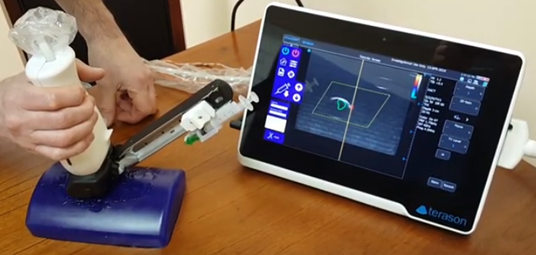
    Cincinnati Children’s Hospital has a research partnership with Ben Gurion University in Israel. While in Israel judging a competition, Dr. von Allmen met Hugo Guterman, an electrical and computer engineer and robotics expert with Ben Gurion University. While attending the competition , Dan shared his idea with Hugo and the two sketched it out over lunch. To their delight, the idea was funded during the conference based on the significant unmet in precision needle placement. Hugo and his research lab built the first prototype of what’s now called FIND—Fast Intelligent Needle Delivery—a robotic ultrasound transducer that automates ultrasound-guided needle placement in the body.

    BP: How did you get involved?
    AC: Cincinnati Children’s Hospital was excited about the FIND platform and reached out to me to explore commercialization opportunities. My advice to them was that a startup would be needed to ensure that the technology was fully developed and pediatric patients could benefit from it. Xact Medical was launched with the help of Cincy Tech, a public-private seed stage investor that provides a variety of resources and funding to life sciences and tech startups. In 2016, we (Cincinnati Children’s Cincytech, Ben Gurion, and me) co-founded Xact Medical and I was named CEO based on my 25 years of experience in medtech management and a shared passion for the FIND Platform and the mission to advance new technologies in the underserved pediatric patient population.

    Xact Medical CEO Andrew Cothrel

    BP: Talk to me about central vascular access. Why build a company around it?
    AC: Believe it or not, there are over five million central vascular access “sticks” performed each year, and millions more for peripheral vascular access. These aren’t simply needle sticks; central vascular access (usually in the jugular, femoral or subclavian veins or arteries) is done to deliver chemotherapy, feed a patient, introduce an instrument, or to place a catheter. It’s serious business and requires a highly skilled clinician, typically an interventional radiologist, surgeon, or anesthesiologist. When you factor in patients who are obese, have diabetes or other conditions, are very old or very young, the process can be very time-consuming, unpredictable, frustrating and painful.

    Let me share an example. The hospital has a pediatric patient scheduled for surgery who needs central vascular access procedure performed before surgery can start. The patient is in the OR and the surgeon and the surgical team are waiting. The anesthesiologist is trying to get the A-line in (peripheral arterial catheter) and having trouble. Two hours later, he’s still working on it. Meanwhile, you’re tying up an operating room, surgeon and surgical team, and patient’s procedure is significantly prolonged, including time under anesthesia. The longer a person is under, the higher the risk, not to mention the expense, while pushing the next surgery cases for that room to another location or later in the day, all adding costs to the hospital system.

    FIND uses the principles of man-machine teaming and advanced adaptive algorithms to automate the process and enhance clinician capabilities and control so they can precisely, quickly place a needle tip at any ultrasound-imaged point in the body. This is a platform technology with many clinical applications, so the unmet need was significant enough to form Xact Medical to commercialize the technology and ultimately position for an exit.

    See FIND at VisionTech Angels June Pitch Week

    BP: Where are you in development of FIND?
    AC: We’re moving quickly. The initial proof of concept is done and we now have a fully functional prototype we’re using for market research and large animal studies, with plans for a cadaver study. Once we get sterilization processes prepared, we’ll be ready for use on humans. We plan to begin clinical testing with healthy volunteers in Q3 and then move to FDA 510(k) clearance in Q4 FIND is a class 2 medical device and we don’t anticipate any issues; the FDA considers it safer to be stuck by a robot than a human.

    We’re also focused on patents. Cincinnati Children’s Hospital and Ben Gurion University own the original patents. Xact Medical holds the exclusive global license. We’ve also submitted two provisional patents in the U.S. with another three more in the works.

    BP: What barriers to adoption do you anticipate?
    AC: Selling into hospitals. (Smiles.) Any new technology has to go through value analysis and capital request committees, which can draw out the sales cycle. In addition, behavior change is the other potential barrier as humans generally don’t like to change how they currently do things. We spent a lot of time making sure the FIND system fits seamlessly into current workflows. We also made FIND intuitive so most people are proficient in minutes. The best approach is to let physicians play with the system and then observe their reactions. They literally get giddy.

    BP: What is Xact Medical’s commercialization pathway?
    AC: Our plan is to launch nine beta sites in the first half of 2020. We’re in the process of lining up three children’s hospitals, three research hospitals and three general hospitals for the beta now. We’ll expand rapidly from there, launching in pediatrics first.

    BP: Why should VisionTech Angels invest in Xact Medical?
    AC: I’ll give you four reasons. First, the market need is rock solid; there are millions of central and peripheral vascular sticks each year that the FIND Platform can address. Second, with robotics and adaptive algorithms we can “de-skill” the workforce required to place needles as we increase safety and efficiency and reduce costs. Third, we have a leadership dream team with experts in all of our functional areas. Finally, we designed Xact Medical to be acquired and right now there are six companies that are solid exit prospects.

    To learn more about Xact Medical, visit their website. For details on VisionTech Angels’ June Pitch Week, visit our events calendar.


  • VisionTech’s Ben Pidgeon to Speak at Fort Wayne Angel Investing Event

    VisionTech’s Ben Pidgeon to Speak at Fort Wayne Angel Investing Event

    INDIANAPOLIS, Ind. (June 4, 2019) – – Next to friends and family, angel investors are often an entrepreneur’s best source of capital for a startup company. Eager to grow Indiana’s angel investor infrastructure, Elevate Ventures and and Elevate Northeast Indiana are hosting an educational session on angel investing in Fort Wayne on Tuesday, June 25. They have chosen Ben Pidgeon, executive director of VisionTech Angels, the state’s largest and most active angel investing network, as the featured speaker.

    The discussion will focus on what it means to be an angel investor, angel investing best practices, and expectations from entrepreneurs before and after the investment. The hour-long event will be held at the Pine Valley Country Club in Fort Wayne and begins at 4:30 p.m. It is intended for individuals with an interest in angel investing or who are current angel investors. Reservations are required.

    Pidgeon joined VisionTech in 2016 as the organization’s first executive director and is charged with expanding VisionTech’s role in Indiana and across the Midwest in supporting startups, innovation, commercialization, and job creation. Each year, he and his screening committee review up to 400 startup companies, selecting 12 to 15 to pitch to VisionTech’s network of 130 accredited angel investors.

    Under Pidgeon’s leadership, VisionTech Angels has expanded to six chapters: Bloomington, Fort Wayne, Indianapolis, Lafayette, Dayton, OH; and a physician-only group, AngelBOM. VisionTech’s investment portfolio stands at 29 companies, many of which are headquartered in Indiana.

    Following the educational event, guests are welcome to stay for the VisionTech’s bi-monthly Pitch week meeting, featuring startup Xact Medical. VisionTech Angels Fort Wayne Chapter President Eric Beier is the host.

    Register here for tickets.


  • Insights from an Angel Investor: Patterns and Core Values

    I technically started angel investing in 2012, but I wasn’t serious about investing until I became a managing partner of VisionTech Angels in late 2014. With roughly 120 accredited investors who review up to 15 screened investment opportunities each year and about 30 portfolio companies we’ve invested in, we have a very active, very engaged group.

    Tony Petrucciani

    In my excitement to get in the game, my initial strategy was the shotgun approach. If the company made it through VisionTech’s fairly rigorous process, I figured it was good enough for me.

    Let me back up for a minute. I began my professional career writing code for small companies in the early 1980s while a student at Ball State University. (I tell my kids that I was a nerd before nerds were cool.) There are two things it takes to be a coder: the ability to learn a new language (C++, Java, Python) and the ability to create and debug an algorithm. By the time I graduated in 1985, I had my own startup company with half a dozen customers who paid me to customize their off-the-shelf software.

    Here’s what’s interesting. I realized at the ripe age of 20, I wasn’t creating one-off, custom solutions. What I was really doing while creating software products was pattern matching. Each company I worked with, while different, had similar needs that required similar solutions. Identifying the pattern helped me reach the right solution more efficiently without reinventing the wheel.

    The Power of Patterns

    It was a pivotal moment. Once I realized this, pattern matching showed up everywhere, from the gaps and shortcomings in standard software products to patterns in vertical and micro-vertical markets. I discovered common patterns in skill sets and how they could generate career options and salary increases. I found pattern matching in people who turned out to be my best friends. Like Malcolm Gladwell’s book Blink, our brains develop pattern matching algorithms way before we decide to do almost everything in life, and for me that included writing that first line of code.

    Still, I didn’t explicitly understand my propensity for pattern matching. When I founded Single Source Systems in 1985, I was pattern matching as I interviewed potential employees, explored potential vendors/partners, and even as I participated in sales cycles with potential customers. And it worked. Over the years, I built a team of talented individuals who allowed our company to grow rapidly. Twice we landed on Inc. Magazine’s list of the 500 Fastest Growing Privately Held Companies in the United States.

    It goes without saying, but nearly 100 percent of our best employees, partners, and customers shared our company’s core values. We didn’t set out to use our core values as a measuring stick, but consciously or unconsciously aligning core values worked.

    I was further reminded of the power of pattern when I was fortunate enough to go through a failed acquisition in 2007. I say fortunate because this was a first for me. The negotiations and ultimate breakdown offered no pattern upon which I could match. Our team learned from that experience, and when a similar opportunity arose in 2011, we were better prepared to take advantage of it. A global enterprise software provider acquired Single Source Systems for a much better number than we would have gotten just four years earlier.

    Isn’t it funny how a small amount of data points can give you so much information?

    I was reflecting on this recently as I look back on the 37 different companies in which I have invested since December 2014. How would I tell what kind of companies I would like/love/hate when I looked back over the years? You guessed it. It’s all about pattern matching. But unlike the time when I was six and warned not to touch the hot iron in my parent’s workroom only to go back to touch it when no one was watching (my dad may have left it hot on purpose as I blistered my finger really well!), you don’t get immediate feedback on what to pattern match when you are in angel/seed stage investing. (By the way, the phrase, “I bet you won’t do that again” sticks with me nearly 50 years later.)

    So what have I learned over the last five years?

    Five years is long enough for me to know there are certain types of companies and/or leadership teams that I don’t mix well with, but more on that in a minute.

    Early in my career, I was lucky enough to go through the Entrepreneurship Masters Program created by Inc. Magazine, MIT and EO. The facilitator was a guy named Verne Harnish, who had a book called Mastering the Rockefeller Habits. The program taught me a great process for managing companies, especially fast growth companies.

    One of the basic tenets is to identify your company’s core values, then honestly measure everyone in the company based on these core values. If they share your core values, you find the right seat on the bus for that person. If they don’t, they likely need to get off your bus and find a bus where they fit.

    I got into angel investing with the thought that in addition to providing startup capital, I’d have a seat on the bus of the companies I invested in as a coach/mentor. Fortunately, I’ve found that many companies want me to help based on my experience—after all, I have made many, many mistakes as well as achieved great success. I do it because I love product management, problem solving and providing stories of experiences to management teams. Not so they do what I say, but so they have more data points to do their own pattern matching. So far I have participated in more than 10 board of director positions.

    Not every startup has had a seat on the bus for me. Some don’t want my opinion, advice or involvement; they just want my money. And I appreciate that data point.

    What have pattern matching and core values taught me and how has it influenced my investments?

    The short answer is a lot.

    I’ve learned to recognize and appreciate pattern matching in the companies I’m considering for investment. If the patterns are positive, I’m much more likely to invest. If the patterns I value are not there, forget about it!

    I’ve also learned that if I don’t do a thorough job checking to see if the founders of my potential investment match (or don’t match) my core values, meaning their personal and company’s core values, I’m going to be frustrated at some level. This requires me to meet with founders and understand their core values. If they don’t know their core values, I need to talk them through it. If they don’t think it’s important, I probably need to wait for the next opportunity.

    A company’s patterns and core values influence my investment decisions. This type of investing isn’t the same as just buying stock in Apple, Amazon or Walmart (although it could be). My approach requires real person-to-person work with a lot of interaction. Each founder, no matter how much they think they know, will need help many times during their process. Even if they don’t think they need help, mine or someone else’s, they probably can’t argue that help would make things easier and/or faster. Founders need to understand that investors are not working against them, but with them. This should be clear in their core values. This is how they earn my support, financial and otherwise.

    Learn more about VisionTech Angels at our website. If you would like to speak with Tony personally, contact us and we’ll make an introduction.