Tag: Pitch Week

  • VisionTech Angels’ Final February Pitch Company Is “CRäKN” to Hit the Road with Ben

    Industry experience is among the things we look for in startups that want to pitch our group. How can you offer a better solution if you haven’t experienced the problem in some manner? I recently sat down with CRäKN President and CEO Scott Mindrum who gave up the life of a CPA to enter the “death care” industry more than 20 years ago. He was, in fact, very hesitant; funerals are kind of a downer. But his wife convinced him it was O.K. Today he’s happy he did. Scott launched and successfully exited one company in this space before launching his new company, which he will be pitching during VisionTech Angels’ February Road Show. It’s a good story and even better opportunity for our investors. Here’s our conversation:

    Scott Mindrum, CEO, CRaKN

    Also, over the last 15 years, funerals have moved from being very traditional religious ceremonies to being celebrations of life with cremations rather than in-ground burials. So the expectations of families and friends of the deceased are changing, which places a bit more pressure on funeral directors to meet these evolving expectations. I have deep experience in the industry, have founded and sold a very successful business in this space, and after a few years of retirement and a little angel investing of my own, felt the time was right for a new SaaS venture.

    BP: Where did the name CRäKN come from. I envision giant octopus crawling over ships.
    SM: (Laughs) Yes, the name was inspired by the legendary kraken, a Nordic octopus-like sea monster that terrorized sailors. When we were naming the company, we wanted something memorable and meaningful. Funeral directors are, by nature, world-class jugglers. Our tools give them extra arms to get the job done. The CR and KN in our name stand for customer relationships and knowledge respectively, which are important in the death care profession. But, the name also makes funeral directors smile—the ones that envision a giant octopus—which is nice to do in this industry. Finally, the name has personal meaning for me. My father, who has passed away, was 100% Norwegian and my north star so in a way, CRäKN is my homage to him.

    Ben Pidgeon, Executive Director, VisionTech

    BP: Explain your solution.
    SM: Death care is not a glamorous business, but the people who work in the industry have a high degree of empathy and are driven to help people. It’s very much a detail-oriented business that can be overwhelming. CRäKN’s software platform makes all of the processes that go into end-of-life arrangements far easier to manage. Here are some examples. A large part of a funeral director’s day is spent pulling information from several systems and paper files. CRäKN’s single entry system eliminates duplicate administrative tasks. Call answering services can be integrated with the accounting system. Pre-need records can be converted to at-need arrangements? All with a click of a button.
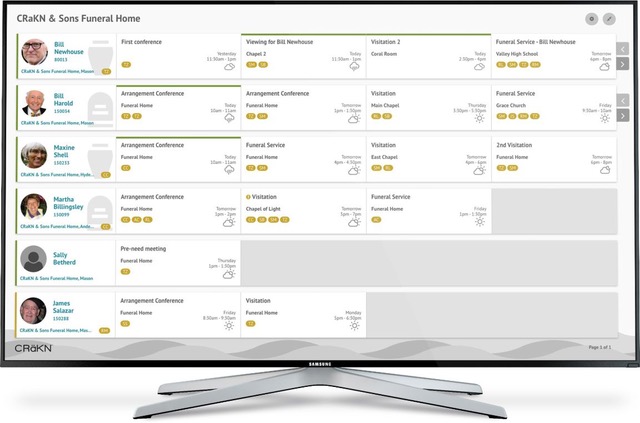
    CRäKN also allows all events to be tracked using the digital whiteboard. Funeral directors can see who is working an event and details that still need to be finalized, so the ball never gets dropped. All of this can be done from a laptop, tablet or smartphone. Funeral directors get calls at all hours so this is a big plus! We also make the compliance side of the business easy and transparent.

    BP: Do you have competitors that offer solutions comparable to yours?
    SM: We do, but other software companies catering to this market are typically not SaaS and are focused on the accounting side of the business, while CRäKN addresses the entire business from relationship management to finance and accounting and all of the important services provided by funeral homes. Our intent is to automate processes so funeral directors and their staffs can focus on the families and getting them through a challenging time.
    BP: What is your competitive advantage?
    SM: The biggest advantage is we address the enter funeral home enterprise and not just a portion of it so clients don’t have to manage and maintain multiple software licenses and vendors. And while competitors’ solutions require user training, CRäKN’s patented technology is very intuitive, easy to use and requires little or no training.

     BP: What is your revenue model?
    SM: We’re a SaaS solution, but with a twist. Instead of charging our clients by the number of users or “desks,” we offer an unlimited license and charge by the number of funerals per month. This way, any person on the funeral home staff can access the CRäKN software. This makes the monthly fee a variable, but allows us to grow with our clients or retract if their business slows. This is attractive because there is some seasonality to the death care industry; flu season and post-holidays can cause spikes. Also, cities that are either losing or gaining population like the financial flexibility.

    BP: What market traction do you have to date?
    SM: Strong. We’ve grown 1000% year-over-year since 2018. Our client base is a good cross section of the industry, ranging from very small funeral homes to very large, multi-location and publicly traded businesses.

    BP: How much money are you raising and what will the funds be used for?
    SM: The target is $800,000. This is a syndication deal through Queen City Angels. They’ve done due diligence and have already funded $300,000. In addition to VisionTech Angels, we’re talking with two other angel groups and hope to close the round with angels rather than VCs or private equity groups. We plan to use the funds to accelerate our national rollout.

    BP: Why should VisionTech Angels invest in CRäKN?
    SM: You may not know this, but Indiana is the world’s headquarters for casket manufacturing and a major state for investing in funeral startups. Aside from that, CRäKN has a number of things going for us that should be attractive to investors. Our technology is state-of-the-art. Collectively, our team has been in the death care industry for 100-plus years so our relationships and contacts are deep. Lastly, our terms are friendly to angel investors.

    To learn more about CRäKN visit their website. To RSVP for the VisionTech Angels’ February Road Show, visit our events calendar. Accredited investors interested in learning more about joining our group should contact Ben Pidgeon, bpidgeon@visiontech-partners.com.

     

  • Qumulex Has a Strategy – and the Leadership – to Move the Physical Security Industry to the Cloud

    Never underestimate the value of an experienced leadership team. Fishers, Indiana-based Qumulex has this in spades. The seven founders have all worked together in the commercial physical security industry and have successfully launched and exited two companies before founding their new endeavor in September 2018. I recently sat down with Qumulex President Dan Rittman who will be presenting during our February Road Show on its strategy of moving this legacy system industry to the cloud. Here’s our conversation:

    Ben Pidgeon, Executive Director, VisionTech

    BP: What are the trends within the commercial video surveillance/access control space?
    DR: Cyber security dominates conversations today yet physical security is a huge concern. Every time there’s a school shooting, a breach at a military installation or an intruder at a workplace, the first thing people ask is, what could we have done differently? Physical security systems, specifically those that are video-based, have undergone major technology shifts. Today, there’s a push to move away from on-premise equipment to cloud-based solutions. The commercial security industry is among the last to move to the cloud even though benefits are significant. Given the role of video and point-of-entry security in identifying, responding to and managing threats in real time and often in concert with law enforcement, the time for industry disruptors is now.

    BP: Explain the Qumulex solution.
    DR: Qumulex offers a cloud-based, mobile-first, unified access control and video surveillance solution for physical security integrators that serve commercial markets. We’re unique in that our mission is to provide integrators with a transition path for customers to embrace cloud technology and mobile accessibility and a subscription-based business model without an integrator having to turn their back completely on the legacy approach based on existing technology and transactional revenue. As this transition happens, Qumulex’ product line will support any mix of systems from on-premises to the cloud. The system is designed to be cloud-agnostic, but will launch with the Google cloud.

    Dan Rittman, President, Qumulex

    BP: Do you have competitors that offer solutions comparable to Qumulex?
    DR: Legacy solution providers control 95% of the market and they are the “comfort zone” for many potential Qumulex integrators and end users. Cloud competitors include Verkada, a Silicon Valley startup that raised an $80 million Series C with a $1.6 billion valuation in late January 2020, and more established companies like Eagle Eye Networks that has solid customers – McDonalds, Shell and Volvo – but has failed to achieve significant market traction.

    BP: What is your competitive advantage?
    DR: The biggest one is the experience and connections of our seven founders within the physical security integration industry. Even though Qumulex is new, the leadership team is a known and trusted in the space. The second advantage is that we’ve designed our product so transitions from legacy systems to the cloud are easier and more manageable. Our hybrid model allows customers to be both on premise and on the cloud. In our demos, people love this approach because end users get the accessibility, redundancy, and mobility benefits of video on the cloud without having to entirely replace a legacy system.

    BP: Who is your ideal customer and what market traction do you have to date?
    D
    R: Every school, hospital, university, military installation, retail/hospitality, office or manufacturing plant is an ideal customer. That said, Qumulex is a channel marketer; we sell directly to physical security integrators who sell to end-users. There are about 10,000 security integrators in North America that range from single person shops to major global integrators. Our ideal customer is in the middle; integrators that currently sell our type of product and at our price point.

    In terms of traction, there is tremendous pent-up demand. We hosted a suite at ISC West last April, which is the largest physical security show in North America. Over the course of two-and-a-half days, we had 91 booked appointments with integrators. We’ve been to other, smaller shows with the same high interest level. We currently have beta tests in progress and plan to launch in late Q2. There’s a lot of anticipation. So far, we’ve signed 11 sales rep firms to cover the United States.

     BP: What are the barriers to adoption?
    DR: The commercial security industry, like others comfortable with legacy systems, is slow to move. People tend to go with what they know so there’s an education process involved. What has really helped us is the rapid adoption of cloud-based consumer solutions like Ring smart home security. People have seen it, used it, and want that type of convenience and accessibility for their business security systems.

    There’s another market pressure working in our favor. The integrator market is consolidating, with larger companies acquiring the little guys. However, acquirers are interested in those with at least 20% in recurring revenue. Most don’t know how to move from a transactional business model to monthly recurring revenue. We can get them there so they are a more attractive acquisition target, but also better positioned should they prefer to remain independent.

    BP: What is your revenue model?
    DR: The commercial security industry is a traditional transactional business so our revenue model is both transactional and SaaS. We sell equipment for on-premise systems, but our main focus is recurring revenue from our software.

    Qumulex Team

    BP: How much money are you raising and what will the funds be used for?
    DR: Our current raise is a Series Seed 2 with the goal of raising $2 million. This will take us to our commercial launch in late Q2, and then through a year of commercial activity before a Series A round. It will supplement a significant investment made by the founders and an earlier seed round.

    BP: Why should VisionTech Angels invest in Qumulex?
    DR: I really have to go back to our leadership team: we know what we’re doing. All of us have been in the industry for 20-plus years and know the market well. We also understand startups, having founded and exited two companies to date: Integral Technologies, which we exited in 2000 for $50 million, and Exacq Technologies, exited in 2015 to Tyco for $150 million. We believe the commercial security market has reached a technology inflection point and Qumulex is positioned to disrupt, but equally important, provide a practical bridge from legacy systems to the cloud that makes adoption easier.

    To learn more about Qumulex, visit their website. To RSVP for the VisionTech Angels’ February Road Show, visit our events calendar. Accredited investors interested in learning more about joining our group should contact Ben Pidgeon, bpidgeon@visiontech-partners.com.


  • VisionTech Angels Kick Off the 2020 Investment Season with Materials Handling AI and Robotics Disrupter, SIERA.AI

    I’ve come to believe that with startups, timing is everything. It’s particularly true in the case of SIERA.AI, an Austin-based company that has created and is now commercializing autonomy software solutions for materials handling in the manufacturing and logistics industries. Though SIERA.AI is a young company, they’re building an impressive book of business with Fortune 500 companies. I recently sat down with SIERA.AI CEO Saurav Agarwal who will be presenting during our February Road Show, on just how well his company’s positioned for the market and the opportunities this affords. Here’s our conversation.

    Ben Pidgeon, Executive Director, VisionTech

    BP: What are the trends within the materials handling space that made you believe you could solve the industry’s challenges?
    SA: In short, it’s explosive growth and the growing pains that have come with it. Over the last five years, there’s been a boom in the logistics industry, due in part to the transformation that’s taken place in the retail industry. These numbers are a bit dated, but from 2014 to 2016, 833 million square feet of warehouse space came online in the U.S. alone. You can look at Indiana’s I-65 corridor and see expansion is still occurring.

    In response, manufacturing and logistics companies are adding about a million forklifts to their operations each year. At the same time, there’s a shortage of 43,000 certified operators. It’s not an easy job. Drivers  operate 10,000-pound machines in tight spaces. There’s no room for error. Sometimes drivers get careless. According to OSHA, there are 96,000 forklift-related accidents a year, with losses of upwards of $9.5 billion a year and lost wages of $3o billion. And that’s just the U.S. The opportunity for disruption was obvious.

    Saurav Agarwal, CEO, SIERA.AI

    BP: Explain your solutions.
    SA: SIERA.AI builds autonomy software for forklifts. We have two primary offerings: a basic version, for accident prevention, and a pro version, for full automation. The SIERA Safety System (S3) is added to existing driver-operated forklifts to sense and prevent accidents before they happen. The system constantly tracks driver behavior and streams real-time data to the cloud for deep analytics. The monitoring has a distinct impact on driver behavior and that coupled with S3’s ability to prevent accidents has a profound impact on safety, productivity and loss due to accidents. Driven by SIERA.AI is our autonomous mobile robot technology; forklift robots if you will. The robots map and navigate in the customer’s facility on their own, interface using Wi-Fi with the MES/ERP systems and industrial controls, and get the job done safely and reliably. Both options can be added to existing forklift fleets or can be licensed by OEMs.

    BP: What’s your revenue model? Is it an initial purchase and then monthly licensing?
    SA: Yes, there are unit sales and annual recurring revenue from licensing our software.

    BP: What market traction do you have to date?
    SA: We have five active pilots, two flagship clients converting to full adoption, and over $6 million in deals we’re currently negotiating. One of our clients is Tyson Foods; our SIERA.AI Safety Solution is in their beef processing plant in Dakota City, South Dakota. One of their biggest problems is forklift manufacturers don’t include safety technology, and they wanted to eliminate accidents. In their pilot, which took place over three months, more than 5,000 miles were driven with no accidents or near misses. Management also noted a significant change – for the better – in driver behavior. Tyson Foods has 8,000 forklifts in its fleet and could potentially license 3,000 of them with SIERA-AI, a nice amount of recurring revenue.

    BP: What are the barriers to adoption?
    SA: With the labor shortage and high cost of accidents and lost wages, the SIERA Safety System and our autonomous robots are both very attractive to companies that need to move goods safely and avoid costs. The beauty of SIERA.AI’s solutions is companies can use both the enhanced safety solution and robotics side-by-side for human-robot collaboration.

    BP: What’s your competitive advantage?
    SA: First, we have a great product market fit; SIERA.AI has the only available forklift brand agnostic safety and automation product on the market. Second is our speed to market and accelerating traction. Finally, our solutions will be well protected. We’ve filed four utility patents and four provisional patents and hope to finalize those by Q1 2021.

    BP: How much money are you raising and what will the funds be used for?
    SA: We’re currently raising a bridge round of $500,000-600,000 and have $175,000 in soft commitments. The capital will be used to fulfill current orders – we’ve signed orders (recurring revenue, 5-year contracts) worth $400,000 in mid-January. We also need to hire an additional engineer, deployment manager, and sales and marketing team members so we continue to grow.

    BP: Why should VisionTech Angels invest in SIERA.AI?
    SA: The most compelling reason to invest is the market wants our solution; we’re solving huge industry problems. We’ve booked significant sales and our pipeline includes Fortune 500 companies that recognize our value. We’ve come extremely far in two years with very little capital and with VisionTech Angels’ investment, we can move that much faster.

    To learn more about SIERA.AI visit their website. To RSVP for the VisionTech Angels’ February Road Show, visit our events calendar. Accredited investors interested in learning more about joining our group should contact Ben Pidgeon, bpidgeon@visiontech-partners.com.

  • Realplay Completes VisionTech Angels’ August Pitch Week and It’s a Homerun!

    VisionTech Angels’ Executive Director Ben Pidgeon recently sat down with Justin Real, CEO of Realplay and former collegiate baseball player, to discuss how the Massachusetts-based startup is transforming how youth baseball and softball are , shared and experienced. It’s a unique play with great market potential. Anyone with a child or grandchild who plays sports will be interested in this pitch. Justin will present Realplay during VisionTech’s upcoming Pitch Week, August 26-29. Read on!

    Ben Pidgeon, Executive Director, VisionTech

    BP: This is the first time VisionTech Angels has hosted a sports-focused startup for Pitch Week. How did you get into the game?
    JR: I originally got into baseball in Little League, worked my way through the high school recruiting process and ended my career playing catcher for four year at Union College. After college, I worked as consultant in the tech industry for four years and continued to work as a private hitting coach. While getting my MBA at Babson College, I found an opportunity to get back into the sport I love from a business perspective. It’s a lucrative market—as the most popular U.S. sport, amateur baseball and softball combined represents a $4 billion market. People play for fun, recreation, or dream of playing at the collegiate and professional levels. There are a lot of memories made on ball fields.

    I saw how the sport and the world at large were using video and saw an opportunity to change how video is captured, edited, shared, and used. In 2016, I founded Realplay and pulled together an all-star team that includes Andreas Randow (CTO), who has worked in the startup ecosystem for 15 years and is an expert in computer vision and systems infrastructure; Michael Salerno (VP of Product), who was with Oracle; and Brian Porter (Director of Operations), who spent 15 years working in Major League Baseball. His final project was consolidating and upgrading the video systems of all minor league teams. We’re now in the market and working hard!

    BP: What problem are you solving?
    JR: People love video, particularly in the sports world. Parents want video of their kids to capture the moment and share with friends and family. Coaches want video to analyze their players and improve skills. Scouts use video to check out prospects and reduce travel. And the players, they love seeing themselves on video. So what are the options? Use a smart phone and do it yourself? Hire a videographer for thousands of dollars or travel across the country showcasing your kid’s talent at expensive camps and showcases? Neither is ideal. And this doesn’t even include the time and labor involved with editing and sharing player videos with everyone who wants them.

    Realplay eliminates the need for parents, coaches, scouts, and whomever to be videographers, editors, producers, organizers, or publishers. We deliver video of every swing, pitch, and catch that any player on makes on a baseball or softball field. And we do it by automating the capture, editing, analysis, and distribution of player video. This allows everyone to focus on the game and have fun—which is what baseball and softball are about.

    BP: Sounds cool. How does it work?
    JR: There are three key components: the camera system, machine learning software and a multi-channel platform. Here’s how they work together to make Realplay cover all the bases. Each ball field is equipped with three cameras that operate through an app. The app also serves as an e-scorebook, capturing stats throughout the game. At the end of the game, the video is uploaded to the cloud where it’s processed by our machine learning software into single player clips and stats. This information is uploaded to player profiles. The final piece is the multi-channel platform with pages for players, parents and teams. There’s also a social media integration component to make sharing easy. We’ve taken a process that used to require nine man hours of work per game, and reduced it to seven minutes.

    BP: What’s Realplay’s revenue model?
    JR: First, there’s no charge to the field owner or sports complex; Realplay is a free service with a revenue share. Our revenue comes from player and team subscriptions. To get people started, we offer a freemium subscription that includes three free videos that can be viewed on a player’s page we create for them. The basic subscription includes all of a player’s videos uploaded to their page with stats, on-video annotation and a few other features. The premium subscription includes an end-of-season highlight reel, virtual coaching portal, college recruitment prep, and premium social sharing features.

    We partner with the existing organizers of the game to ensure high volume wherever we go. Subscriptions can be offered through teams as part of their annual fees or made available through specific tournaments or events by facilities and tournament organizers. Even if it’s just an online purchase, It’s a nice addition for players, families and coaches!

     BP: Who is the ideal customer for Realplay?
    JR: Any family with a kid playing baseball or softball. Our immediate focus and ideal target is multi-field sports complexes that can have anywhere from two to 50-plus fields for youth and adult leagues. For example, in Westfield, Indiana, there’s a privately owned complex with 57 fields. In 2018, it had 1.9 million visitors. Currently, there are 550 similar facilities with a total of 3,500 fields. Each facility can see upwards of 125,000 players a year.

     BP: What’s your pipeline look like now and what are you doing to fill it up?
    JR: In 2019, we’ve secured two contracts and one letter of intent for just under $1 million in annual recurring revenue. We have two other facility prospects in the pipeline. We’re aggressively targeting sports facilities, tournament organizers, and multi-team programs like Little League, AAU, Cal Ripkin Baseball, and others.

     BP: There are others doing this. What is Realplay’s competitive advantage?
    JR: Yes, there are several competitors with Hudl being the most entrenched. They’ve been on the market since 2006 and their technology is out of date. Realplay has four things going for us. First, we are free to the sports facility with the revenue sharing component; all of our competitors charge for their service.

    Second, our technology is superior; our automation moves the responsibility of creating videos from people to the machines. Third, we’re entirely focused on baseball/softball and aim to be the standard at premium facilities; everyone else is focusing on team-field sports like soccer and football. Finally, as the first mover in this space, our position gets more entrenched with each new facility we sign.

    BP: Why should VisionTech Angels invest in Realplay?
    JR: The market potential is huge. Baseball and softball have 36.5 million participants, many who’d love to have video. We’ve already raised the majority of our seed round and are looking to use the funding to secure more contracts for 2020, and start the process of raising our next round at a higher valuation. Realplay is a low technology risk, fast to production and results, with low cap intensity. We’re gaining traction and we love baseball.

    To learn more about Realplay, visit their website. To RSVP for VisionTech Angels’ August Pitch Week, visit our events calendar.


  • February Pitch Week Preview: Glutenostics Redefines Celiac Disease Diagnostics and Monitoring

    Ben Pidgeon, VisionTech

    VisionTech Angels’ Executive Director Ben Pidgeon recently sat down with David Winternheimer, co-founder and CEO of Glutenostics, to learn more about how his company is redefining how those with celiac are diagnosed and manage their disease. David will be presenting Glutenostics during our first Pitch Week of 2019, February 25-28.

    BP: What is the current state of celiac disease in the U.S. and how is it diagnosed?
    DW: Celiac disease is a serious autoimmune disease triggered by ingesting gluten that damages the villi of the small intestine and interferes with absorption of nutrients from food. More than 1% of the U.S. population—about 3.5 million people—have celiac disease. Of those individuals, 85% have yet to be diagnosed. As many as 10% of the population are gluten intolerant and have painful symptoms after eating products containing wheat, barley or rye. The standard test for diagnosing celiac disease involves an endoscopy and biopsy and requires eating gluten daily for four to six weeks before the procedure. Many patients seeking diagnosis are already gluten-free, so this ‘gluten challenge’ is a major barrier to diagnosis. Our new blood test circumvents the need to eat gluten in order to get a diagnosis, and is much easier than a biopsy. Additionally, there has been no way to monitor compliance with a gluten-free diet.

    David Winternheimer, Glutenostics

    It’s also worth noting that access to diagnostics and ongoing care for this condition is highly lacking. Family doctors and internists don’t do biopsies to diagnose celiac disease and gastroenterologists don’t have a way to diagnose patients who are gluten free and refuse to reintroduce gluten into their diet. There are; however, about 1,200 celiac physicians in the United States and about 200 celiac clinics nationwide. Glutenostics’ technologies were developed over the past decade in response to thought leaders’ explicit call for better tools to diagnose and manage the disease.

    BP: What solutions does Glutenostics offer?
    DW: Glutenostics was founded in 2016 with the mission of bringing new technologies to market that improve the diagnosis, monitoring, and quality of life of those with celiac disease and gluten intolerance. In 2017, we launched our first product line, Gluten Detective, a rapid at-home urine and stool monitoring test, that’s much like a pregnancy test, to measure compliance with a gluten-free diet.

    We’re now preparing to launch our lab tests, including a blood flow cytometry test for diagnosing celiac disease that involves a proprietary HLA gluten tetramer reagent and doesn’t require the eating gluten prior to the test. We also plan to launch a lab version of the urine/stool test for diet monitoring as well for physicians to order We’re working with multiple collaborators nationwide at major institutions to drive the adoption of both of these technologies into the official celiac clinical guidelines. The Harvard celiac program continues to be our biggest advocates.

    BP: Is this technology you developed or licensed? Is it patent protected?
    DW: Glutenostics has exclusive licensing rights for both the blood diagnostic and urine/stool monitoring tests in the U.S. and Canada. The blood test comes from Ludvig Sollid’s lab at the University of Oslo, Norway, a world-renowned immunology lab that is well respected among the celiac community. The urine and stool tests comes from Biomedal of Seville, Spain, whose CEO is also a co-founding member of Glutenostics and credited with developing the world’s second most commonly used test for assessing gluten content in foodstuffs.

    BP: What are the regulatory and reimbursement requirements?
    DW: As lab developed tests, the FDA does not regulate tests such as our flow cytometry and at-home rapid tests. CMS currently reimburses similar blood tests at a rate of about $400 and private payers reimburse at around $1,000, which is a third of the cost of a biopsy, hence the appeal to payers. We don’t yet have reimbursement rates yet for the at-home rapid test, but we’re working on that.

    BP: Does Glutenostics have an Indiana connection?
    DW: I’m a native of Evansville and our CLIA lab partner, Xeno Diagnostics, is located in Indianapolis, where we’re in the process of establishing our blood diagnostic test as a CLIA Lab Developed Test. Immediately after closing this round of financing, we will move our distribution center for the at-home kits to Indy as well as establish our physical headquarters office here, too.

    BP: What kind of patient advocacy support do you have?
    DW: The celiac community is extremely enthusiastic and supportive about what we’re doing. We have partnerships with Beyond Celiac and the Celiac Disease Foundation, which are both trusted U.S. non-profit groups for celiac disease. By partnering with these organizations, we will work to educate the celiac community about our diagnostic test and at-home testing product, Gluten Detective. We also have the support of all major celiac centers and key opinion leaders nationwide.

    BP: Do you have customers and are you generating revenue?
    DW: We are currently generating revenue from our direct-to-consumer at-home monitoring test, Gluten Detective. We have a clear plan to drive future sales and clinical adoption of our new tests.

    BP: Looking forward to your pitch!
    DW: We’re looking forward to the road show!

    To learn more about Glutenostics, visit their website. For details on VisionTech Angels’ February Pitch Week, visit our events calendar.

  • PPC Pro and Hero Conference Founder Is Also VisionTech Angels’ PPC Expert

    VisionTech Angels’ bi-monthly pitch weeks have a stealth expert in the audience listening to startup companies present their case for funding.

    He listens with neutral interest. But when a presenter starts talking about pay per click (PPC) or digital advertising, he leans forward, expression suddenly serious, intent on the speaker. He holds his thoughts until the presenter leaves the room. His insight is invaluable to other VisionTech Angels considering investing in early growth companies.

    The stealth expert is Pat East, president of VisionTech Angels’ Bloomington chapter and also founder of one of the nation’s top five PPC marketing agencies and its top industry event, the Hero Conference. He started his company when the digital marketing industry was in its infancy. Now Pat and his colleagues at Hanapin Marketing advise a client base that includes The Home Depot, The Weather Channel, Uggs, Shoe Carnival, and Purdue University.

    One of Pat’s hot buttons during pitch week is how presenters often overestimate how easy PPC advertising is and how effective it will be. This from a person whose strategy helped Icelandair increase its flight bookings by 80 percent.

    “When I hear a presenter say they got an estimate from an agency and this is how many leads they will generate when they get funding, it’s a red flag. You don’t just turn on pay per click and your business takes off,” says Pat. “There’s a tremendous amount of research, messaging, testing, retesting, and analysis that makes a PPC campaign work.”

    On the flip side, Pat’s surprised to hear companies say they’re not using PPC, retargeting website visitors and converting them into leads. “It’s the best way to generate leads and reduce the costs associated with lead generation.”

    He should know. In 2000 when he was working for another company, he started dabbling in PPC before Google was GOOGLE. At his suggestion, his boss bought a single keyword and soon the company had quintupled its leads for a fraction of the cost. The company saw its sales grow from $6 million a year to $20 million. In 2004, Pat opened Hanapin Marketing; his former boss was his first client.

    Since then, Pat and Hanapin Marketing have become one of the industry’s most gracious ambassadors. In addition to freely sharing their expertise and knowledge through blogs and webinars, they sponsor the Hero Conference, the world’s largest PPC conference series. This year the events are in Austin (April 16-18) and London (October 22-24). Attendees come from around the world to learn the latest in PPC and digital advertising from innovators and thought leaders from Google, Bing, Facebook, Twitter, Pinterest, and more.

    Pat’s other passion is angel investing. He joined VisionTech Angels in 2014 because of a desire to support entrepreneurs in Bloomington and across Indiana. VisionTech Angels Executive Director Ben Pidgeon says having Pat as a chapter president and resident PPC expert is beneficial to his fellow investors, pitch companies and portfolio companies (those receiving VisionTech Angels investments).

    “With so many companies relying on digital advertising to drive sales, we are fortunate to have an industry pioneer like Pat. His knowledge base is invaluable when we’re evaluating investment opportunities or providing advice to our portfolio companies,” said Ben. “The more informed our members are, the better our investment decisions.”

    Would you like to know more about using pay per click advertising to launch or grow your start-up company or existing business? Or, are you an angel investor who wants to amp up your knowledge base? Hanapin Marketing’s next Hero Conference is April 16-18 in Austin, Texas. Learn more and register here.

    Editor’s Note: One VisionTech Angel is attending Hero Conference in April. Stay tuned!