There’s no doubt that 16 Tech is THE address for those in the Indianapolis innovation ecosystem. 16 Tech is an urban innovation district being developed in the historic Riverside neighborhood and within the Indiana Avenue Cultural District on the northwestern edge of downtown Indianapolis. It’s where innovators and entrepreneurs in the fields of life sciences, technology, advanced manufacturing, and engineering are coming together to leverage their skill sets, draw inspiration from the region’s top-ranking research universities and global corporations, and channel their combined creative energy to plant the seeds for Central Indiana’s future economic growth.
Given the energy at 16 Tech, it makes sense that VisionTech, which has one of the most active angel investing networks in the Midwest and an investment portfolio pushing 50 companies, should be in the center of things.
As of March 31, VisionTech has a new home and address in 16 Tech at 1220 Waterway Boulevard, Suite H108, Indianapolis, IN 46202.
While much of the last year has been virtual, we look forward to enjoying our new physical location in 16 Tech and collaborating with others with a passion for innovation, developing new tech, supporting entrepreneurs, and growing companies.
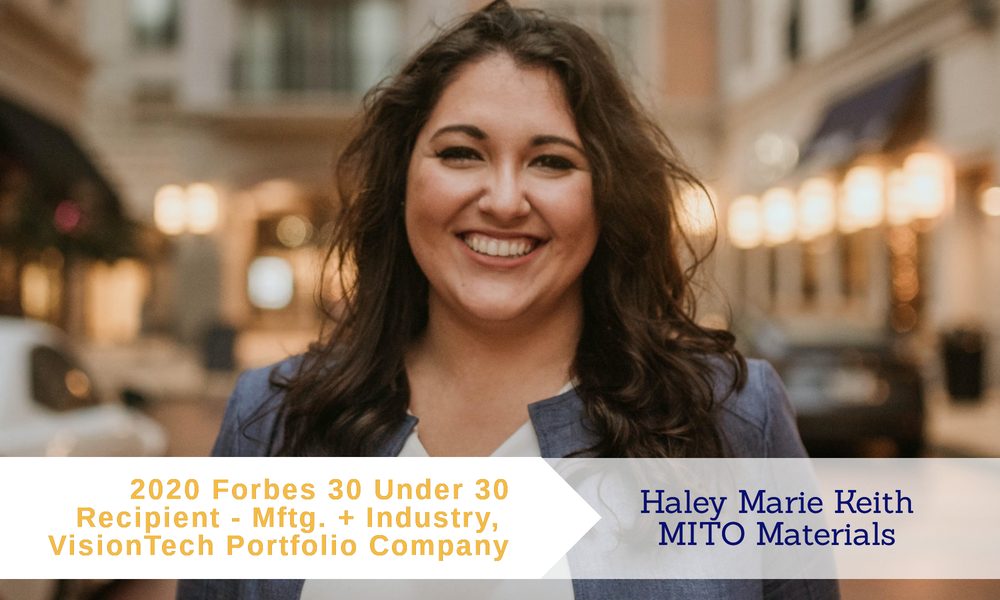
Haley Marie Keith, CEO and co-founder of MITO Material Solutions, knew she and her co-founder Kevin Keith were on to something with their advanced hybrid polymer modifiers. But startups in manufacturing and materials science often face an uphill climb when looking for funding. You see, there are plenty of investors who understand apps and SaaS, but few who really understand more traditional hard tech.
As with everything else in her life, Haley employed her own due diligence when looking for potential investors. When the the company relocated to Indianapolis in 2019, she started putting feelers out in the Indiana venture community. One name kept coming up in her conversations: VisionTech.
“I had heard good things about VisionTech as being one of the more active groups Indiana. I was impressed that Indiana had such a connected and well-organized angel group. I was also impressed with the fact that VisionTech had invested in hard science before and they weren’t afraid of it. That made me eager to pitch to the group.”
Haley Marie Keith, CEO + Co-founder MITO Materials
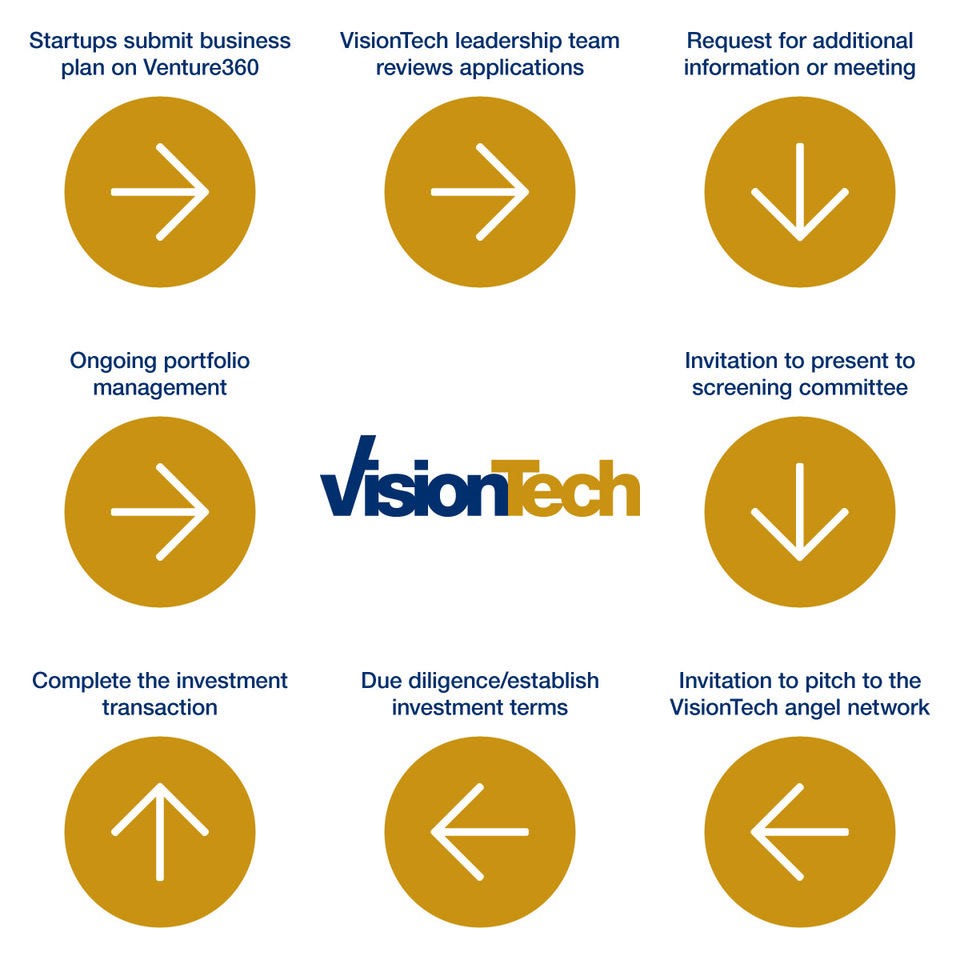
When she reached out to VisionTech Executive Director Ben Pidgeon, the two realized they’d already met at the Angel Capital Association meeting in 2017. After the re-introduction, Ben invited Haley Marie to present to VisionTech’s Screening Committee for a chance to present to the group’s 120-member strong angel investor network.
A highly competitive selection process
And so began MITO Material’s journey through VisionTech’s rigorous road to becoming a portfolio company with one of the Midwest’s most active, hands-on angel investing groups. Each year, the VisionTech leadership team receives some 400 inquiries from startups looking for funding. Of these, 80 are invited to meet virtually with the Screening Committee composed of experienced businesspeople-members, which does a preliminary but thorough assessment of a company’s investment potential. Only 12 to 16 startups a year make it to the final round and an invitation to pitch to VisionTech Angels during the group’s bi-monthly investor events.
Haley and MITO Materials made the cut; she was invited to pitch in April 2020. But instead of the group’s typical five-city, two-state barnstorm of live pitch events, Haley was one of the original “virtual” pitch presenters when VisionTech moved its investor events online when the global pandemic broke. That created a new level of pressure, but Haley received additional one-on-one coaching from Ben as a result.
VisionTech Managing Director Tony Petrucciani says the group has honed its screening process over the last decade to emphasize quality over quantity. “We balance a rigorous process to meet two objectives. First, provide the best opportunities for our investors and second, provide feedback to founders seeking capital so they can put their best foot forward with our group and others that may follow. It’s mutually beneficial.”
Fair, organized and thorough
Haley describes her experience with VisionTech’s screening process as “incredibly fair and organized.”
“It felt like a conversation with members of the group who A) had experience and interest in my technology and end markets and B) asked logical, thoughtful, and thought-provoking questions in a way that didn’t seem like they were seeking for their version of the ‘right’ answer,” Haley recalls. “This happened to me in other angel groups and it was exhausting. I also appreciated that VisionTech Angels were more apt to hop on a call if they had a question rather than ask me to make more materials to illustrate a point.”
With VisionTech Angels, each investor makes their own decision on which deals to participate in and how much to invest. For this reason, members are encouraged to question startup CEOs during the pitch events and take part in due diligence of the companies that advance in the process.
“The investment process is exciting because our investors really get to know founders after a level of investment interest has been determined. We have weekly meetings with the founders with the theme of ‘trust but verify’ which helps our investors identify the key risks—what needs to be believed—and the opportunities. It’s insightful for investors, but also for the entrepreneurs as they get to know our investors and their expertise.”
Ben Pidgeon, Executive Director, VisionTech
A mutually beneficial process
Haley experienced this firsthand when the screening committee wanted a deeper dive into MITO Material’s customer pipeline. A VisionTech investor offered to speak with MITO Material’s head of business development. “They’re both from Brazil and had a great conversation in Portuguese about our pipeline, strategy, and how our team functioned under married founder leadership, which was an appropriate thing to investigate as an investor. I think in many ways that sealed the deal for me because it made my team feel like they were a part of the funding success and that our investors are invested in helping them succeed as well.”
MITO Materials came through due diligence and negotiation of investment terms with flying colors; VisionTech Angels joined other investment groups in an oversubscribed $1 million seed round.
It’s important to note that VisionTech’s process does not end with a check to the now portfolio company. The group and its collective experience across industries remains actively involved with its portfolio companies, providing as needed:
Referrals to other investor groups
Follow-on investments
Technology and business plan evaluation
Strategic planning
Marketing support
Financial controls and reporting
Interim executive management
Key management interviews
Critical vendor selection
Business continuity planning
Haley is grateful for the relationship and access it affords to people who can help advance MITO Materials. “If there is ever something I think Ben can help me with, I don’t hesitate to ask. Ben is very supportive and approachable. I also pulled on some other VisionTech investors when I need connections or help and they have always come through.”
She adds, “It was definitely worth the effort to become a VisionTech portfolio company.”
VisionTech invites startups in need of capital to visit our website for details on our screening and due diligence process. If you believe you are a good fit, we encourage you to submit your business plan for review. Also, take a look at our portfolio companies and our calendar of events for this year’s pitch events. We hope to hear from you.
Michael Bloomberg once explained farming in this tongue-in-cheek way: “You dig a hole, you put a seed in, you put dirt on top, add water, up comes the corn.” Even I, a city guy, know that farming is a lot more complicated than that. In fact, agtech is among the hottest and arguably sophisticated tech sectors today. That’s why I’m excited to introduce our first October Pitch Week presenter, Jon Jackson, president of Global Neighbor Inc. (GNI). His company may be on the verge of transforming how farmers around the world control a growing problem, herbicide-resistant weeds, using a green technology called Directed Energy to kill weeds and their seeds rather than chemical-based herbicides. GNI has secured $3 million in support from the U.S. Department of Defense and the USDA and captured the attention of farmers. Here’s a preview of the investment opportunity Jon will share in detail at VisionTech Angels’Pitch Events later this month. Enjoy!
Ben Pidgeon, executive Director, VisionTech Angels
BP: How did you get interested in agtech? JJ: I have to credit my parents. At 14, they let me farm five acres on the family farm and keep the money from the crop sales. I planted soybeans, sold my harvest, made some money—and wrestled with weeds. Later, I saw my brother’s epic struggle with weed control as he was raising organic soybeans for export to Japan. This “tribal knowledge” coupled with being an engineer, ultimately led to Global Neighbor Inc. (GNI) and helps tremendously when I talk with the farm community about our technology.
BP: You also have a connection with VisionTech Angels. JJ: I do. GNI is headquartered in the Dayton area and we’ve worked with TEC Dayton, which hosts a VisionTech Angels chapter, on multiple projects such as filing our international patents. TEC has also supported us with mentors, who suggested VisionTech Angels should be at the top of our list.
BP: Explain GNI and the problem you’re solving. JJ: Agricultural around the world is at a crossroads in terms of feeding the world and doing so in a sustainable manner. One answer is regenerative agriculture which is a conservation and rehabilitation approach to food and farming systems. Currently, the industry relies heavily on chemical herbicides and insecticides, which can have devastating consequences for the environment and public health. At the same time, weeds are becoming increasingly resistant to chemical herbicides. This increases weeding costs, reduces farmer yields and profits, and exacerbates the excessive use of herbicides that contributes to soil degradation and also the incidence of non-Hodgkin’s lymphoma. Farmers using combines to harvest crops make the problem worse as combines collect and distribute weed seeds back into the field, increasing weeds in following years.
“Weed-related crop losses are a huge issue. Without weed control measures, U.S. and Canadian corn and soybean farmers would see estimated yield losses near 50 percent, losing $43 billion annually. That’s why farmers spend billions annually on weed control measures.“
Jon Jackson, President, Global Neighbor
Our vision is to solve the world’s food sustainability problem with technology. We use high-intensity, multi-wavelength light sources called directed energy to control weeds. This technology has the potential to be deployed at scale economically. When combined with regenerative agriculture techniques, we can provide a novel farming system that will allow wide adoption of sustainable ag practices and reduce dependence on chemical herbicides.
BP: What products do you have in the pipeline? JJ: Though our consumer-directed Weederase is already selling and our SmartSprayer will be out shortly, our first agtech product is the Weed Seed Destroyer (WDSD) that kills weeds at the seed stage. The WDSD addresses the challenge of herbicide-resistant weeds in grain crops, a clear and urgent pain point in terms of lower yields and loss of income. The WDSD mounts to the back of a combine and applies directed energy to basically kill the weed seeds which are in the chaff. We’ve tested the WDSD concept with many farmers, and they immediately grasp the concept and the value. We produced a video with farmers expressing their excitement about directed energy weed control. They are pretty excited! View video here.
BP: How easy will it be to commercially scale your solution? JJ: From a manufacturing perspective, scaling is straightforward. It is not a highly capital-intensive business, and the gross margins are high. Our primary market will be aftermarket sales, which involves retrofitting combines with our WDSD system, a process that takes about an hour. Our sales channel will be through the independent ag dealer network across the country. These dealers already offer similar retrofit and aftermarket technical support to farmers.
BP: What’s the status of your intellectual property? JJ: We are an early pioneer in the use of directed energy for weed control and our approach is unique. This has allowed us to craft our intellectual property to provide broad protection. We have seven issued U.S. patents and four U.S. and international patents pending.
BP: Why hasn’t anyone tried this before? JJ: Until now, sustainable ag practices like non-chemical herbicides have not been widely adopted because of how impractical they are to scale. Others are exploring the use of lasers for weed control but lasers for use in ag are technically complex and cost prohibitive. The most direct competition for weed seed control are chaff mills, which use high-speed mills to grind weed seeds. Chaff mills, although highly effective, are high price—up to $100,000. There are other issues, but chaff mills are gaining market acceptance. Our WDSD system will sell for about half the price, use approximately half the power, and will not suffer from excessive maintenance or result in system downtime.
BP: Who is your ideal customer? JJ: Our target market is small grain owner-operator family or smaller corporate farmers that own combines. These farmers care about their land, and herbicide resistant weeds reduce the value of their farmland and a farm’s profitability. There are approximately 120,000 operating combines in the United States, with approximately 100,000 of them owned by family or small corporate farmers that farm more than 500 acres of grain crops.
BP: You have the USDA’s support via an SBIR Phase I grant. What captured their interest? JJ: We are thrilled to have won an SBIR from USDA to support our WDSD development! Their interest is driven by the acceleration of global trends. First is the tremendous growth in the number of herbicide-resistant weeds in the United States and worldwide. Research out of Australia confirm that a major tool in the fight against herbicide-resistant weeds is harvest weed seed control; that is, making the weed seeds non-viable at the time of harvest. Finally, our approach of using non-chemical directed energy to control weed seeds is novel and consistent with consumer preferences and government policy trends, reflecting a tidal shift toward sustainable ag.
BP: What will this fundraising round be used for? JJ: We are raising a $375,000 seed round to leverage our USDA SBIR funding. This will be used to bring on a key engineering hire, support product development efforts including prototype and demonstration expenditures, and support initial marketing outreach and initial product sales. Our goal is to achieve a significant value inflection milestone prior to raising our next round.
BP: Why should VisionTech Angels members invest in GNI? JJ: Two reasons. First, it takes the chemical industry $300 million and 10-plus years to develop a new herbicide with a new mode of action to destroy weeds. We’ve received $3 million in non-dilutive grants and with this substantial R&D investment, we’re developing alternative weed control modes of action for substantially less money and in far less time than the chemical industry.
Second, there are many companies applying software, the internet of things, machine learning, robotics, and genomic tech to agriculture, all in attempt to disrupt the industry. Many of these attempts will fail as they are a technology searching for a market, a me-too strategy not substantially differentiated, or are burdened by substantial costs of development and deployment. We are not falling into these traps. Instead, we are integrating a proven technology, directed energy weed control, into a farmer’s normal operating practices, and leveraging existing equipment to solve real problems. We believe we have the potential to disrupt the industry and change the world.
To learn more about Global Neighbor Inc., visit their website. VisionTech Angels’ October Pitch Events include a live event on Tuesday, October 27 in Fort Wayne at the Pine Valley Country Club at 6 p.m. and a virtual pitch event on Thursday, October 29 at 6 p.m. Pitch events are open to our members and accredited investors interested in joining our group. To register, check your email for an invitation or email Ben Pidgeon at bpidgeon@visiontech-partners.com.
I recently met with CarrierHQ CEO Scott Prince, an Indianapolis-based company that focuses on optimizing small fleet insurance and payments and offers a much-needed solution to small carriers in the form of an online marketplace where they can get insurance, bring down premium costs, and enjoy a host of other add-on services that make running a small business easier and more profitable. Here’s a preview of the CarrierHQ story Scott will share in detail at VisionTech Angels’Pitch Events later this month. Enjoy!
BP: How did you learn about VisionTech Angels? SP: I’ve lived in Indianapolis since 2007 and have been on the board of The Venture Club of Indiana and other investing groups. When we started our fundraising, I mentioned it to Oscar Moralez and he referred me to VisionTech Angels.
Ben Pidgeon
BP: Explain CarrierHQ and the problems you’re solving. SP: Just like any industry, the commercial carrier industry is driven by two things, time and money. You have to get products to their destination as cheaply, safely, timely, and as profitably for yourself as possible. And you have to do it by insuring your tractor-trailer rigs. While challenging, the big carriers keep their insurance costs under control by negotiating contracts for thousands of trucks at a time. That’s not the case for small fleet owners. The biggest problem they have is getting and paying for insurance, which has doubled in the last few years, with some paying over $20,000 per truck. Compounding that is insurance companies want large premium down payments. With thin operating margins and weekly receivables, small operators find it hard to start a policy without adding the expense of premium financing and then find it difficult to pay the quarterly installments. Helping their cash outflows match up with weekly inflows can really strengthen their business.
Our solution is similar to ones being used in the personal vehicle space that combine in-vehicle telematics data with an insurance premium risk and rating algorithm to qualify and track active driver performance and reward those with safe driving practices. An example of this is State Farm’s Drive Safe and Save program. We’re applying that same approach to the commercial carrier industry. Earlier this year, we launched Fleet Advantage, the first and only usage-based insurance to the motor carrier industry in partnership with Aon and Crayhill Capital Management. Aon is a $40 billion, publicly traded, global professional services firm that sells a range of financial risk-mitigation products including insurance. Crayhill supplies us with a $150 million factoring facility we can turn dozens of times each year. By tracking driver performance and rewarding those who adopt safer driving habits, we can bring down insurance costs by as much as 50%. We provide actionable data into their drivers’ on-the-road behaviors so they can coach or make other changes.
BP: What are the other benefits? SP: We’re following the consumer model there, too. With CarrierHQ, small fleet owners can go to our online portal, get a quote, purchase their insurance, manage payments, and update their policy—all in minutes versus days or weeks. This is a huge time-saver for people juggling all of the other tasks associated with running a fleet. No more time wasted with back and forths with brokers, supplying frustrating loss data and faxing. Yes, faxing is still prevalent in the industry if you can believe it. Additionally, we offer factoring, and without going into a lot of detail here, so they pay monthly for their insurance and enjoy a no money down option. It’s very similar to automatic bill pay. It’s a huge solution for small fleets that often have problems with cash flow.
Scott Prince, CarrierHQ
BP: Is insurance your only offering? SP: No, but it is our primary focus along with payments. We offer some add-on products like Comdata OnRoad fuel and funds cards, ELDs, leasing, and business formation services, and eventually will leverage the unique data we’re collecting across the motor carrier value chain in a number of ways.
BP: Who is the ideal customer – small or large fleets? SP: Our ideal customer is the small, privately owned commercial carrier company with a fleet of less than 20 tractors. These folks tend to be very entrepreneurial, typically have a high school education, pretty good at juggling all aspects of the business, but challenged by insurance premium costs and slow cash flow. We also meet with larger fleets and aggregators in the industry that want to consolidate contractors or convert fleets to owner-operators.
BP: What do fleet owners like about CarrierHQ? SP: The biggest thing is the money we save them direct control of their big insurance cost. We’re effectively turning insurance from a fixed to a controlled variable cost. It can cost up to $20,000 a year to insure a Class A truck. Semi-tractors like this can gross over $200,000 a year, and it’s painful when 10 percent of that has to go to insurance. If they drive safely, they get an initially competitive rate that can go down by as much as 30 percent in-term. Instead of spending $15,000-20,000 per truck, they’re spending $8,000-12,000. Putting that kind of money back in their pocket makes them very happy and gives them the ability to add equipment to their fleet. Conversely, if they don’t drive safely, their rates increase. Either way they get access to data so they can instantly manage their drivers. Fleet owners also like the fact they can manage everything on the CarrierHQ portal on their smartphones. When you’re on the road like they are, that convenience is greatly appreciated.
BP: How big is the market? SP: There are a million small fleet motor carriers with 20 or fewer trucks, and many have fewer than five. In terms of the usage-based, pay-as-you-go insurance market, it’s anticipated to cross $115 billion (US) by 2026. Our initial focus is a 250,000-truck market of safer driving small fleets with annual premiums of $36 billion. We’ll expand from there.
BP: Do you have competitors? SP: No. We’re the first and only usage-based motor carrier insurance. Progressive and Great West are major players in the motor carrier market, but don’t yet have comparable products to compete with us. BP: What is your competitive advantage? SP: It’s definitely being first to market with a solution for a major business-killing pain point. Also, companies have to meet individual state requirements and be approved by state departments of insurance as well as meet federal regulations. Currently, we’re approved in 22 states with another 12 states pending. We’ll be in 47 states by the end of the year.
BP: There’s been tremendous disruption in the logistics and trucking industries due to COVID-19. How has it affected your business? SP: Like everyone else, we were closely monitoring how the pandemic would impact our business. Instead of slowing down, it has boomed. While some industry sectors have slowed, ecommerce and consumer products-related hauling is active, and smaller fleets have adjusted much more quickly to the new normal. While the larger fleets have had difficulty quickly adapting to supply chain disruptions, small fleet owners are often more flexible. And CarrierHQ is right there with them, keeping them covered and supplying them with essential, competitively priced and easy to use back-office services to help them grow.
BP: What will this fundraising round be used for? SP: Right now, we have a productive team of 13. We’ve purposefully hired people who are experienced, very good at their roles and can multi-task. As we bring on states, we’ll need to scale our team. The new funds will largely be directed toward product development, customer acquisition and marketing, and expanding our client service team.
BP: Why should VisionTech Angels invest in your company? SP: There are two reasons. What CarrierHQ is doing should be an interesting play to anyone with experience in insurance technology, fintech or transportation; they know the pain points. And frankly, we want investors who won’t stand on the sidelines, but will share their expertise. Second, the financial return could be significant. We’re very much tech-driven and tech-enabled and while we’re solving an immediate need, insurance, the data we’re collecting opens the door to more opportunities. All of this makes CarrierHQ exciting and attractive to investors.
To learn more about CarrierHQ, visit their website. VisionTech Angels’ August Pitch Events include a live event on Tuesday, August 25 in Fort Wayne at the Pine Valley Country Club at 6 pm and a virtual pitch event on Thursday, August 27 at 6 pm. Pitch events are open to our members and accredited investors interested in joining our group. To register, check your email for an invitation or email Ben Pidgeon at bpidgeon@visiontech-partners.com.
Disruptive startups have the ability to change entire industries. Think about Airbnb and how they disrupted the vacation rental industry. Or Instacart, which is changing how we shop for groceries. Rajan Kumar, founder and CEO of Ateios, our first August Pitch Event presenter, has big plans to redefine the battery industry with a technology called conformal electronics. I have to admit, I had no idea what that was before meeting Rajan. In a nutshell, it’s a battery printed on flexible material that conforms to the application’s requirements. This is the polar opposite of traditional rigid batteries that fit into products designed to accommodate their shape. Rajan’s battery technology is driven by the $6.7 billion primary market demanding thinner, lighter power sources for a wide range of electronics. Here’s a preview of the Ateios story Rajan will share in detail at VisionTech Angels’s Pitch Events later this month.
Ben Pidgeon, Executive Director, VisionTech
BP: How did you learn about VisionTech Angels? RK: I met Oscar Moralez for coffee through the TechStars Accelerator powered by The Heritage Group. After sharing the Ateios story, he suggested VisionTech Angels was a better fit given the stage of the company. So here I am.
BP: Why did you relocate Ateios from the West Coast to Indiana? RK: Actually, we’re bi-coastal. Our business team is located in San Diego to be accessible to Southern California and Silicon Valley. Our R&D and manufacturing team, including myself, relocated to Indiana to take advantage of the Battery Innovation Center (BIC), a $15 million R&D and commercialization center in southern Indiana. We had landed a significant customer and they were concerned about our ability to manufacture. The BIC could help us with scaling our manufacturing. Since we began collaborating with the BIC, we’ve improved our battery capacity by 30%.
BP: Ateios’ focus is “conformal electronics?” What exactly is this? RK: Conformal electronics includes materials, components, and devices that exhibit some degree of mechanical strain tolerance or stretchability. Traditionally, batteries used in electronics are very rigid and shaped like a cylinder or coin. The technology has not changed in more than 40 years. Here’s an example, if you wanted to integrate a heart monitor into clothing, conformable electronics make the device thinner, less bulky, more forgiving with body movement, and infinitely more wearable than a rigid device. Ateios is building paper-thin, flexible batteries that enable this.
BP: Explain Ateios and the problem you’re solving? RK: Basically, what we’ve done is enable any material to be printed with energy with three key attributes: our batteries are paper thin, they achieve 2-5 times the energy density of coin cells and they’re customized to the needs of the product. These printed, stretchable batteries satisfy the trend of ever thinner electronics and personal devices. There is tremendous growth in etextiles used in the fitness and medical device industries; shirts and other garments that can monitor heart rates, blood pressure, diabetes, etc. Another application is industrial IoT such as sensors that monitor temperature, humidity, and vibrations in a manufacturing or distribution environment. Rigid batteries just don’t work for these applications.
Rajan Kumar, CEO, Ateios
The other major problem we’re solving is how to produce these batteries at a cost attractive to customers. We can manufacture our batteries 10 times faster and at one-third the cost of our competitors. This will drive innovation and adoption.
BP: What kind of IP do you have? RK: Our company started with the invention of the first printed, stretchable battery. We have progressed a portfolio of intellectual property structured around systems, analytics, materials, and technologies that are needed to reshape batteries through rapid, custom manufacturing.
BP: What’s your business model? RK: Our goal is to manufacture and sell the batteries to customers. We plan to build our manufacturing facility in Indiana as the state has deep experience with battering technology and a strong manufacturing presence. We have also received incentives from the Indiana Economic Development Corporation (IEDC) to locate here.
BP: How big is the market? RK: Huge. Primary batteries for electronics, typically zinc oxide, is a $6.7 billion market. The rechargeable battery market is a $15 billion market. We are concentrating our efforts on the primary battery market such as wearable devices first. However, we also will pursue larger opportunities in industrial IoT space that includes soft robotics and complex sensors used by global companies like Amazon and others for asset tracking.
BP: Do you have competitors? RK: ThinFilm in San Jose, California, is our largest competitor and they’re looking at one billion in unit sales by 2025. There are smaller companies as well. Ateios’ advantage is that we’ve achieved price parity with coin batteries, and we have great partnerships to scale manufacturing. The latter has been a challenge for competitors.
BP: What will this fundraising round be used for? RK: We are in the process of closing an $800,000 investment round and plan to use the funds to convert three to four customers – two in wearables and two in industrial IoT – into multi-million-dollar customers. We also plan to strengthen our IP and increase our customer pipeline to 10 to 12 customers. In addition, our recent success with NSF SBIR proposal, we are confident the funding round will give us beyond 18-month runway to achieve these goals.
BP: Why should VisionTech Angels invest in Ateios? RK: We have a compelling product with paying customers. Our management team has more than 30 years of experience in the semi-conductor and battery industries, giving us tremendous industry credibility. Our partners—Techstars, The Heritage Group and the Battery Innovation Center—are exceptional. Lastly, we will be extremely efficient in our use of funds.
BP: Sounds great! We’re looking forward to the pitch events.
To learn more about Ateios, visit their website. View VisionTech Angels’ August Pitch Events schedule here. The pitch events are open to our members and accredited investors interested in joining our group. To reserve your spot, check your email for an invitation or email Ben Pidgeon at bpidgeon@visiontech-partners.com.
Never underestimate the value of an experienced leadership team. Fishers, Indiana-based Qumulex has this in spades. The seven founders have all worked together in the commercial physical security industry and have successfully launched and exited two companies before founding their new endeavor in September 2018. I recently sat down with Qumulex President Dan Rittman who will be presenting during our February Road Show on its strategy of moving this legacy system industry to the cloud. Here’s our conversation:
Ben Pidgeon, Executive Director, VisionTech
BP: What are the trends within the commercial video surveillance/access control space? DR: Cyber security dominates conversations today yet physical security is a huge concern. Every time there’s a school shooting, a breach at a military installation or an intruder at a workplace, the first thing people ask is, what could we have done differently? Physical security systems, specifically those that are video-based, have undergone major technology shifts. Today, there’s a push to move away from on-premise equipment to cloud-based solutions. The commercial security industry is among the last to move to the cloud even though benefits are significant. Given the role of video and point-of-entry security in identifying, responding to and managing threats in real time and often in concert with law enforcement, the time for industry disruptors is now.
BP: Explain the Qumulex solution. DR: Qumulex offers a cloud-based, mobile-first, unified access control and video surveillance solution for physical security integrators that serve commercial markets. We’re unique in that our mission is to provide integrators with a transition path for customers to embrace cloud technology and mobile accessibility and a subscription-based business model without an integrator having to turn their back completely on the legacy approach based on existing technology and transactional revenue. As this transition happens, Qumulex’ product line will support any mix of systems from on-premises to the cloud. The system is designed to be cloud-agnostic, but will launch with the Google cloud.
Dan Rittman, President, Qumulex
BP: Do you have competitors that offer solutions comparable to Qumulex? DR: Legacy solution providers control 95% of the market and they are the “comfort zone” for many potential Qumulex integrators and end users. Cloud competitors include Verkada, a Silicon Valley startup that raised an $80 million Series C with a $1.6 billion valuation in late January 2020, and more established companies like Eagle Eye Networks that has solid customers – McDonalds, Shell and Volvo – but has failed to achieve significant market traction.
BP: What is your competitive advantage? DR: The biggest one is the experience and connections of our seven founders within the physical security integration industry. Even though Qumulex is new, the leadership team is a known and trusted in the space. The second advantage is that we’ve designed our product so transitions from legacy systems to the cloud are easier and more manageable. Our hybrid model allows customers to be both on premise and on the cloud. In our demos, people love this approach because end users get the accessibility, redundancy, and mobility benefits of video on the cloud without having to entirely replace a legacy system.
BP: Who is your ideal customer and what market traction do you have to date?
DR: Every school, hospital, university, military installation, retail/hospitality, office or manufacturing plant is an ideal customer. That said, Qumulex is a channel marketer; we sell directly to physical security integrators who sell to end-users. There are about 10,000 security integrators in North America that range from single person shops to major global integrators. Our ideal customer is in the middle; integrators that currently sell our type of product and at our price point.
In terms of traction, there is tremendous pent-up demand. We hosted a suite at ISC West last April, which is the largest physical security show in North America. Over the course of two-and-a-half days, we had 91 booked appointments with integrators. We’ve been to other, smaller shows with the same high interest level. We currently have beta tests in progress and plan to launch in late Q2. There’s a lot of anticipation. So far, we’ve signed 11 sales rep firms to cover the United States.
BP: What are the barriers to adoption? DR: The commercial security industry, like others comfortable with legacy systems, is slow to move. People tend to go with what they know so there’s an education process involved. What has really helped us is the rapid adoption of cloud-based consumer solutions like Ring smart home security. People have seen it, used it, and want that type of convenience and accessibility for their business security systems.
There’s another market pressure working in our favor. The integrator market is consolidating, with larger companies acquiring the little guys. However, acquirers are interested in those with at least 20% in recurring revenue. Most don’t know how to move from a transactional business model to monthly recurring revenue. We can get them there so they are a more attractive acquisition target, but also better positioned should they prefer to remain independent.
BP: What is your revenue model? DR: The commercial security industry is a traditional transactional business so our revenue model is both transactional and SaaS. We sell equipment for on-premise systems, but our main focus is recurring revenue from our software.
Qumulex Team
BP: How much money are you raising and what will the funds be used for? DR: Our current raise is a Series Seed 2 with the goal of raising $2 million. This will take us to our commercial launch in late Q2, and then through a year of commercial activity before a Series A round. It will supplement a significant investment made by the founders and an earlier seed round.
BP: Why should VisionTech Angels invest in Qumulex? DR: I really have to go back to our leadership team: we know what we’re doing. All of us have been in the industry for 20-plus years and know the market well. We also understand startups, having founded and exited two companies to date: Integral Technologies, which we exited in 2000 for $50 million, and Exacq Technologies, exited in 2015 to Tyco for $150 million. We believe the commercial security market has reached a technology inflection point and Qumulex is positioned to disrupt, but equally important, provide a practical bridge from legacy systems to the cloud that makes adoption easier.
To learn more about Qumulex, visit their website. To RSVP for the VisionTech Angels’ February Road Show, visit our events calendar. Accredited investors interested in learning more about joining our group should contact Ben Pidgeon, bpidgeon@visiontech-partners.com.
I’ve come to believe that with startups, timing is everything. It’s particularly true in the case of SIERA.AI, an Austin-based company that has created and is now commercializing autonomy software solutions for materials handling in the manufacturing and logistics industries. Though SIERA.AI is a young company, they’re building an impressive book of business with Fortune 500 companies. I recently sat down with SIERA.AI CEO Saurav Agarwal who will be presenting during our February Road Show, on just how well his company’s positioned for the market and the opportunities this affords. Here’s our conversation.
Ben Pidgeon, Executive Director, VisionTech
BP: What are the trends within the materials handling space that made you believe you could solve the industry’s challenges? SA: In short, it’s explosive growth and the growing pains that have come with it. Over the last five years, there’s been a boom in the logistics industry, due in part to the transformation that’s taken place in the retail industry. These numbers are a bit dated, but from 2014 to 2016, 833 million square feet of warehouse space came online in the U.S. alone. You can look at Indiana’s I-65 corridor and see expansion is still occurring.
In response, manufacturing and logistics companies are adding about a million forklifts to their operations each year. At the same time, there’s a shortage of 43,000 certified operators. It’s not an easy job. Drivers operate 10,000-pound machines in tight spaces. There’s no room for error. Sometimes drivers get careless. According to OSHA, there are 96,000 forklift-related accidents a year, with losses of upwards of $9.5 billion a year and lost wages of $3o billion. And that’s just the U.S. The opportunity for disruption was obvious.
Saurav Agarwal, CEO, SIERA.AI
BP: Explain your solutions. SA: SIERA.AI builds autonomy software for forklifts. We have two primary offerings: a basic version, for accident prevention, and a pro version, for full automation. The SIERA Safety System (S3) is added to existing driver-operated forklifts to sense and prevent accidents before they happen. The system constantly tracks driver behavior and streams real-time data to the cloud for deep analytics. The monitoring has a distinct impact on driver behavior and that coupled with S3’s ability to prevent accidents has a profound impact on safety, productivity and loss due to accidents. Driven by SIERA.AI is our autonomous mobile robot technology; forklift robots if you will. The robots map and navigate in the customer’s facility on their own, interface using Wi-Fi with the MES/ERP systems and industrial controls, and get the job done safely and reliably. Both options can be added to existing forklift fleets or can be licensed by OEMs.
BP: What’s your revenue model? Is it an initial purchase and then monthly licensing? SA: Yes, there are unit sales and annual recurring revenue from licensing our software.
BP: What market traction do you have to date? SA: We have five active pilots, two flagship clients converting to full adoption, and over $6 million in deals we’re currently negotiating. One of our clients is Tyson Foods; our SIERA.AI Safety Solution is in their beef processing plant in Dakota City, South Dakota. One of their biggest problems is forklift manufacturers don’t include safety technology, and they wanted to eliminate accidents. In their pilot, which took place over three months, more than 5,000 miles were driven with no accidents or near misses. Management also noted a significant change – for the better – in driver behavior. Tyson Foods has 8,000 forklifts in its fleet and could potentially license 3,000 of them with SIERA-AI, a nice amount of recurring revenue.
BP: What are the barriers to adoption? SA: With the labor shortage and high cost of accidents and lost wages, the SIERA Safety System and our autonomous robots are both very attractive to companies that need to move goods safely and avoid costs. The beauty of SIERA.AI’s solutions is companies can use both the enhanced safety solution and robotics side-by-side for human-robot collaboration.
BP: What’s your competitive advantage? SA: First, we have a great product market fit; SIERA.AI has the only available forklift brand agnostic safety and automation product on the market. Second is our speed to market and accelerating traction. Finally, our solutions will be well protected. We’ve filed four utility patents and four provisional patents and hope to finalize those by Q1 2021.
BP: How much money are you raising and what will the funds be used for? SA: We’re currently raising a bridge round of $500,000-600,000 and have $175,000 in soft commitments. The capital will be used to fulfill current orders – we’ve signed orders (recurring revenue, 5-year contracts) worth $400,000 in mid-January. We also need to hire an additional engineer, deployment manager, and sales and marketing team members so we continue to grow.
BP: Why should VisionTech Angels invest in SIERA.AI? SA: The most compelling reason to invest is the market wants our solution; we’re solving huge industry problems. We’ve booked significant sales and our pipeline includes Fortune 500 companies that recognize our value. We’ve come extremely far in two years with very little capital and with VisionTech Angels’ investment, we can move that much faster.
To learn more about SIERA.AI visit their website. To RSVP for the VisionTech Angels’ February Road Show, visit our events calendar. Accredited investors interested in learning more about joining our group should contact Ben Pidgeon, bpidgeon@visiontech-partners.com.
INDIANAPOLIS, Indiana (January 2, 2020) – VisionTech Angels closed 2019 by leading a Series A seed round investment in Carmel, Indiana-based Atlas Energy Systems, LLC, exceeding the energy technology company’s goal of $400,000 by nearly 35 percent. When the funding tranche closed December 27, 2019, the Indianapolis-based angel investing group succeeded in leading a $558,000 raise. West Suburban Angels of Naperville, Illinois, and Lateral Capital of Sarasota, Florida, also participated in the round.
Although VisionTech Angels has invested in 43 startup companies since 2008, this is the first investment round it has led in last 18 months, says Executive Director Ben Pidgeon. He credits the triple value proposition of the company’s technology, strength of the leadership team, and exit potential for the incredible momentum of the investment round’s first tranche.
“Atlas Energy Systems CEO Ian Hamilton originally pitched to VisionTech Angels for funding in April 2019 and while they were early in the commercialization process, our investors immediately liked what they saw. Based on investor interest, we started due diligence,” explained Pidgeon. “We also connected Ian with Scott Noble, who has mentored a number of startups associated with the Purdue Foundry and the Notre Dame IDEA Center, for his business acumen and experience with mergers and acquisitions activity. Scott is now Atlas Energy Systems’ chief financial officer.”
Although Atlas Energy Systems is a startup, its patent-pending technology, thermionic energy converters for waste heat power generation, concentrated solar, and advanced nuclear reactors was originally developed by NASA in the 1960s. The original technology designs were either top secret or patent protected. However, most of the original patents were for space and nuclear applications and expired in the 1980s when the government lost interest in the space program. Hamilton first learned about the technology while an undergrad at Purdue University—he now holds a Masters in Nuclear Engineering—and has since repurposed the thermionic energy converting technology for contemporary industrial energy applications.
Hamilton says interest his company’s technology is high. “We’ve been approached by multiple industries and have chosen to focus on the oil and gas industry for our commercial launch. The main advantages of our thermionic energy converters are their compact size, high power density and no moving parts operation, making them virtually maintenance free even in the harshest environments. We can provide onsite power using flare gas, while reducing CO2 emissions and the environmental impact of drilling sites.”
He adds that the seed round funding will be used in part to deliver converters for oil and gas power generation as soon as the first half of 2020.
In conjunction with the successful seed investment raise, Atlas Energy Systems has added three new board members. Scott Baxter, a VisionTech Angel member, will serve as the seed investor reserved director. James Barkley, also a VisionTech Angel member, will serve as the board observer. Former GE executive George Sassine joins the board as the at-large independent director. Atlas CEO Ian Hamilton is the board chair. The first board meeting is scheduled for late January.
VisionTech Angels who invested in Atlas Energy Systems and reside in Indiana qualify for the Indiana Venture Capital Investment income tax credit.
Funding momentum continues as Atlas Energy Systems has been invited to pitch to Tamiami Angels of Naples, Florida, January 9.
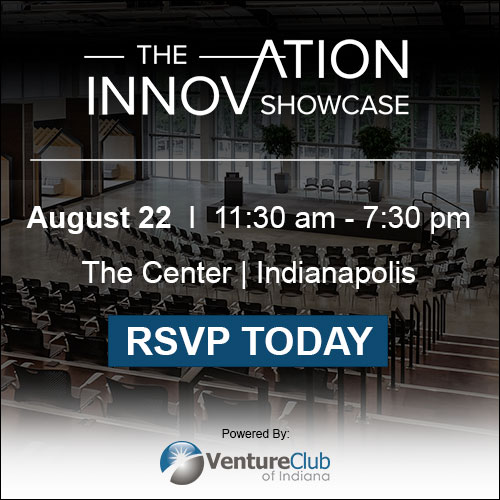
Excitement is growing as the Venture Club of Indiana counts down to its premier, carefully curated startup pitch event, The Innovation Showcase on August 22 in Indianapolis. This year, a companion event joins the Showcase: The Next Level Fund Indiana Venture Summit. The Summit is designed to introduce venture capitalists and others to the exciting opportunities available through the Next Level Indiana Fund. I’ve invited Venture Club of Indiana Board Member and Program Committee Leader Sandy Wilcox to tell us about The Innovation Showcase, how the day will roll out, and the all-star line-up of speakers whose experiences as entrepreneurs, educators, and investors are legendary. VisionTech Angels is pleased to share Sandy’s inside perspective. Read on!
Sandy Wilcox, The Innovation Showcase Program Chair
In planning to hold the Next Level Fund Indiana Summit the same day as the Innovation Showcase, our objective was to encourage venture capitalist from all over the country to participate in The Innovation Showcase along with our statewide investment community. We all know that Indiana has long been considered a flyover state. The Venture Club Board and our president, Aaron Gillum, who is also senior vice president with 50 South Capital, are seeking to transform this perception and reflect the excitement and extraordinary progress of Indiana’s tech-driven innovation. By inviting investors to both events on the same day and putting our startups on stage in front of those investors, we know that we are fulfilling our objective, “Where Capital Meets Innovation!”
When I volunteered to be program chair for The Innovation Showcase, I knew my committee and I had an amazing job ahead of us. Our goal was to make the Showcase a dynamic event for everyone regardless of your perspective, startup or VC, student or supporter.
When the Next Level Fund Summit ends at around 11:30 a.m. and the attendees leave their seats, they will walk out of the hall and into The Innovation Showcase’s Entrepreneur’s Expo filled with booths hosted by some of Indiana’s finest startups for a “walking lunch.”
At precisely 1 p.m., The Innovation Showcase will kick off with welcoming remarks from Venture Club President Aaron Gillum and Kip Frey, Executive Vice President, New Ventures, The Heritage Group.
Don Brown, The Accidental Entrepreneur
Seeking one of the most significant pioneers in Indiana’s technology space, we asked Don Brown, CEO of LifeOmic, to be our keynote speaker. As a leader at Software Artistry, and then as founder and CEO of Interactive Intelligence, Don negotiated the successful creation and sale of Interactive Intelligence to Genesys Telecommunications for a record $1.6 billion. His new adventure is LifeOmic, an Indianapolis-based software company that leverages the cloud, machine learning, and mobile devices to offer disruptive, precision medicine solutions to healthcare providers. A serial entrepreneur, Don still calls himself, an “accidental entrepreneur.” Sharing his entrepreneurial journey as well as lessons learned, Don will also outline his bold vision for the future of healthcare with Innovation Showcase guests.
Don Kuratko, IU Kelley School of Business
Following our keynote, the pitches begin! Two rounds of 10 of Indiana’s finest startup companies will present to Investors in the audience and to win a cash prize. Who better to serve as the emcee of this competition than Dr. Don Kuratko, the Gill Distinguished Chair and Professor of Entrepreneurship at the Indiana University Kelley School of Business. Recognized among the Top 10 entrepreneurship scholars in the world, “Dr K” created one of the country’s first entrepreneurship centers at Ball State University in 1983. His love, drive, and determination to build the foundation in education to prepare and support the growth of entrepreneurship make him a stunning choice to emcee our pitch competition!
Jeff Ready, CEO, Scale Computing
In between the two pitch segments, Jeff Ready, CEO of Scale Computing, will lead us on the “The Road… After the Showcase.” Jeff will share the impact winning The Innovation Showcase’s Venture Idol pitch competition in 2008 presented to him as CEO of an Indiana startup. Today, with 2,000 customers in 30 countries and a total capital raise of $96 million, Scale is poised for explosive growth through partnerships with much larger companies skillfully negotiated by Jeff and his team. He will also interview two other past winners to demonstrate the real impact of presenting and winning at the Venture Club’s Innovation Showcase. We ask from time to time, “Does the Showcase make a difference?” Jeff and the other winners prove that “YES,’ it absolutely does!
Jane Martin
After the final round of pitches, Jane Martin, a retired venture capitalist, will present “Seven Decades of Venture Capital, A Brief History.” A maverick as a women investor in the venture capital world, Jane was instrumental in numerous deals, investing in the likes of FedEx, MCI, Control Data, Sun Microsystems, Gymboree, and Calloway Golf to name a few. She will further discuss what it will take to bring venture capital investors to Indiana.
The Showcase will wrap up with a dynamic panel of female VCs discussing venture investing from a woman’s perspective. At 5:30 p.m., the winners of the pitch competition will be announced and we’ll celebrate with a VIP reception. A full day to be sure, but a day that you won’t want to miss!
The Venture Club of Indiana hopes you are as excited about the outstanding program and speakers we’ve assembled for The Innovation Showcase, Thursday, August 22, 11:30 a.m.-7:30 p.m. at The Center in Indianapolis. For more information about The Innovation Showcase, visit our website. If you don’t have you ticket yet, grab it now! Space is limited and you don’t want to miss out on Indiana’s largest pitch event.
As VisionTech Angels know, I hate to turn away interesting investment opportunities. That’s why our selection committee reviews some 400 startups a year; we’re hoping for a unicorn. So when Brickell Biotech contacted me earlier this week to see if they could participate in VisionTech’s June Pitch Week, I agreed to take a look.
Ben Pidgeon, VisionTech Executive Director
It didn’t take long for me to invite the Boulder, Colorado-based company to come on the road with me for Pitch Week, June 24-27, and pitch to VisionTech Angels’ chapters in Lafayette, Dayton, OH; Fort Wayne, Bloomington, and Indianapolis.
Here’s what caught my eye about Brickell:
Brickell is a clinical-stage pharmaceutical companyfocused ondifferentiated innovative prescription therapeutics for treating debillitating skin diseases. Their lead pipeline asset, sofpironium bromide, is a topical soft anticholinergic intended for axillary hyperhidrosis (uncontrolled excessive sweating) that recently completed Phase 3 in Japan, successfully meeting all primary and secondary endpoints, via Brickell’s partner, Kaken Pharmaceutical Co., Ltd. Brickell is eligible to receive sales-based milestones and royalties of future net sales from Kaken in Japan and other Asian countries.
The market for sofpironium bromide is large. There are many individuals living with hyperhidrosis. Roughly 15.3 million in the United States alone suffer from hyperhidrosis. This condition is chronic and has the tendency to negatively impact virtually all important aspects of life.
A competitor is paving the way for reimbursement in the United States. Dermira, a public company valued at $550 million, recently launched the first topical prescription treatment for hyperhidrosis, Qbrexza®, approved by the FDA. Brickell’s investigational product is being developed to offer potentially unique differentiating features that the company believes could be best-in-class.
Brickell just announced a reverse merger with Vical Inc. (Nasdaq:VICL) and, in combination, is raising $25 million from a prominent life sciences investment firm to fund the pivotal U.S. registration trials that Brickell intends to start in Q4 2019. Brickell will merge with a wholly owned subsidiary of Vical in an all-stock transaction. When finalized, the combined company will operate under the name, Brickell Biotech, Inc., and trade on the Nasdaq under a new ticker symbol to be determined. Brickell will own 60 percent of the new company. Read the release here>
Here’s the deal for VisionTech Angels investors: Brickell is raising $10 million in a convertible debt offering to get through the closing of the reverse merger. Just under half is already subscribed from current investors and the leadership team’s own personal investments, with an additional $1 million in commitments from two venture capital firms. The reverse merger is scheduled to close prior to the end of Q3 2019. The new company is estimated to have a post-merger valuation of approximately $90 million. Funds from the merger will get Brickell through completion of a Phase 3 clinical trial of the lead pipeline asset, sofpironium bromide, in the United States.
Brickell’s management team is impressive. Its members have launched multiple billion-dollar blockbuster drug brands such as Prozac®, Cialis®, Taltz®, Cymbalta®, and Juvederm® and successfully built several biotechs that were acquired by big pharma at very attractive multiples. CEO Rob Brown and General Counsel David McAvoy are both former long-time Lilly executives.
We now how two presenting companies for June Pitch Week, Xact Medical and Brickell Biotech and I’m excited by them both. If you have not RSVP’d yet, I encourage you to do so now. Find details here.










 BP: Do you have competitors?



 To learn more about Qumulex, visit their


 To learn more about SIERA.AI visit