INDIANAPOLIS, Indiana (January 10, 2020) – – Inspired by a physics teacher at Homestead High School in Fort Wayne, Ian Hamilton began as a teenager to seriously contemplate ways to create alternative energy sources.
Ian Hamilton, CEO, Atlas Energy Systems
By the time he stepped onto the Purdue University campus as a freshman in 2011, he already had some firm ideas about how to do that.
But while in a class studying thermionic energy—the conversion of high-intensity heat into electricity—he dug into some long-forgotten technology developed by NASA in the 1960s during the space race with Russia.
The technology’s patents had expired, making the science fair game for new applications.
“I saw that this technology matched the ideas in my head for energy generation,” Hamilton said. “Really, it was pure happenstance that I found that old technology.”
He studied it intently and said to himself, “This could work.”
INDIANAPOLIS, Indiana (January 2, 2020) – VisionTech Angels closed 2019 by leading a Series A seed round investment in Carmel, Indiana-based Atlas Energy Systems, LLC, exceeding the energy technology company’s goal of $400,000 by nearly 35 percent. When the funding tranche closed December 27, 2019, the Indianapolis-based angel investing group succeeded in leading a $558,000 raise. West Suburban Angels of Naperville, Illinois, and Lateral Capital of Sarasota, Florida, also participated in the round.
Although VisionTech Angels has invested in 43 startup companies since 2008, this is the first investment round it has led in last 18 months, says Executive Director Ben Pidgeon. He credits the triple value proposition of the company’s technology, strength of the leadership team, and exit potential for the incredible momentum of the investment round’s first tranche.
“Atlas Energy Systems CEO Ian Hamilton originally pitched to VisionTech Angels for funding in April 2019 and while they were early in the commercialization process, our investors immediately liked what they saw. Based on investor interest, we started due diligence,” explained Pidgeon. “We also connected Ian with Scott Noble, who has mentored a number of startups associated with the Purdue Foundry and the Notre Dame IDEA Center, for his business acumen and experience with mergers and acquisitions activity. Scott is now Atlas Energy Systems’ chief financial officer.”
Although Atlas Energy Systems is a startup, its patent-pending technology, thermionic energy converters for waste heat power generation, concentrated solar, and advanced nuclear reactors was originally developed by NASA in the 1960s. The original technology designs were either top secret or patent protected. However, most of the original patents were for space and nuclear applications and expired in the 1980s when the government lost interest in the space program. Hamilton first learned about the technology while an undergrad at Purdue University—he now holds a Masters in Nuclear Engineering—and has since repurposed the thermionic energy converting technology for contemporary industrial energy applications.
Hamilton says interest his company’s technology is high. “We’ve been approached by multiple industries and have chosen to focus on the oil and gas industry for our commercial launch. The main advantages of our thermionic energy converters are their compact size, high power density and no moving parts operation, making them virtually maintenance free even in the harshest environments. We can provide onsite power using flare gas, while reducing CO2 emissions and the environmental impact of drilling sites.”
He adds that the seed round funding will be used in part to deliver converters for oil and gas power generation as soon as the first half of 2020.
In conjunction with the successful seed investment raise, Atlas Energy Systems has added three new board members. Scott Baxter, a VisionTech Angel member, will serve as the seed investor reserved director. James Barkley, also a VisionTech Angel member, will serve as the board observer. Former GE executive George Sassine joins the board as the at-large independent director. Atlas CEO Ian Hamilton is the board chair. The first board meeting is scheduled for late January.
VisionTech Angels who invested in Atlas Energy Systems and reside in Indiana qualify for the Indiana Venture Capital Investment income tax credit.
Funding momentum continues as Atlas Energy Systems has been invited to pitch to Tamiami Angels of Naples, Florida, January 9.
VisionTech Angels’ Executive Director Ben Pidgeon recently sat down with Ian Hamilton, founder and CEO of Atlas Energy Systems, to learn more about the company that’s repurposing technology originally developed in the 1960s by NASA for space applications into an exciting new solution for the oil and gas, nuclear and solar energy industries. Ian, a Purdue graduate with a Masters in Nuclear Engineering, will be presenting Atlas Energy during VisionTech’s upcoming Pitch Week, April 15-18. Read on!
BP: The story behind Atlas Energy Systems’ technology is unique. Tell me about it. IH: Our thermionic energy converter (TEC) was inspired by technology previously developed in the 1960’s by NASA for space nuclear power. When the Soviet Union fell in the 1980s, NASA cancelled its space nuclear power programs. Russia was our competitor and with the end of the Cold Way, there was no reason to pursue it further despite the fact the technology was proven to work in space. So patents expired. I learned about it while an undergrad at Purdue, got interested, founded Atlas Energy Systems, and now we’re using NASA technology to develop plasma thermionic energy converters for waste heat power generation, concentrated solar and advanced nuclear reactors.
BP: How does your technology work – in layman’s terms? IH: It’s all in our tagline: Heat to Electricity, No Moving Parts. What we’re doing is directly converting heat from any source you can think of, whether it’s sunlight, nuclear or the waste gas from oil wells, into electricity. If you have a source of high intensity heat, we can generate electricity with a convertor that has no moving parts. Digging deeper, Atlas Energy Systems is leveraging modern materials science, new plasma physics simulations, and advanced manufacturing techniques to develop a thermionic energy converter for the 21st century. Our novel device designs incorporate proprietary electrode materials and coatings as well as an electrode form factor to increase converter performance and reduce operating temperatures. Bringing this new capability to the technology is the necessary step in taking thermionic energy converters from a lab technology to a commercialized product.
BP: What’s the driver behind the technology? IH: The short answer is that it’s a simple way to generate electricity. Also, the technology is proven; we’re not breaking new ground, we’re finding new applications. What makes it attractive is the simplicity of the process and the converter itself. The device has no moving parts so there’s nothing to break. It’s compact and saves space. We were originally thinking of compact power source for nuclear subs, but there are many other applications.
BP: You were targeting the nuclear industry with batteries made from nuclear waste, but now you’re focused on the oil and gas industry. How did that come about? IH: We initially were working on nuclear batteries for NASA and the U.S. Navy and its nuclear subs. We got a call from far left field—a company in the oil and gas industry. They were interested in replacing current three-decades old technology used in oil and gas sensors combustion fuel systems with our thermal electric converters. So it seems oil and gas chose us.
BP: What benefits do your thermionic energy converters offer the oil and gas industry? IH: Oil and gas production sites such as wells and offshore rigs use flare stacks, a gas combustion device, to burn off unusable, waste gas. The main application of our thermionic energy converters would be to replace the old combustion device with ours and convert the flair gas into electricity. The advantages are significant. Current systems are inefficient and expensive. Our converters turn the waste gas into electricity that can be used at the well site or on offshore rigs. Our converters have no moving parts and are proven to survive in the harshest environment possible, space, so maintenance is minimal; always a good thing in remote locations. Repurposing the waste reduces CO2 emissions and methane, which is good for the environment. Overall, it’s a smart solution for the industry.
BP: What type of patent protection do you have? IH: Original technology designs were either top secret or patent protected. What’s interesting is most of the original patents were for space and nuclear applications and expired in the 1980s when the government lost interest. Now anyone can access the old patents and use the information, which we have done. Atlas Energy Systems now has a patent pending on our plasma thermionic energy converter and will file additional patents on uses and applications.
Ian Hamilton, CEO, Atlas Energy Systems
BP: You have the unique honor of being included on Forbes’ 2018 “30 Under 30” list in 2018 that recognizes the brashest entrepreneurs across the United States. You were all of 25 years old when you won. That’s impressive. IH: It was exciting and also an honor as I was nominated by two different people. I’ve always been interested in entrepreneurship and, in fact, founded Atlas Energy Systems during my sophomore year at Purdue with three classmates. After earning my masters in Nuclear Engineering, I did a fellowship at Argonne National Labs Chain Reaction Lab in part because of their emphasis on entrepreneurship and how to translate energy tech into the marketplace. I’ve always thought it’s one thing to do research and scientific discovery, but if you can’t turn commercialize your technology and deliver a product the market cares about, it goes to waste.
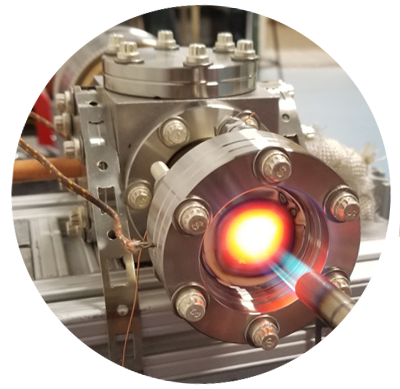
BP: Why should VisionTech Angels invest in Atlas Energy Systems? IH: Although we’re an early stage energy startup, we’re positioned as a hard tech scalable manufacturing company capable of providing thousands of units to companies. And the oil and gas industry is a great launch pad for us with interest from customers and a potential acquirer that I will discuss in my pitch. We currently have a demonstration unit and money from VisionTech Angels would fund our initial units for immediate sales and support our go to market strategy for oil and gas.
To learn more about Atlas Energy Systems, visit their website. For details on VisionTech Angels’ April Pitch Week, visit our events calendar.